Mario Monicelli (1915-2010)
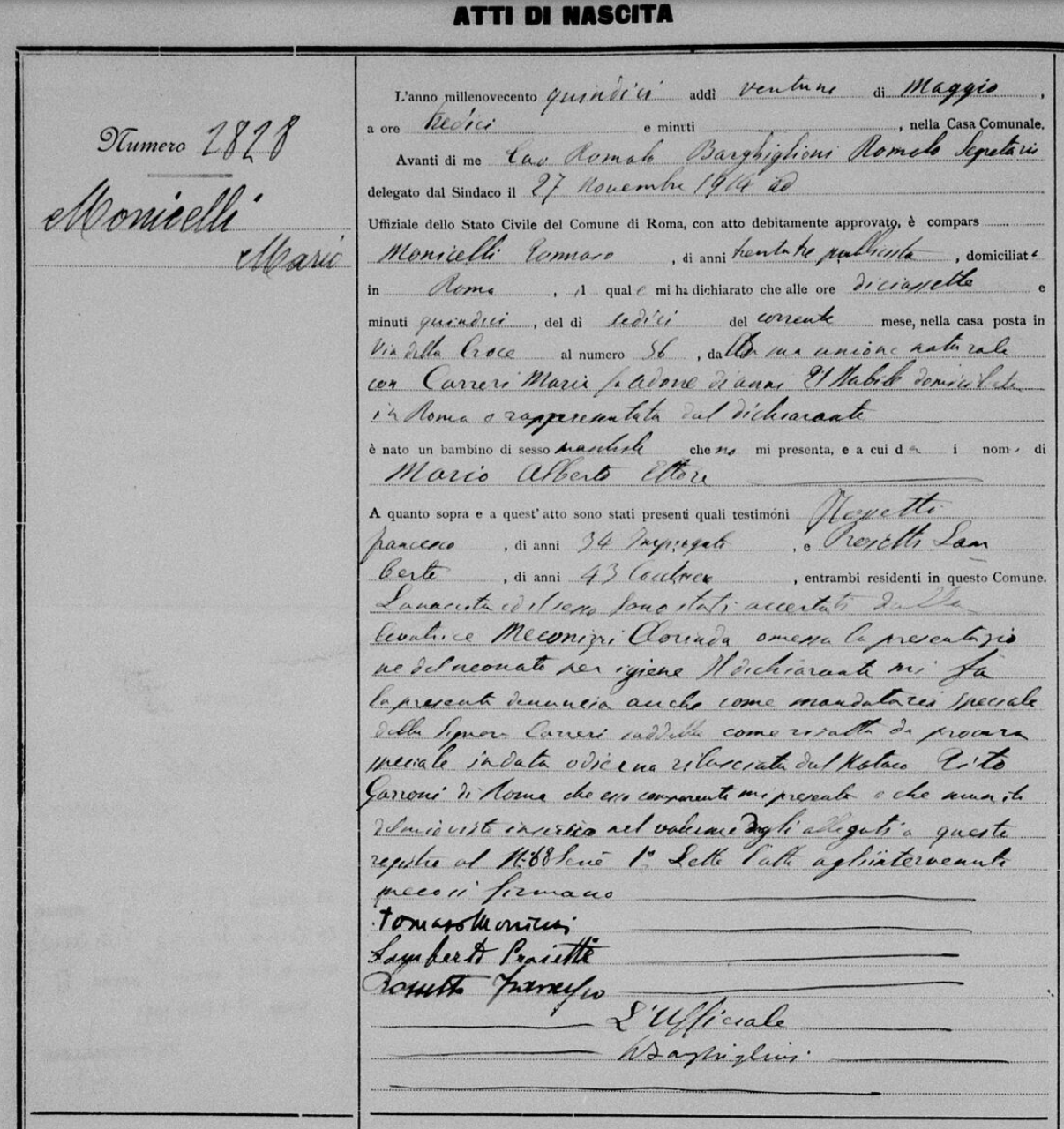
Mario Alberto Ettore Monicelli was born in Rome on May 16, 1915.
His father, Tomaso, a journalist and playwright, was editor of Il resto del Carlino andAvanti!, while his mother, Maria Carreri, a housewife.
Growing up in a culturally vibrant and stimulating environment, he soon developed a keen cultural curiosity. After school in Rome and high school between Viareggio, Prato and Milan, he came into contact with a group of young people destined to become leading figures in twentieth-century Italian culture. Alongside his cousin Arnoldo Mondadori, he hung out with poet Vittorio Sereni, future director Alberto Lattuada and other young intellectuals. From this environment came his collaboration with the weekly Camminare, where he dealt with film criticism.
It was, however, in the mid-1930s that he began his first experiments behind the camera, making the short film Cuore rilevatore in 1934, and collaborating the following year with Alberto Mondadori on the feature film I ragazzi di via Pàl, which was screened at the Venice International Film Festival.
In 1940, immediately after graduating from the University of Pisa, he enlisted.
At the end of World War II, he embarked steadily on a film career, often teaming up with Pietro Germi and Stefano Vanzina, and moving with ease between different genres, from comedy to adventure film to drama. His partnership with Vanzina ended in 1953, after he had given birth to some of the most representative comedies of the postwar period, including Totò cerca casa (1949), Guardie e ladri (1951), which won Cannes for best screenplay, Le infedeli and Totò e le donne.
In 1957, he won best director at the Berlin Film Festival with Fathers and Sons; while with The Great War (1959) he won the Golden Lion and an Oscar nomination for best foreign language film. A second nomination came in 1963 with I compagni, for best original screenplay. These, along with I soliti ignoti, are unanimously considered among his masterpieces.
With L’armata Brancaleone (1966) and Brancaleone alle crociate (1970) he staged a grotesque and tragicomic Middle Ages, made memorable by the invention of a macaronic and original language. In the 1970s, his quest led him to confront a darker present: Un borghese piccolo piccolo (1977) Un borghese piccolo piccolo (1977) marked a turn toward a decidedly more dramatic register, far removed from earlier tones. Instead, with Il marchese del Grillo (1981), starring Alberto Sordi, he returned to a more ironic vein, which earned him the Silver Bear for Best Director at the Berlin Film Festival in 1982.
In the last two decades of his life, he focused on telling the story of the vices and contradictions of the average Italian family, addressed in films such as Speriamo che sia femmina (1986) and Parenti serpenti (1991), characterized by a grotesque, paradoxical style steeped in black humor. Alongside his film activity, he also devoted himself to theater directing, both opera and prose.
Although he gradually slowed down the pace of his work, he never lost his intellectual clarity and took an increasingly active role in civic engagement, openly participating in protest initiatives against cuts to culture and the entertainment industry.
In 1991 he was awarded the Golden Lion for Lifetime Achievement.
On November 29, 2010, marked by a long illness, Mario Monicelli took his own life.
You can consult the birth certificate on the Ancestors Portal: Archivio di Stato di Roma > Stato civile italiano > Roma > 1915
The original is kept at the State Archives in Rome.
For more on the figure of Mario Monicelli, see the entry of the Dizionario Biografico degli Italiani edited by Stefano Della Casa.