Eugene Torelli Viollier (1842-1900)
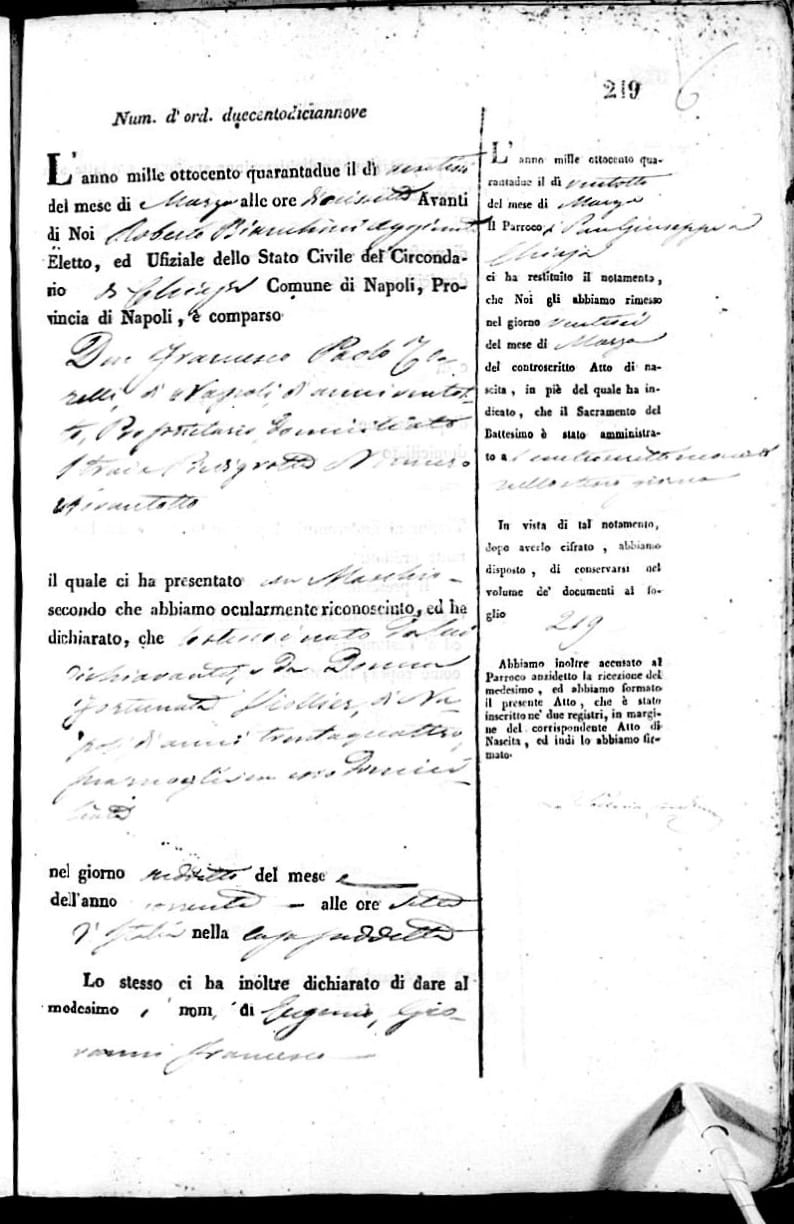
Eugene Giovanni Francesco Torelli was born in Naples on March 26, 1842, to Francesco and Joséphine Viollier. Orphaned, when he was only fourteen years old he was entrusted to the care of his sister Luisa, who followed his education during his teenage years.
Profoundly influenced by the echo of Garibaldi’s exploits, he decided at a young age to join the troops led by Nice, participating in the struggle against the Bourbon power and siding with the unification of Italy. When, however, the units in which he had served were declared irregular and consequently disbanded, he returned to Naples, where he found employment in the Savoy administration.
Parallel to this, in 1861 he began working for L’Indipendente, a newspaper founded by Alexandre Dumas. The collaboration quickly turned into a relationship of close trust: in fact, Torelli became his personal secretary and main collaborator. Not surprisingly, when Dumas returned to Paris, Torelli followed him, and it was then that he also chose to permanently adopt his maternal surname, Viollier, as a tribute to his late mother and the country that was welcoming him.
In 1865 he moved to Milan, a city in which he consolidated his journalistic experience, effectively taking over the editorship of two of the most important newspapers published by the Sonzogno Publishing House and the daily newspaper La Lombardia.
It was precisely from these experiences that he matured the idea of founding the Corriere della sera, a liberal and moderate daily newspaper, whose first issue was published on March 5, 1876, the first day of Lent, when, according to tradition, no newspapers were published in Milan. This was not a random choice, which helped mark its identity from the very beginning.
From its beginnings, it achieved significant public success and substantial financial results, reflecting the vision of its founder, who aspired to a serious, efficient and independent journalism, oriented toward moderate liberalism and monarchism, but capable of stimulating balanced debate on current issues.
Beginning in the 1990s, however, he faced early financial difficulties, due to unsuccessful investments and health problems that forced him to take long periods of rest. At such junctures, and increasingly in the following years, the leadership of the newspaper was entrusted to different personalities, whose editorial choices did not always fully reflect his original vision.
Stricken with endocarditis, Eugenio Torelli Viollier died in Milan on April 26, 1900.
In his will, in addition to his family members, he arranged a small sum for each of his workers, as well as others to benefit a number of Milanese institutions. These include, in particular, a substantial bequest for the construction of a sanatorium in Milan, evidence of his attention to the social and civic dimension of his city.
You can consult the birth certificate on the Ancestors Portal: Archivio di Stato di Napoli > Stato civile della restaurazione (quartieri di Napoli) > Chiaia > 01/01/1842-20/05/1842
The original is kept at the State Archives in Naples.
For more on the figure of Eugenio Torelli Viollier, see the entry of the Biographical Dictionary of Italians edited by Mauro Forno.