Giuseppe Bottai (1895-1959)
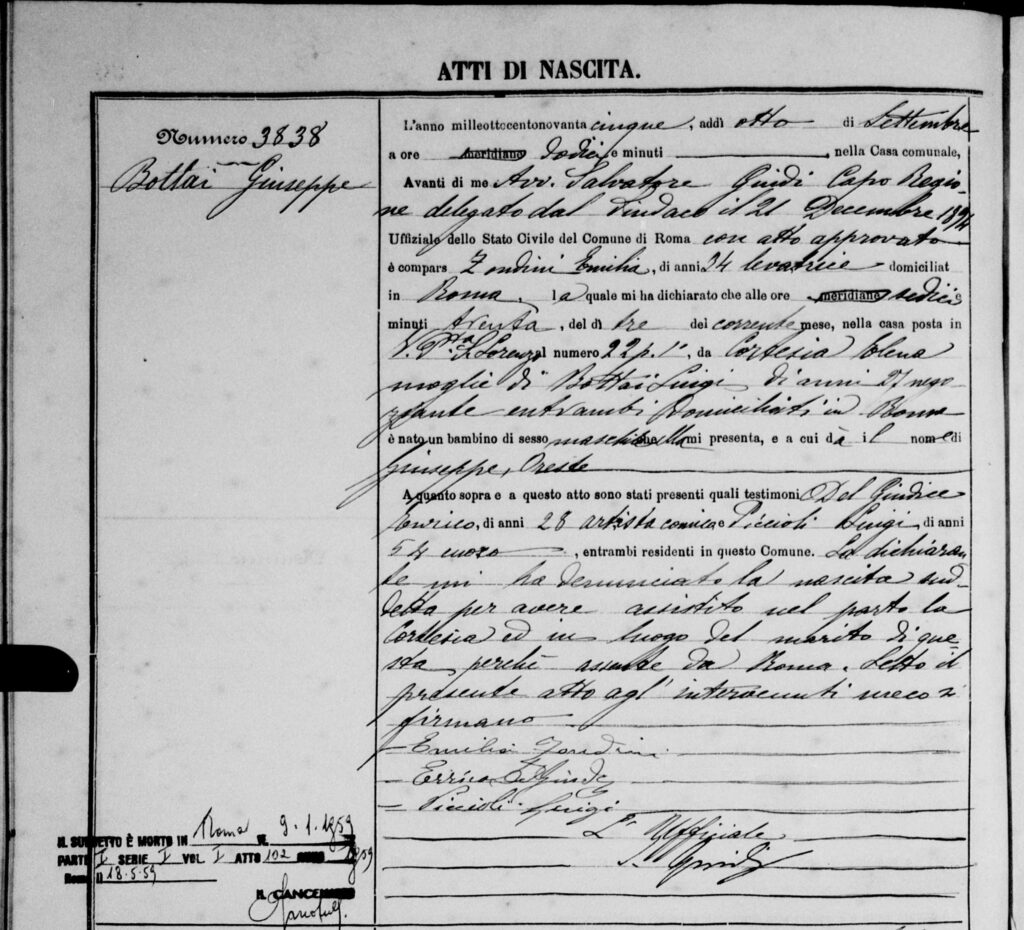
Giuseppe Bottai was born in Rome on September 3, 1895, to Luigi, a wine merchant, and Elena Cortesia.
With the outbreak of the Great War he interrupted his studies to enlist as a volunteer at the front, distinguishing himself in various war actions that earned him the bronze medal for military valor. At the end of the conflict, he graduated in Law and began to cultivate a strong literary and journalistic inclination, collaborating with the editorial staff of the Popolo d’Italia and with the direction of the magazine Roma futurista.
Elected deputy in 1924, he was appointed undersecretary in 1926 and, from 1929 to 1932, held the position of Minister of Corporations, contributing significantly to the drafting of the Labour Charter (1927). In parallel with his political and journalistic activity, starting in 1930 he embarked on an academic career, obtaining the chair of Corporate Law first at the University of Pisa and, from 1936, at the University of Rome.
On November 22, 1936, Bottai assumed the leadership of the Ministry of National Education, which he held until 1943. During his mandate he promoted an incisive reform of the entire school system, aimed at promoting wider access to education, and promoted measures of great importance in the field of the protection of cultural and artistic heritage. Among these, the following stand out: the increase in the number of Superintendencies from 28 to 58, with a more rational distribution of territory and competences; the regulation of the rules relating to the findings, reproductions, exports and expropriations of artistic property; the promulgation of the well-known Bottai law (law no. 1089 of 1 June 1939), or the first organic legislation for the protection of things of artistic and historical interest, to which was added law no. 1497 of 29 June 1939, aimed at the “protection of landscape beauties”; finally, he ordered the creation of the Central Institute for Restoration (l.n. 1240 of 22 July 1939).
Starting in the forties, his relations with Mussolini began to crack. After 1943 he was forced into hiding and, in the Verona trial, he was sentenced to death in absentia. On 4 July 1944 the High Court of Justice deprived him of his university chair and sentenced him to life imprisonment.
Amnestied in 1947, he was able to return to Italy on 2 August 1948 and, although reinstated in his university roles, in 1951 he asked to be retired.
Two years later he founded the political criticism magazine ABC, which he directed until his death in Rome on January 9, 1959.
You can consult the birth certificate on the Ancestors Portal: Archivio di Stato di Roma > Stato civile italiano > Roma > 1895
The original is kept at the State Archives of Rome.
For further information on the figure of Giuseppe Bottai, see the entry in the Biographical Dictionary of Italians edited by Sabino Cassese.