Emilio Segrè (1905-1989)
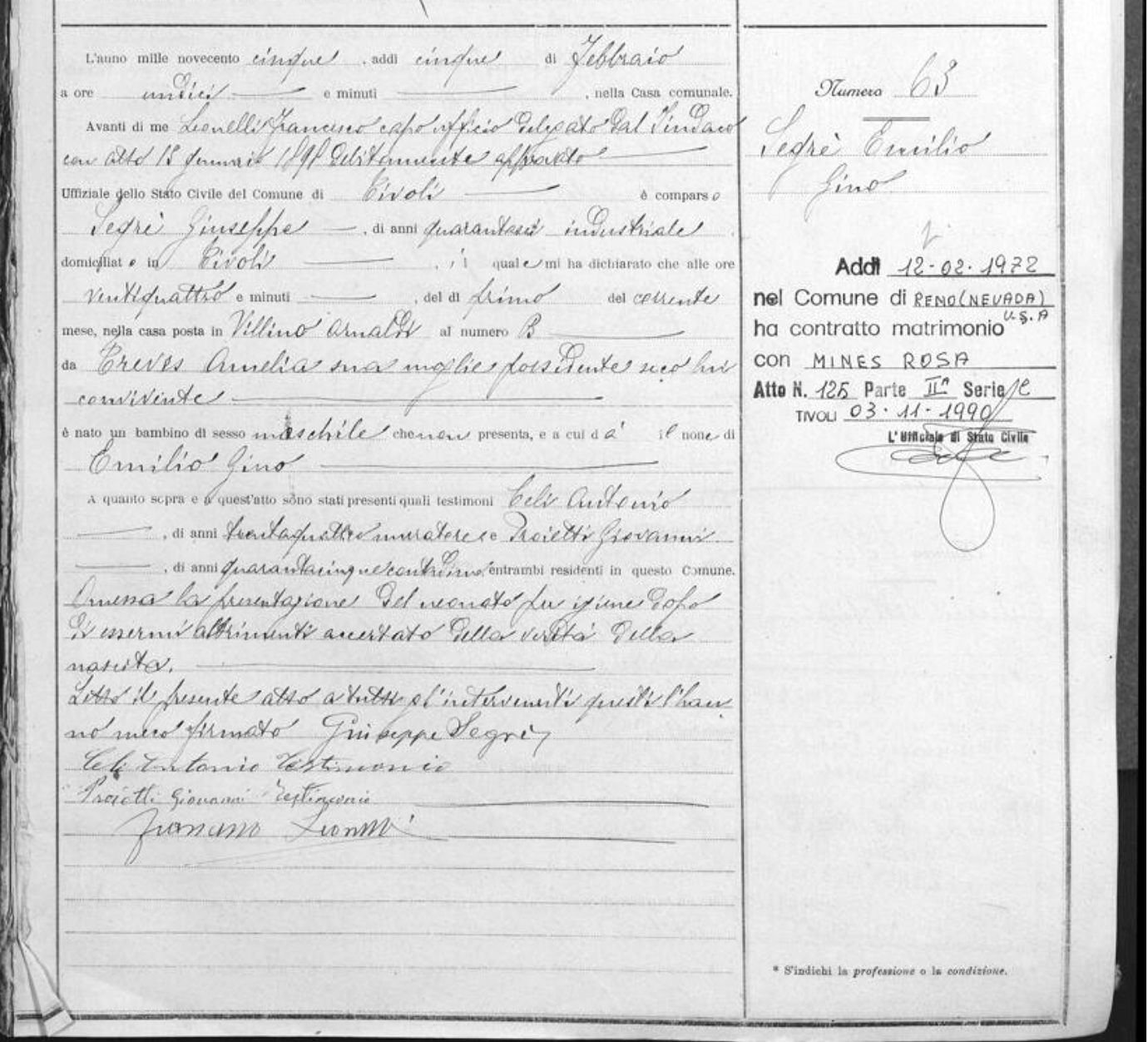
Emilio Gino Segrè was born in Tivoli, in the province of Rome, on February 1, 1905*, into a wealthy and culturally active Jewish family. His father, Giuseppe, was an executive in paper industries operating in Rome, while his mother, Amelia Susanna Treves, was the daughter of a well-known Florentine architect.
After his classical studies, he enrolled in the Faculty of Engineering, which he attended with little enthusiasm or profit. It was his meeting with Enrico Fermi that marked a decisive turning point in his scientific path: attracted by theoretical and experimental physics, he decided to change course of study, graduating in Physics in 1928 from the University of Rome. In those years he joined the famous group of “i ragazzi di via Panisperna,” with which he collaborated on numerous research projects that contributed decisively to one of the most fruitful periods of twentieth-century Italian physics.
Immediately after graduation and military service, Segrè began to devote himself entirely to scientific research.
Between 1932 and 1936 he was an assistant professor in Rome and then moved to Palermo, where he took over as director of the Athenaeum’s Institute of Physics. It was during his Palermo period that he made one of his most significant discoveries: the identification – together with Carlo Perrier – of technetium, the first chemical element obtained artificially by man, a discovery of enormous importance, which opened new perspectives in the understanding of the structure of matter and later found important applications in the medical field, particularly in nuclear diagnostics.
In 1937, Segrè traveled to the United States to further his research at the Radiation Laboratory in Berkeley, California. The enactment of racial laws in Italy in 1938 prevented him from returning to the country, effectively forcing him into a scientific exile that would become – by his own choice – permanent. In the United States, in fact, he continued his academic career successfully, obtaining U.S. citizenship in 1944.
During the period of World War II, he participated in the “Manhattan Project,” collaborating in Los Alamos laboratories on the development of the first atomic bombs. When the conflict ended, he returned to California in 1946 and settled permanently near Lafayette in 1955.
After the war, his research focused on problems in nuclear physics and elementary particle physics. Among his most significant achievements was the discovery of the antiproton, which won him the Nobel Prize in physics in 1959.
In 1974, he returned to Italy to hold the chair of nuclear physics at the “Sapienza” University of Rome. However, having reached retirement age, after about a year he decided to retire again to California, where he continued to devote himself to study, scientific popularization and historical reflection on the development of physics in the twentieth century .
Emilio Segrè died on April 22, 1989, in Lafayette.
His remains rest today at the Tivoli cemetery.
You can look up the birth certificate on the Ancestors Portal: Archivio di Stato di Roma > Stato civile italiano (registri dei comuni) > Tivoli > 1905
The original is kept at the State Archives in Rome.
For more on the figure of Emilio Segrè, see the entry in the Dizionario Biografico degli Italiani edited by Giovanni Battimelli
* Emilio Segrè’s date of birth is sometimes mistakenly given as January 30; in fact-as can be seen from the birth certificate-he was born on February 1, 1905, while the registry entry took place on the 5th of the same month.