Corradino D’Ascanio (1891-1981)
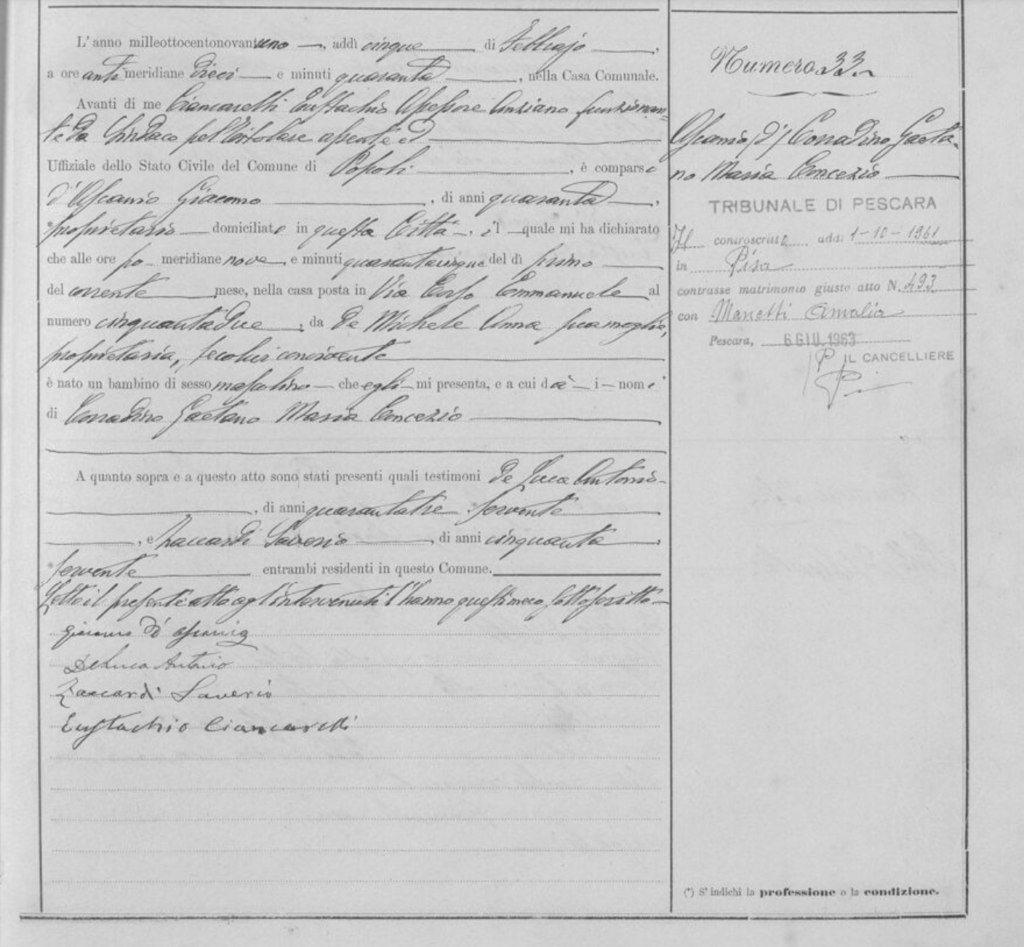
Corradino Gaetano Maria Concezio D’Ascanio was born in Popoli (PE) on 1 February 1891 to Giacomo and Anna De Michele.
From a young age, he showed a keen interest in aviation, which was then in its infancy, so much so that at the age of just sixteen he managed to lift off for a few metres in a glider he had designed himself.
After graduating in industrial engineering from the Polytechnic University of Turin in 1914, he joined the Aviation Battalion as an officer, combining his technical expertise with his interest in flight, eventually securing a patent for an autopilot in 1916.
Two years later, in 1918, he left the army to work at Ottorino Pomilio’s factory in Turin, where he designed several aircraft, including a light bomber, a reconnaissance aircraft and a fighter. He continued in this role even after the company moved to the United States, where he worked alongside Ugo Veniero D’Annunzio, Gabriele’s son, who was then a designer at Caproni Airlines in Detroit.
On his return to Italy in 1920, he opened an engineering practice in Popoli and began research into vertical flight, which led to the patenting of a coaxial-rotor helicopter in 1925. Over the next twenty years, he developed numerous prototypes, making a significant contribution, albeit one that was not fully recognised.
At the same time, he turned his attention to a number of more practical inventions: these included an electric oven for baking bread and cakes, a system for measuring the speed of cars (1925) – a precursor to speed cameras – and a device for automatically searching for data, a forerunner of modern search engines.
However, the invention that made him famous was the one he liked the least: commissioned by Enrico Piaggio, he designed a new type of motorised vehicle, the Vespa, for which a patent was registered on 23 April 1946. The scooter’s huge success was down to its low cost, fuel efficiency and excellent manoeuvrability, effectively making it the Italians’ ‘two-wheeled car’ in the post-war period.
In 1961, he retired from work, having concluded both his role at Piaggio and his academic career at the University of Pisa, where he had been teaching mechanical drawing and design since 1937.
He died in Pisa on 5 August 1981.
You can view the birth certificate on the Ancestors Portal: Archivio di Stato di Pescara > Stato civile italiano > Popoli > 1891
The original is held at the State Archives in Pescara.
For further information on Corradino d’Ascanio, see the entry in the Dizionario Biografico degli Italiani edited by Alberto Mondini.