Roberto Rossellini (1906-1977)
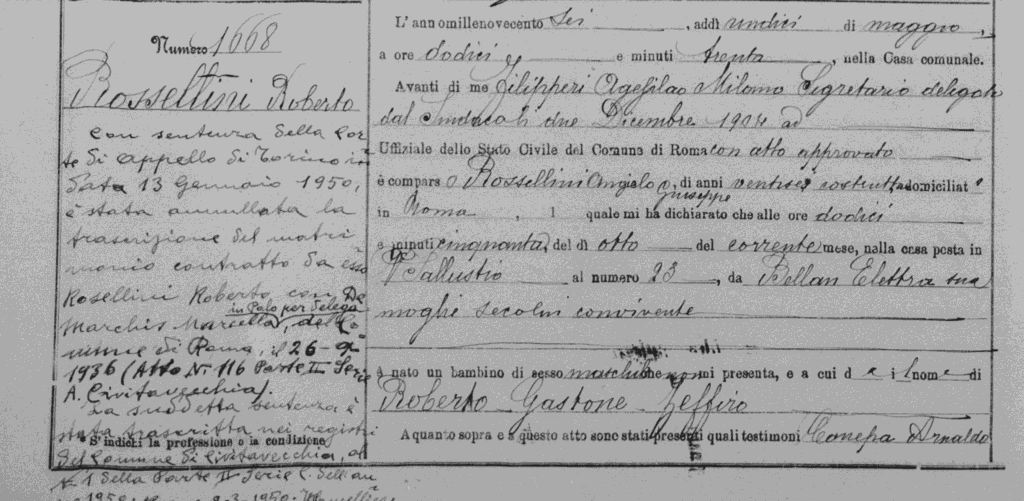
Roberto Gastone Zeffiro Rossellini was born in Rome on May 8, 1906, to Angiolo Giuseppe and Elettra Bellan.
Possessing a rebellious nature, he dropped out of university, despite growing up in a culturally vibrant environment thanks to his father, who loved surrounding himself with artists and intellectuals.
He entered the film industry professionally, initially working as a foley artist before becoming a dubbing and editing technician. Only later did he begin collaborating behind the camera as an assistant to directors such as Goffredo Alessandrini and Francesco De Robertis.
His early works—The White Ship (1941), A Pilot Returns (1942), and The Man with a Cross (1943)—were influenced by the climate of Fascist propaganda, a phase he later sought to overcome with a style of filmmaking more closely aligned with reality.
The turning point came in the post-war period with Rome, Open City (1945), made in collaboration with Federico Fellini and starring, among others, Anna Magnani, with whom he also had a relationship. The film marked the beginning of Neorealism and brought Rossellini international fame.
In 1948, he began a relationship with Ingrid Bergman, starting an artistic and personal partnership that led to films such as Stromboli (1950) and Europe ’51 (1952). These works, initially controversial, were later re-evaluated and profoundly influenced the young French critics of the Nouvelle Vague, who recognized a powerful modernity in his adherence to reality.
After a period spent in India, he returned to cinema, revisiting war themes with films such as General Della Rovere (1959), which won the Golden Lion at the Venice Film Festival (ex aequo with Mario Monicelli’s The Great War), and It Was Night in Rome (1960).
The 1950s, however, marked Rossellini’s move toward television, which he considered a more direct tool for reaching and educating the general public. Driven by this spirit, he progressively directed his work toward historical, philosophical, and scientific subjects, favoring a sober and essential style free of spectacular artifice. Among his most significant works are The Age of Iron (1964), The Rise to Power of Louis XIV (1966), Socrates (1971), Blaise Pascal (1972), and Cartesius (1974).
Roberto Rossellini died in Rome on June 3, 1977, following a heart attack.
You can consult the birth certificate on the Ancestors Portal: Archivio di Stato di Roma > Stato civile italiano > Roma > 1906
The original is kept at the State Archives in Rome.
For further information on Roberto Rossellini, see the entry in the Encyclopedia of Cinema edited by Edoardo Bruno.