Guglielmo Calderini (1837-1916)
Guglielmo Calderini was born in Perugia on March 3, 1837, to Francesco and Antonia Poggini.
He completed his studies in his hometown, then attended university in Turin and Rome, where he obtained a degree as an engineer-architect.
He held numerous positions in the offices of the Civil Engineers and in the Superintendence of Monuments of Latium. Parallel to his professional activity he carried out an intense teaching activity: he was professor of Architecture at the Academy of Fine Arts “Pietro Vannucci” in Perugia from 1868 to 1882, and then taught at the universities of Pisa and Rome.
Trained in the cultural climate of post-unification Italy, Calderini adhered to the language of academic eclecticism, characterized by the reworking of historical models and the search for monumental and representative solutions. This approach emerges both in the works he created and in the projects he submitted to the numerous competitions in which he participated. In particular, in the Umbrian capital he built Palazzo Bianchi (1888-1904), Palazzo Cesaroni – the current seat of the Regional Council of Umbria – the public baths and the Church of San Costanzo with portico.
Calderini’s notoriety, however, remains linked above all to two Roman works: the design and construction of the quadriporticus of the Basilica of St. Paul Outside the Walls and, above all, the Palace of Justice, known as the Palazzaccio. In the latter building in particular, the architect’s eclectic language resulted in an imposing construction of late Renaissance and Baroque inspiration, designed to express solemnity and institutional authority. Work, which began between 1887 and 1888, took a long time, and the work was not completed until 1910. The construction took an extensive amount of time and, once completed, was the subject of criticism both for the technical and administrative disputes that had accompanied the construction site and for negative aesthetic evaluations.
Despite the controversy, the Palace of Justice remained the most emblematic work of his career and one of the most significant examples of monumental eclecticism in post-unification Italy.
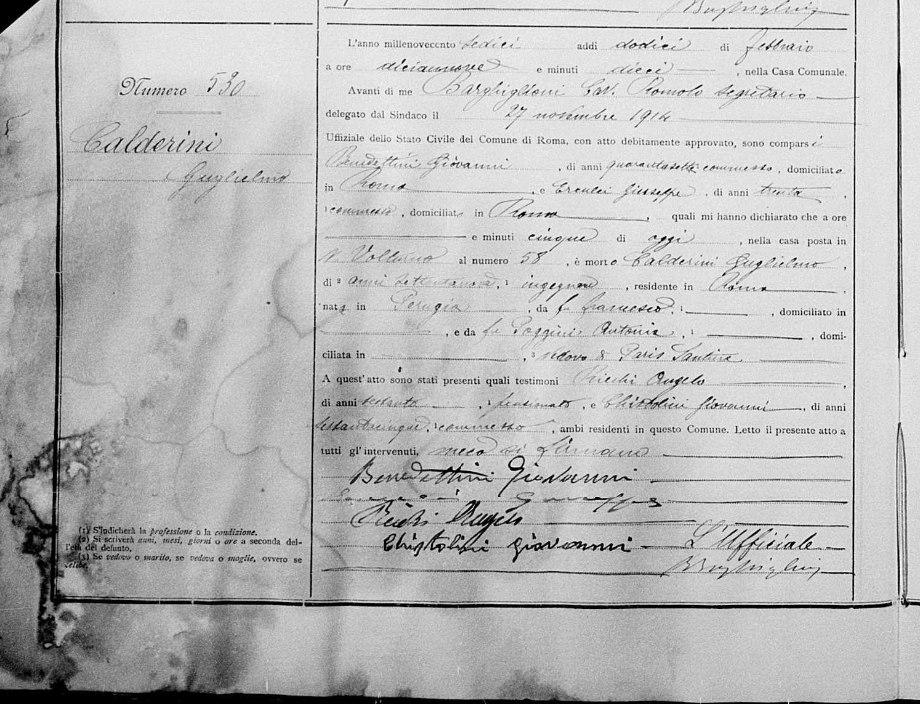
Guglielmo Calderini spent the last years of his life in Rome, where he died on February 12, 1916.
You can view the death certificate on the Ancestors Portal: Archivio di Stato di Roma > Stato civile italiano > Roma > 1916
The original is kept at the State Archives of Rome.