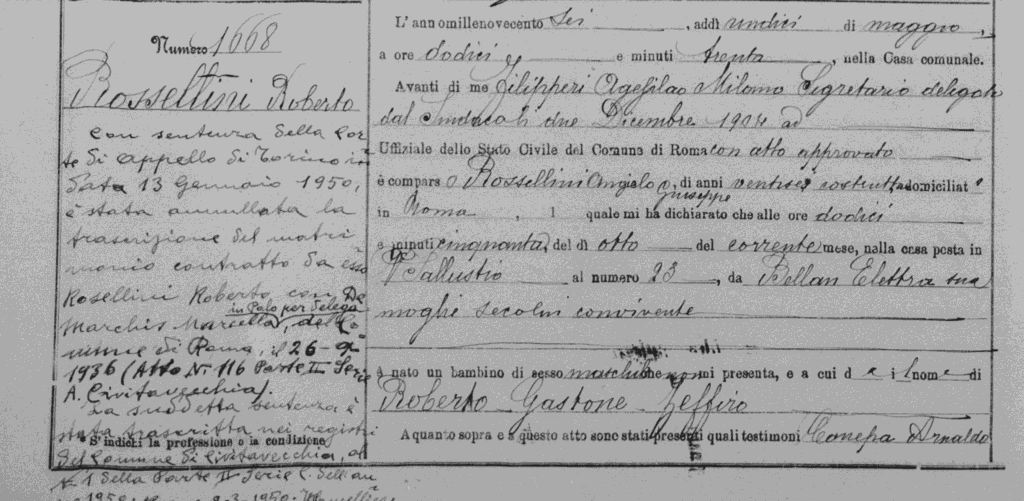
Roberto Gastone Zeffiro Rossellini was born in Rome on May 8, 1906, to Angiolo Giuseppe and Elettra Bellan.
Possessing a rebellious nature, he dropped out of university, despite growing up in a culturally vibrant environment thanks to his father, who loved surrounding himself with artists and intellectuals.
He entered the film industry professionally, initially working as a foley artist before becoming a dubbing and editing technician. Only later did he begin collaborating behind the camera as an assistant to directors such as Goffredo Alessandrini and Francesco De Robertis.
His early works—The White Ship (1941), A Pilot Returns (1942), and The Man with a Cross (1943)—were influenced by the climate of Fascist propaganda, a phase he later sought to overcome with a style of filmmaking more closely aligned with reality.
The turning point came in the post-war period with Rome, Open City (1945), made in collaboration with Federico Fellini and starring, among others, Anna Magnani, with whom he also had a relationship. The film marked the beginning of Neorealism and brought Rossellini international fame.
In 1948, he began a relationship with Ingrid Bergman, starting an artistic and personal partnership that led to films such as Stromboli (1950) and Europe ’51 (1952). These works, initially controversial, were later re-evaluated and profoundly influenced the young French critics of the Nouvelle Vague, who recognized a powerful modernity in his adherence to reality.
After a period spent in India, he returned to cinema, revisiting war themes with films such as General Della Rovere (1959), which won the Golden Lion at the Venice Film Festival (ex aequo with Mario Monicelli’s The Great War), and It Was Night in Rome (1960).
The 1950s, however, marked Rossellini’s move toward television, which he considered a more direct tool for reaching and educating the general public. Driven by this spirit, he progressively directed his work toward historical, philosophical, and scientific subjects, favoring a sober and essential style free of spectacular artifice. Among his most significant works are The Age of Iron (1964), The Rise to Power ofLouis XIV (1966), Socrates (1971), Blaise Pascal (1972), and Cartesius (1974).
Roberto Rossellini died in Rome on June 3, 1977, following a heart attack.
You can consult the birth certificate on the Ancestors Portal: Archivio di Stato di Roma > Stato civile italiano > Roma > 1906
For further information on Roberto Rossellini, see the entry in the Encyclopedia of Cinema edited by Edoardo Bruno.
State Archives of Rome > Italian Civil Status > Rome > 1906
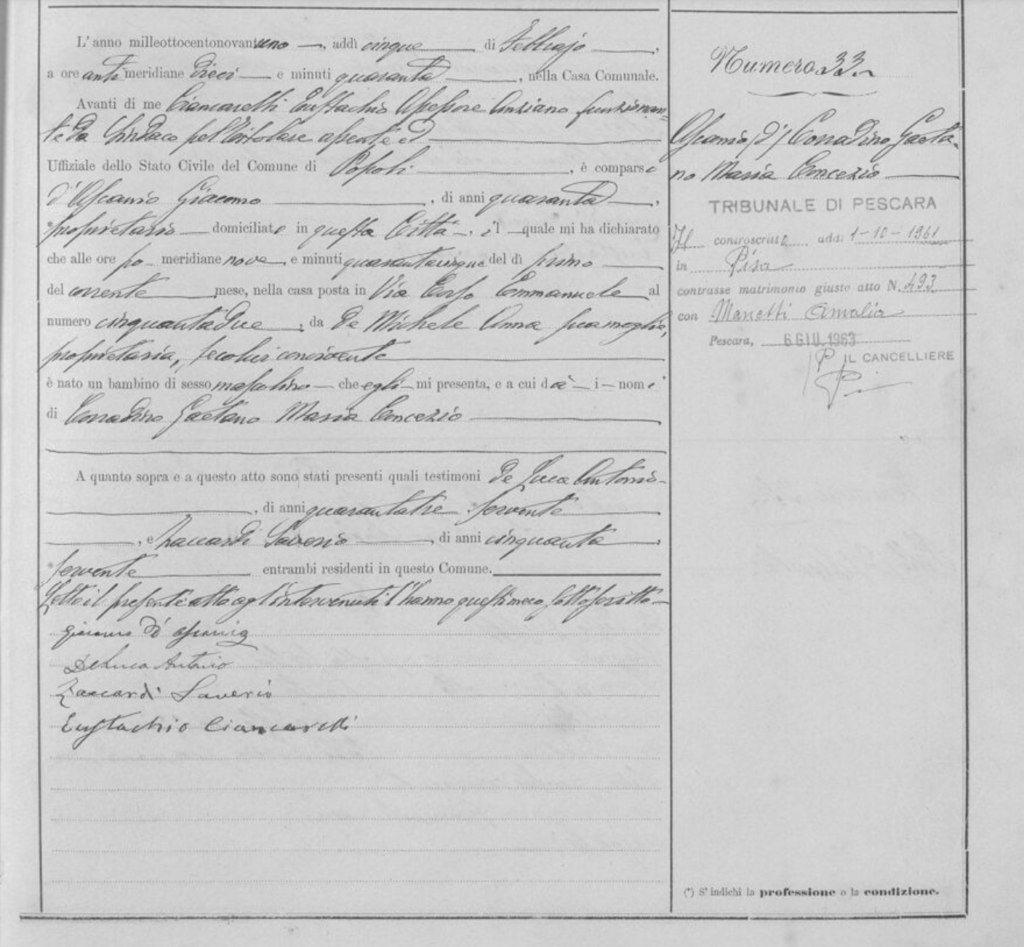
Corradino Gaetano Maria Concezio D’Ascanio was born in Popoli (PE) on 1 February 1891 to Giacomo and Anna De Michele.
From a young age, he showed a keen interest in aviation, which was then in its infancy, so much so that at the age of just sixteen he managed to lift off for a few metres in a glider he had designed himself.
After graduating in industrial engineering from the Polytechnic University of Turin in 1914, he joined the Aviation Battalion as an officer, combining his technical expertise with his interest in flight, eventually securing a patent for an autopilot in 1916.
Two years later, in 1918, he left the army to work at Ottorino Pomilio’s factory in Turin, where he designed several aircraft, including a light bomber, a reconnaissance aircraft and a fighter. He continued in this role even after the company moved to the United States, where he worked alongside Ugo Veniero D’Annunzio, Gabriele’s son, who was then a designer at Caproni Airlines in Detroit.
On his return to Italy in 1920, he opened an engineering practice in Popoli and began research into vertical flight, which led to the patenting of a coaxial-rotor helicopter in 1925. Over the next twenty years, he developed numerous prototypes, making a significant contribution, albeit one that was not fully recognised.
At the same time, he turned his attention to a number of more practical inventions: these included an electric oven for baking bread and cakes, a system for measuring the speed of cars (1925) – a precursor to speed cameras – and a device for automatically searching for data, a forerunner of modern search engines.
However, the invention that made him famous was the one he liked the least: commissioned by Enrico Piaggio, he designed a new type of motorised vehicle, the Vespa, for which a patent was registered on 23 April 1946. The scooter’s huge success was down to its low cost, fuel efficiency and excellent manoeuvrability, effectively making it the Italians’ ‘two-wheeled car’ in the post-war period.
In 1961, he retired from work, having concluded both his role at Piaggio and his academic career at the University of Pisa, where he had been teaching mechanical drawing and design since 1937.
He died in Pisa on 5 August 1981.
You can view the birth certificate on the Ancestors Portal: Archivio di Stato di Pescara > Stato civile italiano > Popoli > 1891
For further information on Corradino d’Ascanio, see the entry in the Dizionario Biografico degli Italiani edited by Alberto Mondini.
Archivio di Stato di Pescara > Stato civile italiano > Popoli > 1891
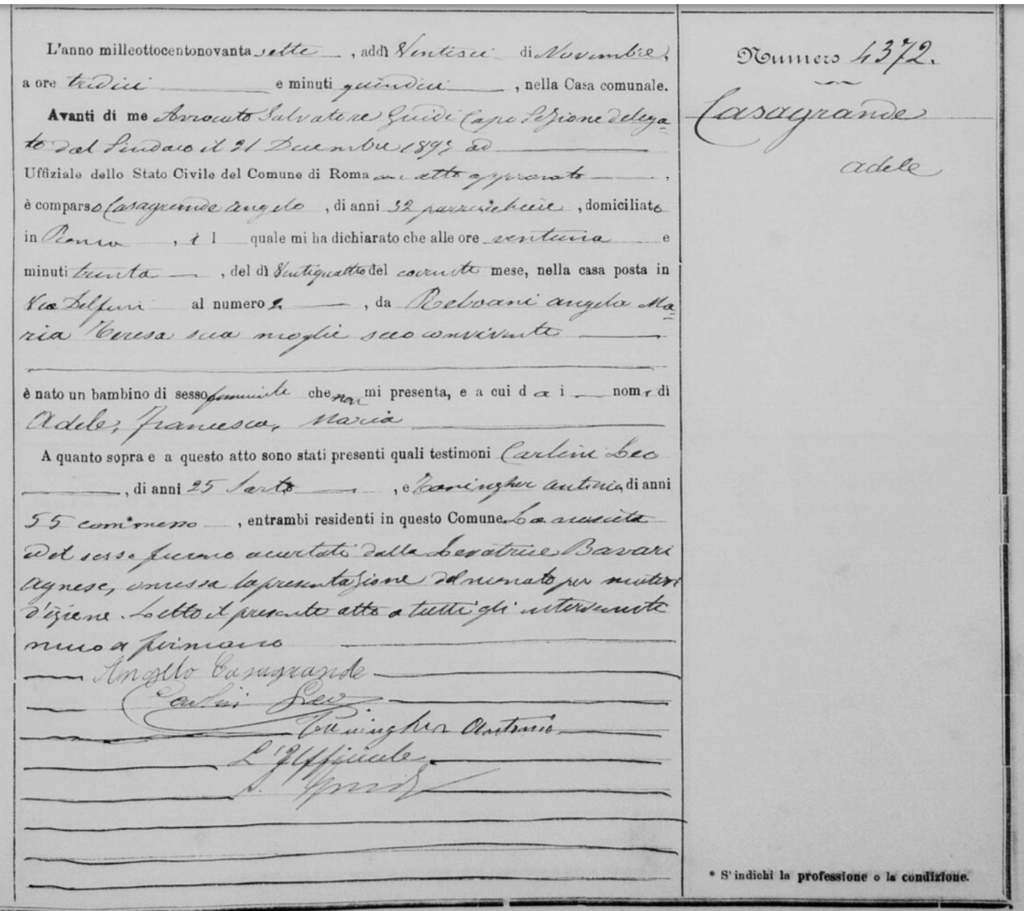
Adele Casagrande was born in Rome on 24 November 1897.
Ancora giovanissima decise di inaugurare un negozio di pelletteria e pellicce nel cuore della Capitale, in via del Plebiscito.
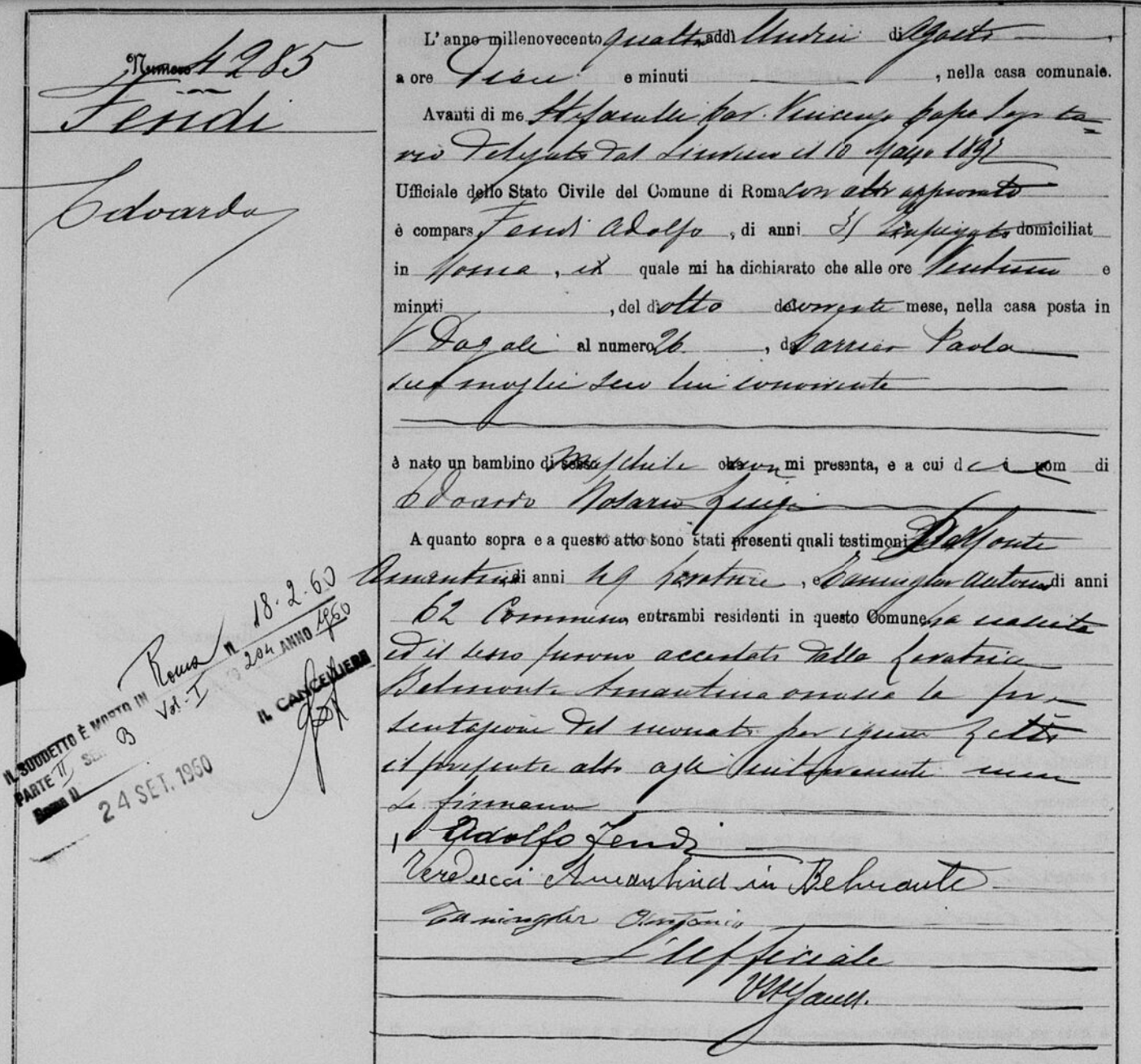
When she married Edoardo Fendi in 1925 – also a Roman, born on 8 August 1904 – the couple began running the business together, choosing to rename it after his surname.
The shop, which started out as a family business, soon began to stand out for the quality of its materials and the skill of its craftsmanship. Expansion and success followed swiftly: in a short space of time, the Fendi brand became a true symbol of artisanal excellence.
In the 1940s, the reins of the company passed to the five daughters (Paola, Anna, Franca, Carla and Alda), who transformed it into a global enterprise thanks to their forward-thinking vision. Two moments in particular marked its history: the partnership with fashion designer Karl Lagerfeld, who revolutionised the concept of fur and designed the iconic double ‘F’ logo, and the creation in 1997 of the ‘Baguette’ by Silvia Venturini Fendi, hailed as the first ‘it-bag’ in history.
In a process of constant evolution, Fendi has grown from a small neighbourhood shop into one of the world’s most influential fashion houses, establishing itself as a leading exponent and benchmark of Italian craftsmanship.
You can view the birth certificates of Adele Casagrande and Edoardo Fendi on the Ancestors portal, held respectively by the State Archives of Rome > Stato civile italiano > Roma > 1897 e Archivio di Stato di Roma > Stato civile italiano > Roma > 1904
Archivio di Stato di Roma > Stato civile italiano > Roma > 1897State Archives of Rome > Italian Civil Status > Rome > 1904
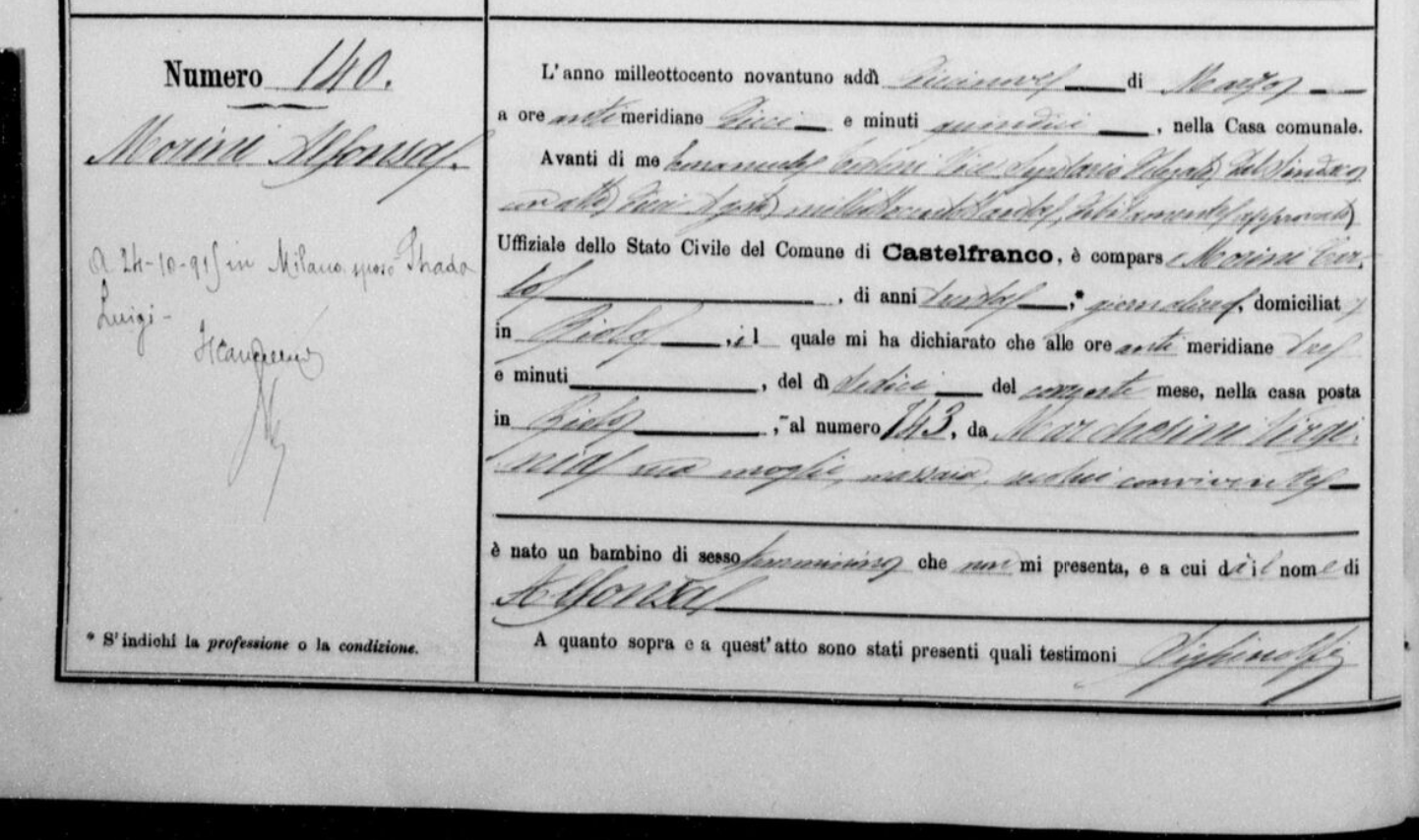
Alfonsa Morini was born in Castelfranco Emilia on 12 March 1881 to Carlo and Virginia Marchesini, both farm labourers.
From a young age, she showed a keen passion for cycling, taking part in various local competitions and earning herself the nickname ‘the devil in a skirt’.
Her sporting ambitions met with strong resistance from her parents, but she found a staunch supporter in her husband, Luigi Strada. So much so that on the occasion of their wedding, held on 26 October 1915, Luigi gave her a racing bicycle. The following year, the couple moved to Milan, where Alfonsina began to train more regularly.
Even before her marriage, she had, in fact, achieved significant sporting success: in 1907, in Turin, she was named ‘best Italian cyclist’; in 1909, at the St Petersburg Grand Prix, she received a medal from Tsar Nicholas II; and in 1911, in Moncalieri, she set the women’s speed record.
Later, in 1917 and 1918, in the midst of the First World War, Morini took part in the Giro di Lombardia, one of Italy’s leading races. However, the most famous moment of her career was her participation in the 1924 Giro d’Italia, where she was admitted amid a degree of scepticism.
More than in any previous competition, her motivation was also driven by financial considerations: her husband Luigi, after years of illness, had been committed to a mental asylum, and the entire burden of supporting the family – which had since grown with the arrival of a daughter – fell on her shoulders.
There were ninety participants at the start in Milan, including just one woman: Alfonsina Strada.
As the newspapers of the time reported, her presence stole the limelight from the other male runners, who were far better known than she was; at every stage, she was greeted with warmth and jubilant cheers, and showered with gifts, often including money.
During the eighth stage (L’Aquila–Perugia), Morini Strada finished after the time limit; however, given the impact of her performance and taking into account injuries and falls, the judges allowed her to continue the race, although she was no longer considered to be in the competition.
In the end, Alfonsina was one of the thirty participants who completed the entire race.
In the 1940s, she retired from competitive sport and opened a bicycle shop in Milan, which she ran together with her husband.
On 13 September 1959, Alfonsina Morini Strada died at the age of 68 following a sudden illness.
You can view the birth certificate on the Ancestors Portal: Archivio di Stato di Modena > Stato civile italiano > Castelfranco dell’Emilia > 1891
Archivio di Stato di Modena > Stato civile italiano > Castelfranco dell’Emilia > 1891
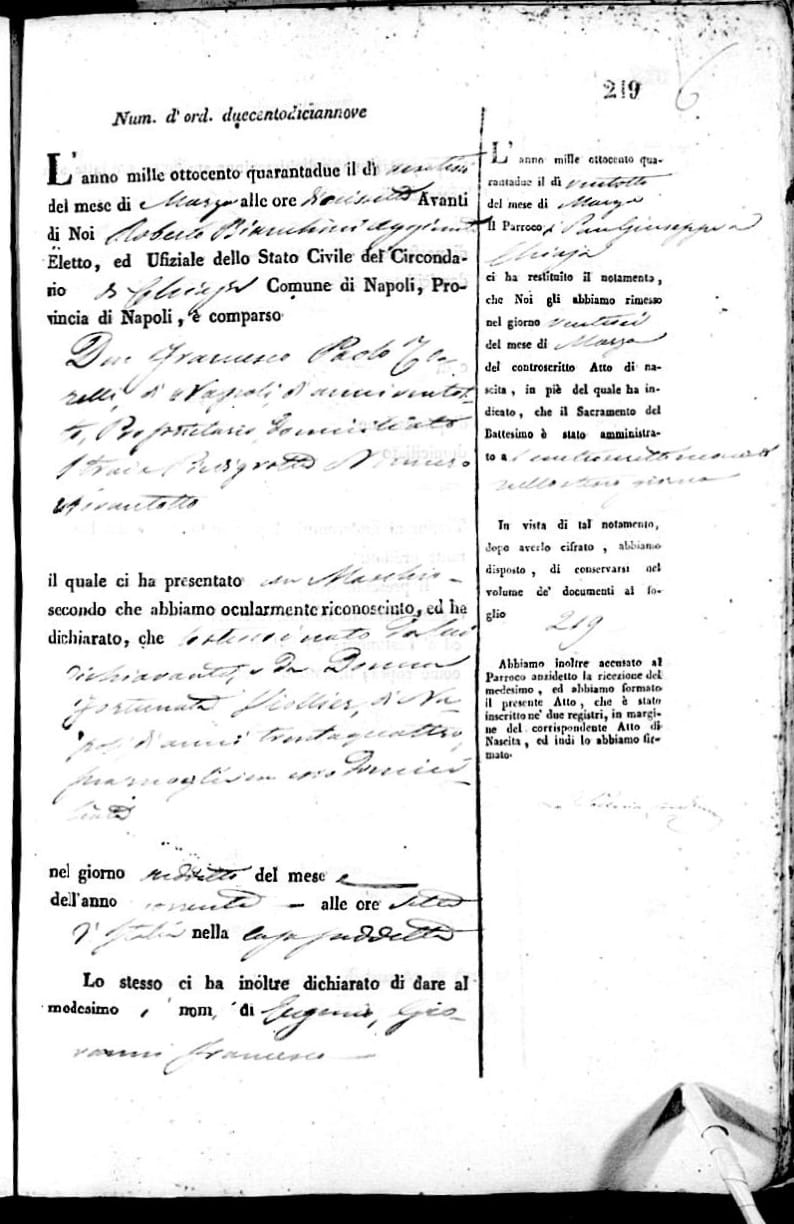
Eugene Giovanni Francesco Torelli was born in Naples on March 26, 1842, to Francesco and Joséphine Viollier. Orphaned, when he was only fourteen years old he was entrusted to the care of his sister Luisa, who followed his education during his teenage years.
Profoundly influenced by the echo of Garibaldi’s exploits, he decided at a young age to join the troops led by Nice, participating in the struggle against the Bourbon power and siding with the unification of Italy. When, however, the units in which he had served were declared irregular and consequently disbanded, he returned to Naples, where he found employment in the Savoy administration.
Parallel to this, in 1861 he began working for L’Indipendente, a newspaper founded by Alexandre Dumas. The collaboration quickly turned into a relationship of close trust: in fact, Torelli became his personal secretary and main collaborator. Not surprisingly, when Dumas returned to Paris, Torelli followed him, and it was then that he also chose to permanently adopt his maternal surname, Viollier, as a tribute to his late mother and the country that was welcoming him.
In 1865 he moved to Milan, a city in which he consolidated his journalistic experience, effectively taking over the editorship of two of the most important newspapers published by the Sonzogno Publishing House and the daily newspaper La Lombardia.
It was precisely from these experiences that he matured the idea of founding the Corriere della sera, a liberal and moderate daily newspaper, whose first issue was published on March 5, 1876, the first day of Lent, when, according to tradition, no newspapers were published in Milan. This was not a random choice, which helped mark its identity from the very beginning.
From its beginnings, it achieved significant public success and substantial financial results, reflecting the vision of its founder, who aspired to a serious, efficient and independent journalism, oriented toward moderate liberalism and monarchism, but capable of stimulating balanced debate on current issues.
Beginning in the 1990s, however, he faced early financial difficulties, due to unsuccessful investments and health problems that forced him to take long periods of rest. At such junctures, and increasingly in the following years, the leadership of the newspaper was entrusted to different personalities, whose editorial choices did not always fully reflect his original vision.
Stricken with endocarditis, Eugenio Torelli Viollier died in Milan on April 26, 1900.
In his will, in addition to his family members, he arranged a small sum for each of his workers, as well as others to benefit a number of Milanese institutions. These include, in particular, a substantial bequest for the construction of a sanatorium in Milan, evidence of his attention to the social and civic dimension of his city.
You can consult the birth certificate on the Ancestors Portal: Archivio di Stato di Napoli > Stato civile della restaurazione (quartieri di Napoli) > Chiaia > 01/01/1842-20/05/1842
For more on the figure of Eugenio Torelli Viollier, see the entry of the Biographical Dictionary of Italians edited by Mauro Forno.
Archivio di Stato di Napoli > Stato civile della restaurazione (quartieri di Napoli) > Chiaia > 01/01/1842-20/05/1842
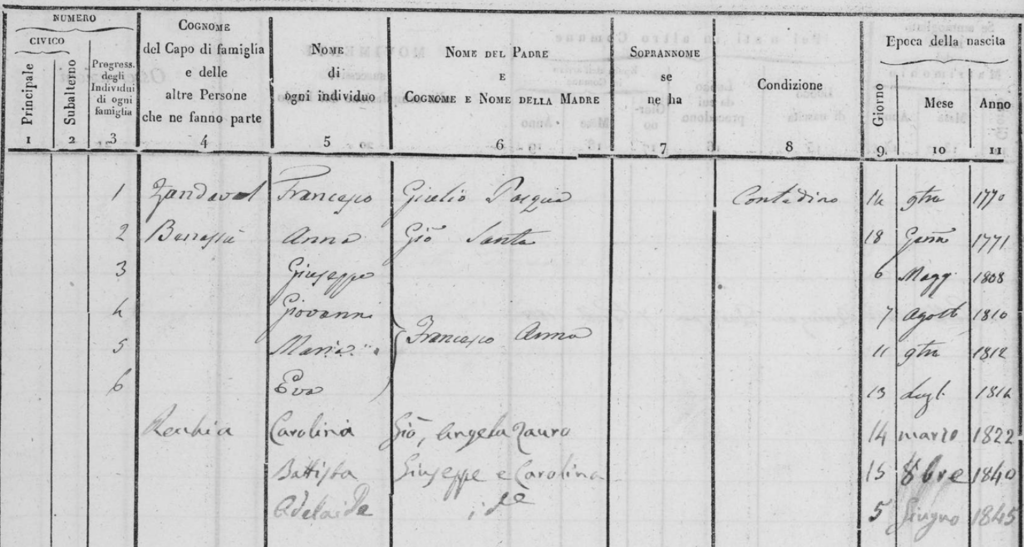
A volte un cognome non cambia per scelta, ma perché cambia il luogo in cui una famiglia vive. Seguendo le persone nei loro spostamenti, anche il nome che le identifica si trasforma, adattandosi ai dialetti, alle amministrazioni e alla lingua del territorio attraversato.
La mia ricerca genealogica nasce proprio dal tentativo di dare un senso a questo cambiamento, partendo da un cognome che ho sempre dato per scontato e che, invece, si è rivelato il risultato finale di una lunga evoluzione.
Dalla Valle: il cognome nella forma attuale
La motivazione iniziale era semplice: capire da dove provenisse il mio cognome e se fosse possibile ricostruire una storia familiare più ampia rispetto a quella tramandata oralmente. Nei primi anni Duemila, quando Internet iniziava a offrire i primi strumenti di ricerca sull’origine dei cognomi, consultai alcuni siti che raccoglievano informazioni generiche e spesso non documentate. Da queste ricerche emergeva l’esistenza di diversi rami principali del cognome Dalla Valle, tra cui uno Vicentino dal quale la mia famiglia pensava di provenire. In una delle fonti inoltre compariva anche un gruppo di Dalla Val presente nel Veronese. Mancando però documenti originali, riferimenti archivistici e strumenti digitali strutturati, non fui in grado di stabilire alcun collegamento concreto con la mia famiglia. In assenza di ulteriori riscontri, la ricerca si arrestò.
La vera svolta arrivò nel 2017, quando venni a conoscenza del Portale Antenati. Per la prima volta avevo accesso diretto ai registri di stato civile e a fonti ufficiali consultabili da casa. Questa possibilità mi spinse a riprendere la ricerca in modo più sistematico e consapevole.
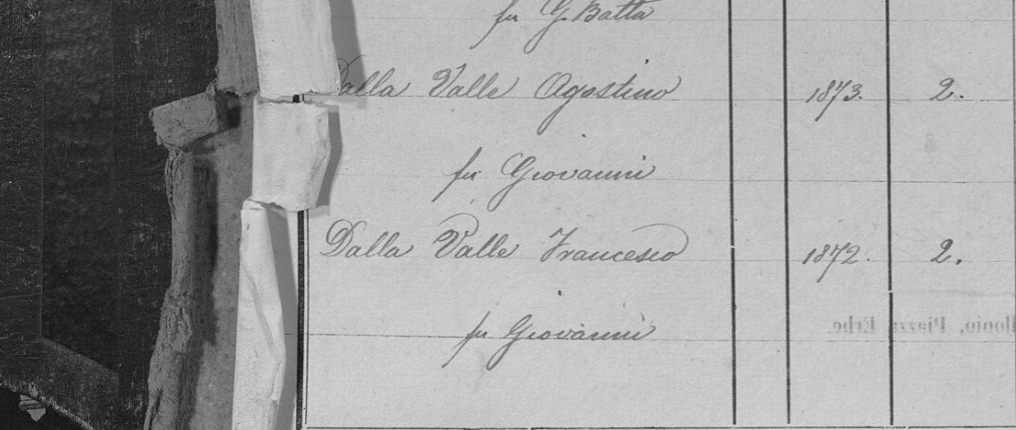
Le informazioni tramandate oralmente in famiglia si fermavano al mio bisnonno Angelo, nato a Castelnuovo del Garda nel 1899 e morto a Ponti sul Mincio negli anni Settanta. L’obiettivo iniziale era quindi superare quel limite e verificare se i documenti confermassero quanto ricordato in famiglia. Grazie alla consultazione dei registri di stato civile disponibili sul Portale Antenati e a un approfondimento presso il Centro FamilySearch di Brescia, emerse che anche il padre di Angelo era nato a Castelnuovo del Garda e che morì nel 1930 a Monzambano, paese in cui la mia famiglia risiede tuttora. Dal certificato di morte risultava inoltre il nome di suo padre: Agostino. Tornando sugli indici decennali di cittadinanza e residenza di Ponti sul Mincio, individuai Agostino (1873) e Francesco (1872), entrambi figli di Giovanni, con ogni probabilità fratelli.
Dalla Val: il cognome nella forma intermedia
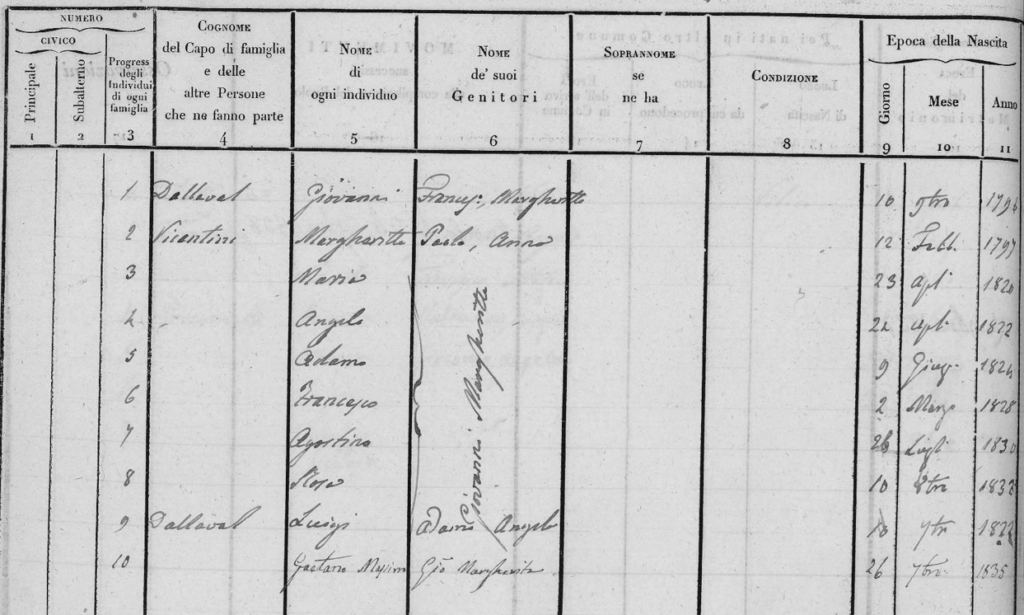
Il risultato che speravo di ottenere era la conferma di una linea familiare coerente e lineare; ciò che trovai, invece, aprì uno scenario del tutto inatteso. Poiché il registro relativo ad Agostino risultava mancante, consultai quello di Francesco, dal quale emerse che era nato a San Massimo all’Adige. Questo dato mi costrinse a spostare la ricerca in un’area geografica che fino a quel momento non avevo mai preso in considerazione. Proseguendo l’indagine nei fogli di famiglia delle anagrafiche austriache, relativi al periodo del Regno Lombardo-Veneto, scoprii un elemento decisivo: il cognome originario non era Dalla Valle, bensì Dalla Val.
A quel punto divenne chiaro che il cognome che avevo sempre conosciuto non corrispondeva alla forma originaria. Nel comune di Verona durante il regno Lombardo-Veneto risultavano solamente famiglie Dalla Valle, mentre a San Massimo erano presenti esclusivamente famiglie Dalla Val, a dimostrazione che si trattava di rami distinti. Il cognome, dunque, era già cambiato una prima volta e la forma attuale mi aveva inizialmente condotto verso un contesto che con la mia famiglia aveva poco a che fare. Questa consapevolezza fu uno dei momenti più significativi dell’intera ricerca.
La ricerca riprese con nuovo slancio nel 2025, quando decisi di affiancare alle fonti digitali una vera e propria ricerca sul campo. Consultando i registri parrocchiali di Ponti sul Mincio, riuscii a colmare un vuoto documentale fondamentale. Qui scoprii che nel 1872 il padre di Agostino e Francesco morì a Ponti sul Mincio. È proprio in questo contesto che
avviene il cambiamento: il cognome Dalla Val si stabilizza definitivamente nella forma Dalla Valle, probabilmente influenzato da una progressiva italianizzazione del nome, tipica della seconda metà dell’Ottocento.
Zandaval: il cognome nella forma originaria
Le ricerche successive presso la parrocchia di San Massimo permisero di risalire ancora più indietro nel tempo. L’accesso diretto ai registri non fu possibile, ma grazie all’autorizzazione della Cancelleria vescovile di Verona e alla collaborazione del caro Valeriano (responsabile degli archivi parrocchiali di San Massimo), che ha svolto per mio conto un’attenta e scrupolosa ricerca sui documenti più antichi, fu possibile consultare i registri delle anime e altra documentazione storica. A lui va un sincero ringraziamento, perché senza il suo lavoro questa ricostruzione non sarebbe stata possibile.
Come appare nei documenti più antichi, il primo Dalla Val presente in archivio è Giovanni “Zandaval”, proveniente da Fane, che sposò nel 1740 la Sanmassimese Elisabetta Biribin. In una fase intermedia il cognome viene latinizzato nella forma “A Valle”, per poi stabilizzarsi in Dalla Val, a conferma di un processo di adattamento linguistico e amministrativo tipico dell’epoca. L’analisi complessiva dei documenti ha permesso di ricostruire l’origine comune di tutte le famiglie Dalla Val di San Massimo, discendenti da questo capostipite.
Ancora oggi il cognome Zandaval, seppur raro, è presente nelle zone della Lessinia, dove i rami rimasti hanno conservato la forma originaria.
Il risultato più importante di questa ricerca non è stato solo ricostruire una linea genealogica, ma comprendere come il cognome della mia famiglia sia cambiato nel corso del tempo e come l’attuale forma Dalla Valle mi abbia inizialmente allontanato dalla vera origine familiare. Questa esperienza conferma quanto, nella ricerca genealogica, i cognomi non siano punti fermi, ma tracce in continuo movimento, profondamente legate alla storia delle persone che li hanno portati.
Guglielmo Calderini was born in Perugia on March 3, 1837, to Francesco and Antonia Poggini.
He completed his studies in his hometown, then attended university in Turin and Rome, where he obtained a degree as an engineer-architect.
He held numerous positions in the offices of the Civil Engineers and in the Superintendence of Monuments of Latium. Parallel to his professional activity he carried out an intense teaching activity: he was professor of Architecture at the Academy of Fine Arts “Pietro Vannucci” in Perugia from 1868 to 1882, and then taught at the universities of Pisa and Rome.
Trained in the cultural climate of post-unification Italy, Calderini adhered to the language of academic eclecticism, characterized by the reworking of historical models and the search for monumental and representative solutions. This approach emerges both in the works he created and in the projects he submitted to the numerous competitions in which he participated. In particular, in the Umbrian capital he built Palazzo Bianchi (1888-1904), Palazzo Cesaroni – the current seat of the Regional Council of Umbria – the public baths and the Church of San Costanzo with portico.
Calderini’s notoriety, however, remains linked above all to two Roman works: the design and construction of the quadriporticus of the Basilica of St. Paul Outside the Walls and, above all, the Palace of Justice, known as the Palazzaccio. In the latter building in particular, the architect’s eclectic language resulted in an imposing construction of late Renaissance and Baroque inspiration, designed to express solemnity and institutional authority. Work, which began between 1887 and 1888, took a long time, and the work was not completed until 1910. The construction took an extensive amount of time and, once completed, was the subject of criticism both for the technical and administrative disputes that had accompanied the construction site and for negative aesthetic evaluations.
Despite the controversy, the Palace of Justice remained the most emblematic work of his career and one of the most significant examples of monumental eclecticism in post-unification Italy.
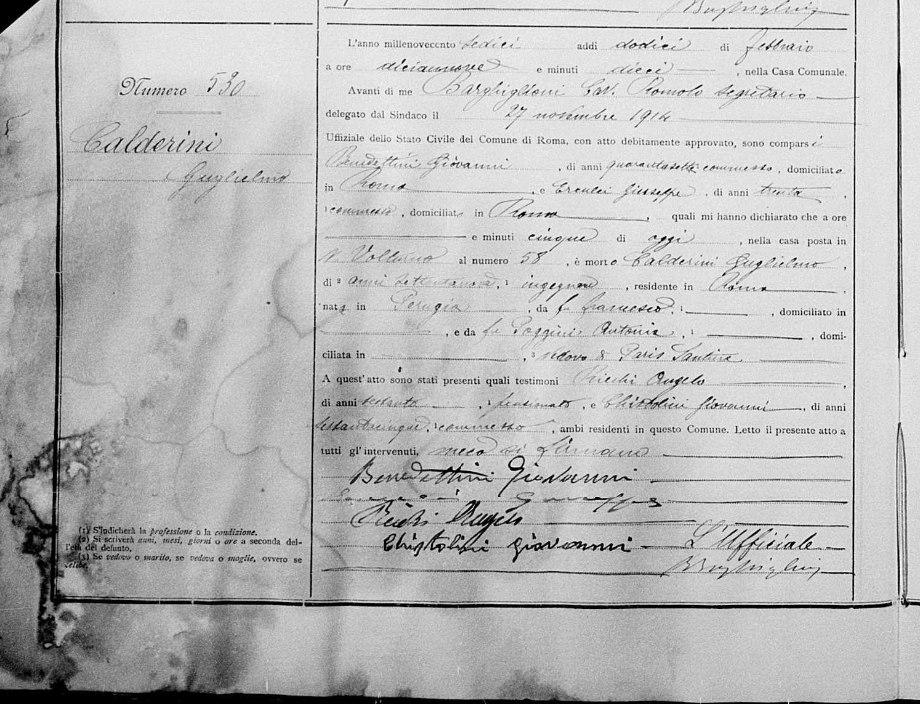
Guglielmo Calderini spent the last years of his life in Rome, where he died on February 12, 1916.
You can view the death certificate on the Ancestors Portal: Archivio di Stato di Roma > Stato civile italiano > Roma > 1916
Archivio di Stato di Roma > Stato civile italiano > Roma > 1916
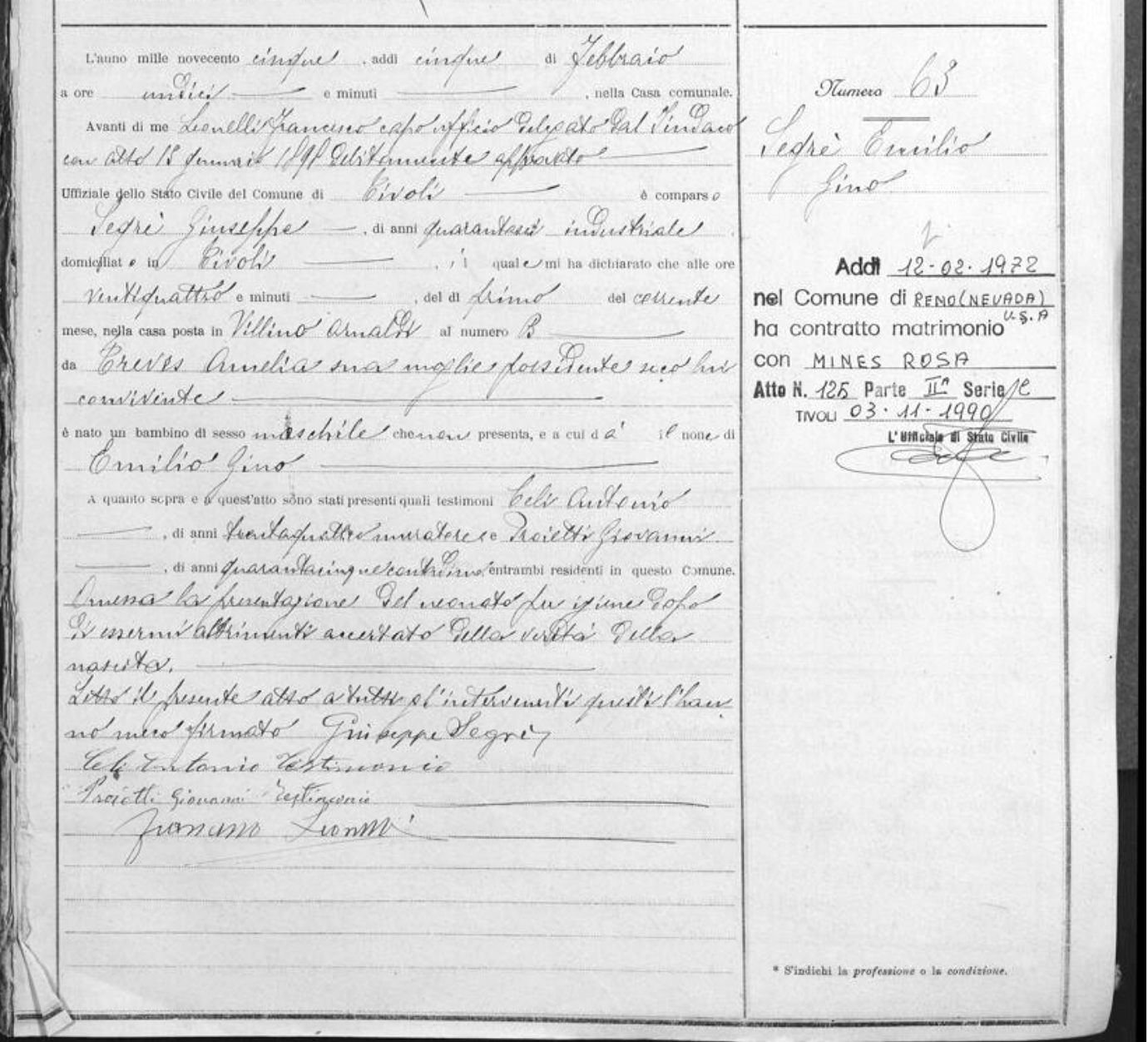
Emilio Gino Segrè was born in Tivoli, in the province of Rome, on February 1, 1905*, into a wealthy and culturally active Jewish family. His father, Giuseppe, was an executive in paper industries operating in Rome, while his mother, Amelia Susanna Treves, was the daughter of a well-known Florentine architect.
After his classical studies, he enrolled in the Faculty of Engineering, which he attended with little enthusiasm or profit. It was his meeting with Enrico Fermi that marked a decisive turning point in his scientific path: attracted by theoretical and experimental physics, he decided to change course of study, graduating in Physics in 1928 from the University of Rome. In those years he joined the famous group of “i ragazzi di via Panisperna,” with which he collaborated on numerous research projects that contributed decisively to one of the most fruitful periods of twentieth-century Italian physics.
Immediately after graduation and military service, Segrè began to devote himself entirely to scientific research.
Between 1932 and 1936 he was an assistant professor in Rome and then moved to Palermo, where he took over as director of the Athenaeum’s Institute of Physics. It was during his Palermo period that he made one of his most significant discoveries: the identification – together with Carlo Perrier – of technetium, the first chemical element obtained artificially by man, a discovery of enormous importance, which opened new perspectives in the understanding of the structure of matter and later found important applications in the medical field, particularly in nuclear diagnostics.
In 1937, Segrè traveled to the United States to further his research at the Radiation Laboratory in Berkeley, California. The enactment of racial laws in Italy in 1938 prevented him from returning to the country, effectively forcing him into a scientific exile that would become – by his own choice – permanent. In the United States, in fact, he continued his academic career successfully, obtaining U.S. citizenship in 1944.
During the period of World War II, he participated in the “Manhattan Project,” collaborating in Los Alamos laboratories on the development of the first atomic bombs. When the conflict ended, he returned to California in 1946 and settled permanently near Lafayette in 1955.
After the war, his research focused on problems in nuclear physics and elementary particle physics. Among his most significant achievements was the discovery of the antiproton, which won him the Nobel Prize in physics in 1959.
In 1974, he returned to Italy to hold the chair of nuclear physics at the “Sapienza” University of Rome. However, having reached retirement age, after about a year he decided to retire again to California, where he continued to devote himself to study, scientific popularization and historical reflection on the development of physics in the twentieth century .
Emilio Segrè died on April 22, 1989, in Lafayette.
His remains rest today at the Tivoli cemetery.
You can look up the birth certificate on the Ancestors Portal: Archivio di Stato di Roma > Stato civile italiano (registri dei comuni) > Tivoli > 1905
For more on the figure of Emilio Segrè, see the entry in the Dizionario Biografico degli Italiani edited by Giovanni Battimelli
* Emilio Segrè’s date of birth is sometimes mistakenly given as January 30; in fact-as can be seen from the birth certificate-he was born on February 1, 1905, while the registry entry took place on the 5th of the same month.
Archivio di Stato di Roma > Stato civile italiano (registri dei comuni) > Tivoli > 1905
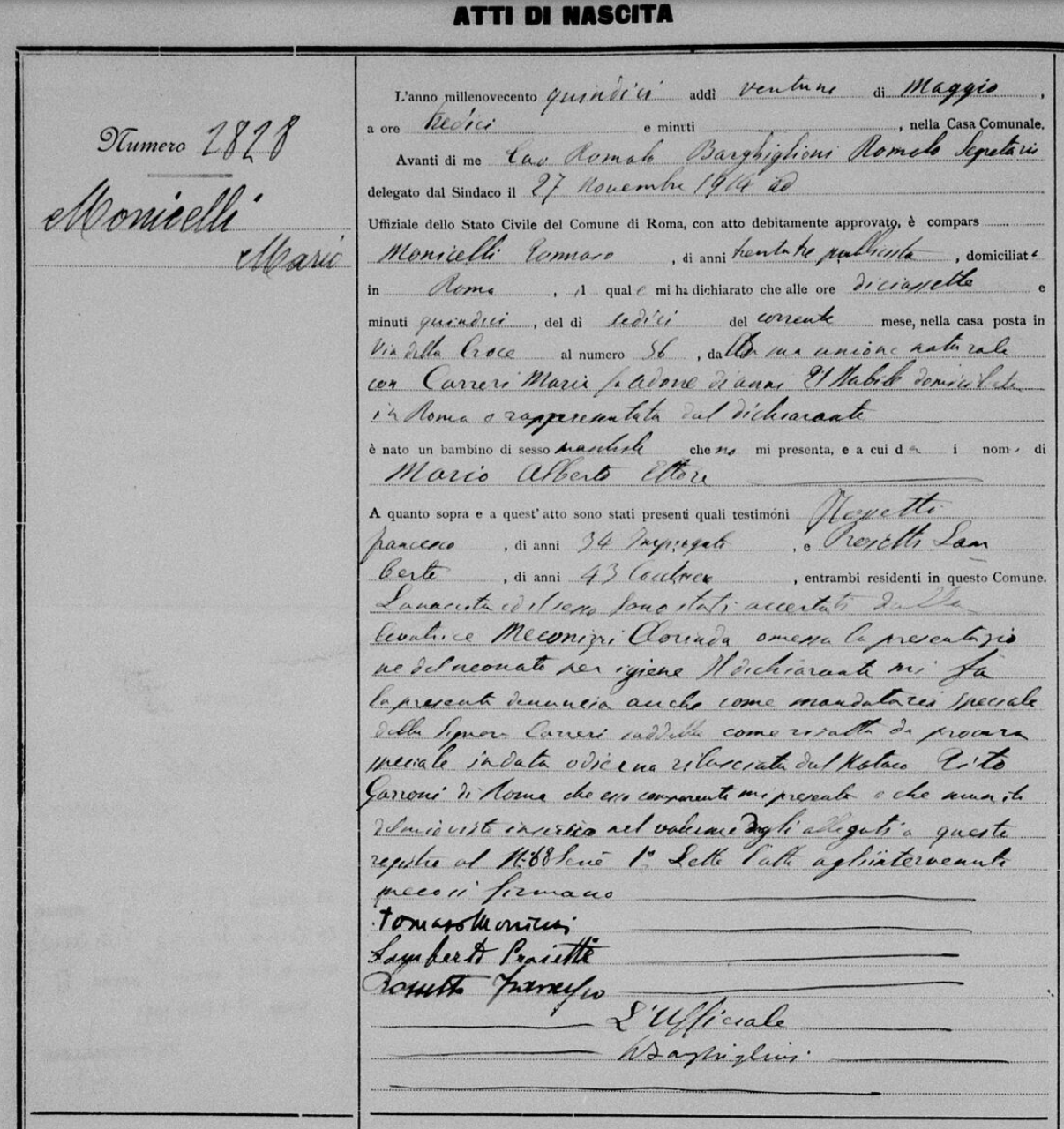
Mario Alberto Ettore Monicelli was born in Rome on May 16, 1915.
His father, Tomaso, a journalist and playwright, was editor of Il resto del Carlino andAvanti!, while his mother, Maria Carreri, a housewife.
Growing up in a culturally vibrant and stimulating environment, he soon developed a keen cultural curiosity. After school in Rome and high school between Viareggio, Prato and Milan, he came into contact with a group of young people destined to become leading figures in twentieth-century Italian culture. Alongside his cousin Arnoldo Mondadori, he hung out with poet Vittorio Sereni, future director Alberto Lattuada and other young intellectuals. From this environment came his collaboration with the weekly Camminare, where he dealt with film criticism.
It was, however, in the mid-1930s that he began his first experiments behind the camera, making the short film Cuore rilevatore in 1934, and collaborating the following year with Alberto Mondadori on the feature film I ragazzi di via Pàl, which was screened at the Venice International Film Festival.
In 1940, immediately after graduating from the University of Pisa, he enlisted.
At the end of World War II, he embarked steadily on a film career, often teaming up with Pietro Germi and Stefano Vanzina, and moving with ease between different genres, from comedy to adventure film to drama. His partnership with Vanzina ended in 1953, after he had given birth to some of the most representative comedies of the postwar period, including Totò cerca casa (1949), Guardie e ladri (1951), which won Cannes for best screenplay, Le infedeli and Totò e le donne.
In 1957, he won best director at the Berlin Film Festival with Fathers and Sons; while with The Great War (1959) he won the Golden Lion and an Oscar nomination for best foreign language film. A second nomination came in 1963 with I compagni, for best original screenplay. These, along with I soliti ignoti, are unanimously considered among his masterpieces.
With L’armata Brancaleone (1966) and Brancaleone alle crociate (1970) he staged a grotesque and tragicomic Middle Ages, made memorable by the invention of a macaronic and original language. In the 1970s, his quest led him to confront a darker present: Un borghese piccolo piccolo (1977) Un borghese piccolo piccolo (1977) marked a turn toward a decidedly more dramatic register, far removed from earlier tones. Instead, with Il marchese del Grillo (1981), starring Alberto Sordi, he returned to a more ironic vein, which earned him the Silver Bear for Best Director at the Berlin Film Festival in 1982.
In the last two decades of his life, he focused on telling the story of the vices and contradictions of the average Italian family, addressed in films such as Speriamo che sia femmina (1986) and Parenti serpenti (1991), characterized by a grotesque, paradoxical style steeped in black humor. Alongside his film activity, he also devoted himself to theater directing, both opera and prose.
Although he gradually slowed down the pace of his work, he never lost his intellectual clarity and took an increasingly active role in civic engagement, openly participating in protest initiatives against cuts to culture and the entertainment industry.
In 1991 he was awarded the Golden Lion for Lifetime Achievement.
On November 29, 2010, marked by a long illness, Mario Monicelli took his own life.
You can consult the birth certificate on the Ancestors Portal: Archivio di Stato di Roma > Stato civile italiano > Roma > 1915
For more on the figure of Mario Monicelli, see the entry of the Dizionario Biografico degli Italiani edited by Stefano Della Casa.
Archivio di Stato di Roma > Stato civile italiano > Roma > 1915
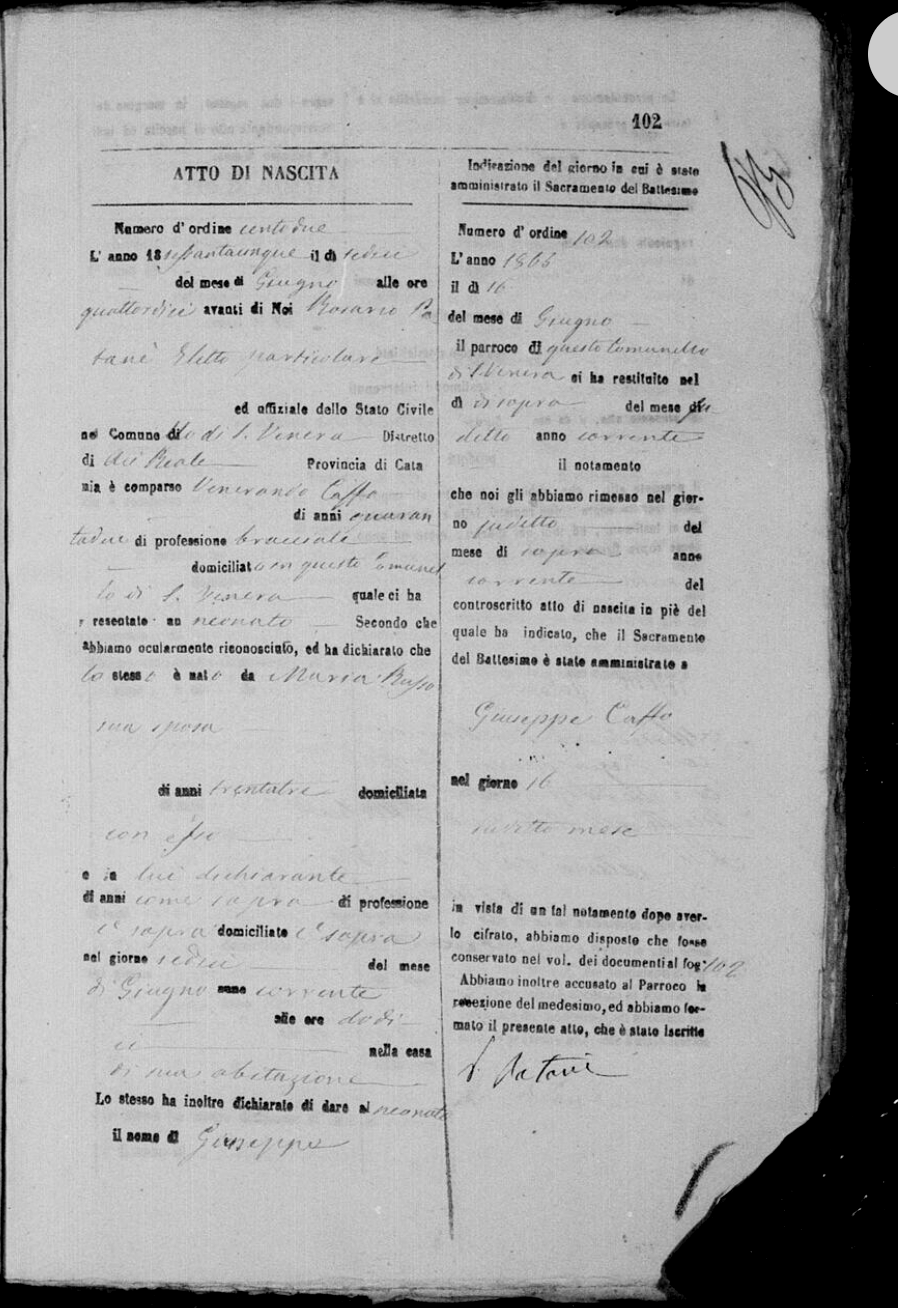
Giuseppe Caffo was born June 16, 1865, in Santa Venerina, in the province of Catania, to Venerando and Maria Russo, both agricultural laborers.
In 1915 he purchased his first distillery, named “Caffo Giuseppe fu Venerando – alcohol and tartar distillery.” The”initial activity was aimed at the production of alcohol and wine-making derivatives, but over time, through progressive research into natural raw materials, he began to develop recipes for liqueurs made from aromatic and medicinal herbs, which quickly met with market favor.
The success of the first productions led Giuseppe to involve three of his five sons-Santo, Sebastiano and Giuseppe-who together started the “Distilleria F.lli Caffo.”
Of the brothers, Sebastiano was the one who most closely followed in his father’s footsteps, becoming in turn an expert master distiller and contributing greatly to the growth of the family business.
In 1952 the Caffo family received a proposal to take over a distillery in Limbadi, in the province of Vibo Valentia, a few kilometers from Capo Vaticano. This Calabrian locality was identified as a strategic location, destined to become the Group’s historic headquarters, on which the brothers decided to focus their entrepreneurial efforts.
This arrangement remained unchanged until 1966, when the company was dissolved following Santo’s death and Joseph’s move to Australia. The leadership of the company then passed to Sebastiano, who was joined by his son Giuseppe Giovanni, known as Pippo, the current president of the group.
From that time, the Limbadi distillery became the main production center. And it was here, in the 1970s, that the liqueur dedicated to Capo Vaticano was born: the famous Vecchio Amaro del Capo. An innovative product for the time, it was composed of some 29 herbs, roots and fruits of the Calabrian territory, characterized by a sweetish note, then unusual for traditional bitters.
Throughout the twentieth century and to the present day, the company has continued to expand, diversifying production with brandy, grappa and other liqueurs, acquiring historic brands and strengthening its presence in international markets, while at the same time maintaining strong ties with the territory and traditions.
You can consult the birth certificate on the Ancestors Portal: Archivio di Stato di Catania > Stato civile della restaurazione > Santa Venerina > 1865