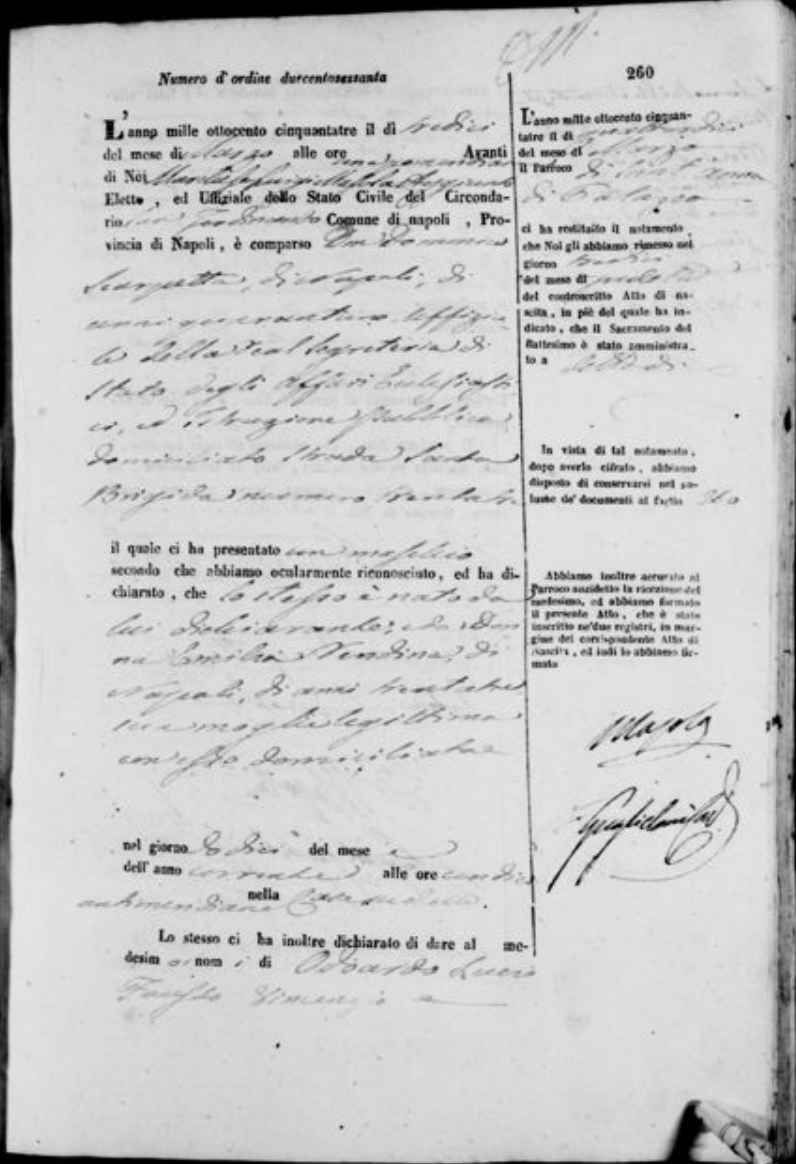
Eduardo Scarpetta, recorded at the registry office as Odoardo Lucio Fausto Vincenzo, was born at 33 Via Santa Brigida, in the San Ferdinando neighborhood of Naples, on March 12, 1853, to Domenico, an official of the Bourbon Kingdom, and Emilia Rendina.
In 1868, still 15 years old, he turned his passion for the stage into a profession to help support his family, which was in dire financial straits. He thus joined the company of Antonio Petito, the celebrated interpreter of Punchinello, and in less than ten years went from young apprentice to head comedian.
In 1870, he gave birth to the character destined to mark his career, Felice Sciosciammocca, soon elected a beloved mask of Neapolitan theater. With the comedy Don Felice Sciosciammocca, mariuolo ‘e ‘na pizza, he achieved, not surprisingly, his first genuine triumph as author and actor.
Upon Petito’s death, he left Naples for a short time, seeking new spaces of affirmation in Rome. Returning to the San Carlino theater, he embarked on a long national tour in 1879. A substantial loan also enabled him to completely renovate the theater, ushering in an extraordinarily prosperous phase.
Soon Scarpetta became one of the leading figures of Italian theater: he profoundly renewed the Neapolitan comic repertoire, setting aside the most antiquated models and bringing to the stage brilliant, lively, irreverent comedies, many of them written in his own hand. Many others, however, were reworkings of Italian and French texts, which he adapted with acumen to Neapolitan and national-popular taste.
In 1887, he saw the debut of what would become his most famous work, Miseria e nobiltà, destined for imperishable success. His total output exceeded one hundred operas, maintained in the repertoire even after his death, thanks to his son Vincenzo. Among his best-known titles are ‘Nu turco napulitano, Santarella and L’albergo del silenzio.
On a personal level, Scarpetta’s love life was complex and articulated, but it helped generate a true theatrical dynasty: in 1876 he married Rosa De Filippo, by whom he had sons Domenico and Vincenzo. From a relationship with Francesca Giannetti was born Maria, later adopted. From his union with Luisa De Filippo, his wife’s niece, were born Titina, Eduardo and Peppino, destined to become leading figures on the 20th-century Italian stage. A further relationship with Anna De Filippo, his wife’s half-sister, led to the birth of Ernesto (future Murolo), Eduardo – aka Eduardo Passarelli – and Pasquale.
Eduardo Scarpetta died in Naples on November 29, 1925.
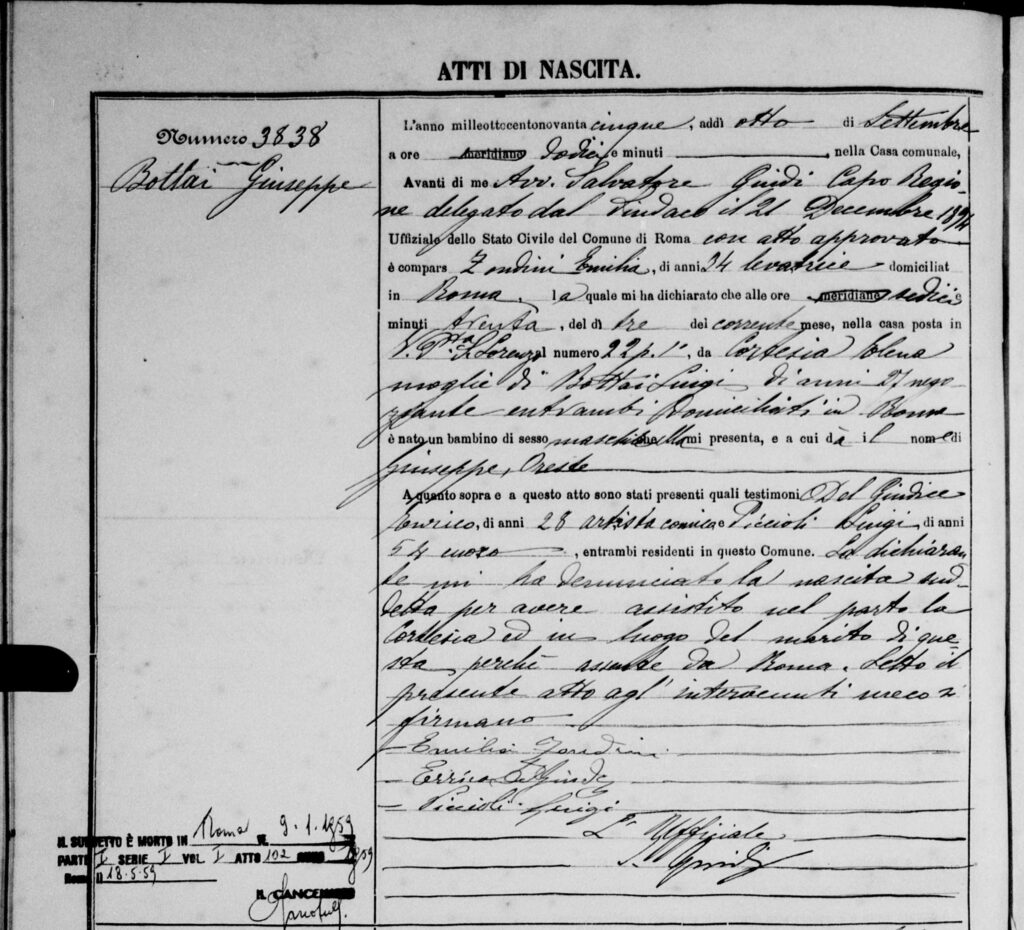
You can consult the birth certificate on the Ancestors Portal: Archivio di Stato di Napoli > Stato civile della restaurazione (quartieri di Napoli) > San Ferdinando > 01/01/1853-28/04/1853
The original is kept at the State Archives in Naples.
For more on the figure of Eduardo Scarpetta, see the entry of the Biographical Dictionary of Italians edited by Valentina Venturini.