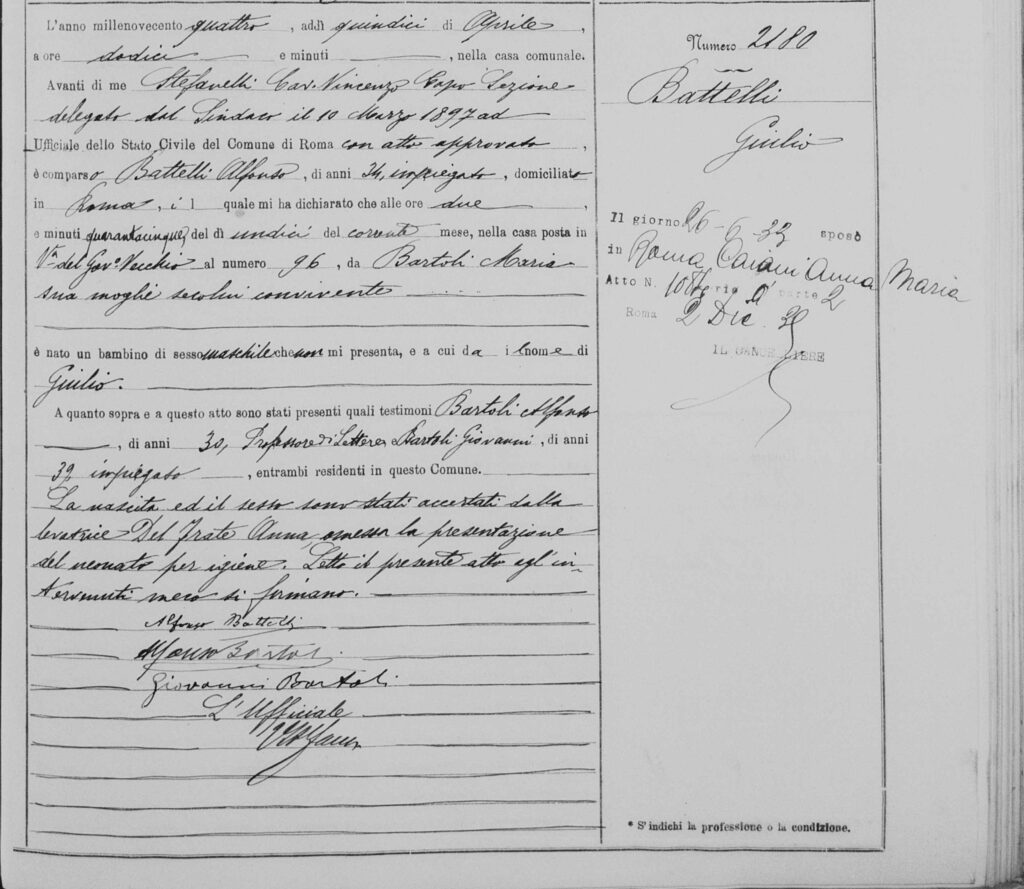
Giulio Battelli was born in Rome on April 11, 1904.
He graduated in 1928 with a degree in Humanities from La Sapienza University under Pietro Fedele.
Concurrently with the university, he had attended the Vatican School of Archivistics, Paleography and Diplomatics, graduating in 1925 and where he taught a number of disciplines from 1932 to 1978. He also became its director from 1955 to 1978.
He taught archivistics, paleography and diplomatics at several public and pontifical universities, such as the Lateran University (1934-1966), Sapienza University of Rome (1970-1979) and the University of Macerata (1967-1970).
The list of his publications stands out for its breadth and variety, demonstrating all his scientific depth. Among his many works, he is remembered for his support of enterprises of great and undisputed value, such as The Census of the Ecclesiastical Archives of Italy and theIndex Actorum Romanorum Pontificum.
He was a partner and member of numerous Institutes and Societies, both national and international, including: the Società Romana di Storia Patria, the National Institute of Roman Studies, the Italian Center for Early Medieval Studies, the Pontifical Roman Academy of Archaeology to the Ecclesiastical Archival Association, the International Commission of Diplomatics, the Comité International de Paléographie Latine and many others. Firm ties to his city, as evidenced by his membership in the Italian Archival Association to the Romanists’ Group, the Friends of the Museums of Rome, up to the presentation in 1996 of the Cultori di Roma award.
Giulio Battelli died in Rome on March 10, 2005.
You can look up thebirth certificate on the Ancestor Portal: Rome State Archives > Italian Civil Status > Rome > 1904
State Archives of Rome > Italian Civil Status > Rome > 1904
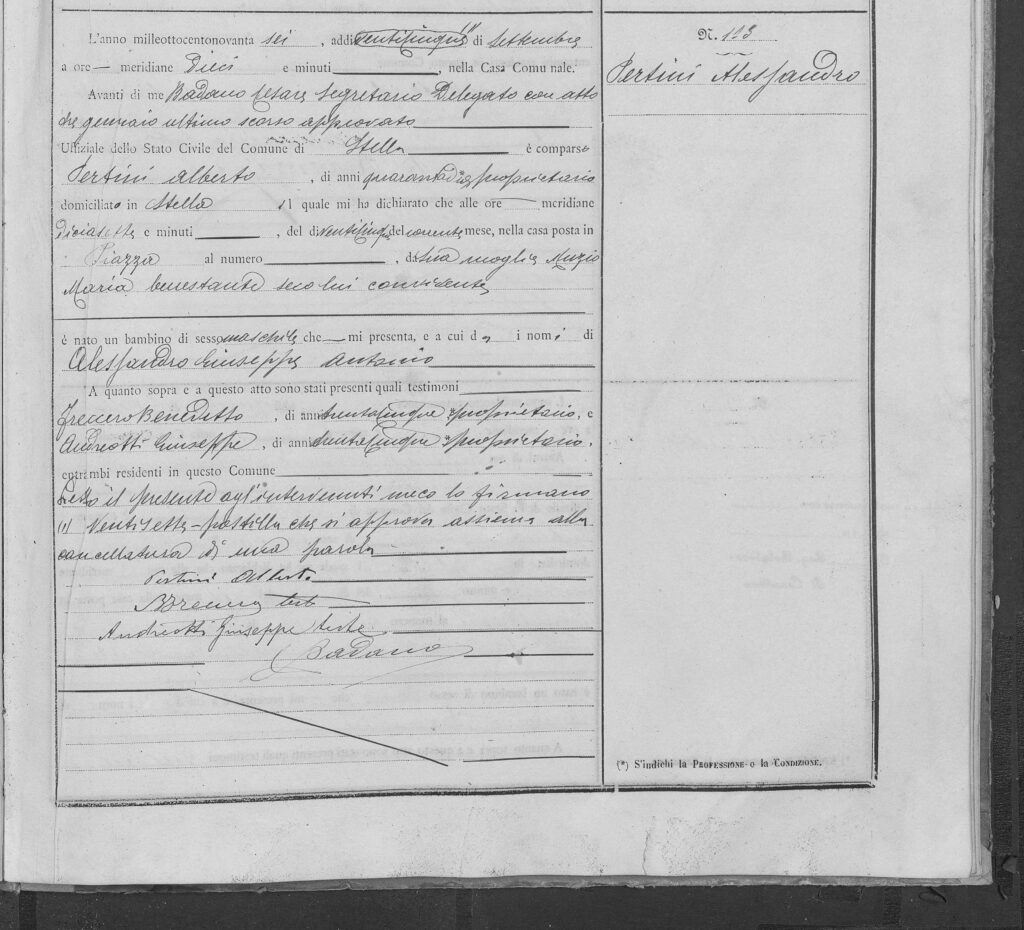
Alessandro Giuseppe Antonio Pertini was born in Stella (SV) on September 25, 1896, to Alberto Gianandrea, a landowner, and Maria Giovanna Adelaide Muzio.
During high school, the teachings of his philosophy teacher, Adelchi Baratono, first brought him closer to socialist ideas.
Called to arms, during World War I he had to serve by attending the officers’ course. As a second lieutenant, he was sent to the front, where he distinguished himself for a number of wartime actions that earned him the silver medal, which, however, he refused as he was never pro-war.
Once discharged, he earned a degree first in Law, from the University of Modena, and then in Political Science from the “Cesare Alfieri” Institute in Florence.
In August 1924 he officially joined the United Socialist Party, in the wake of the outrage provoked by the Matteotti murder.
He soon became the target of Fascist harassment and violence, was also arrested for eight months and sent to police confinement for five years.
To escape conviction, he traveled to France together with Filippo Turati.
He returned to Italy three years later, in 1929, with the aim of rejoining the ranks of the Socialist Party toward fighting Fascism and the person of Mussolini. But, again, he was arrested and sentenced to eleven years in prison: after seven years in prison, he was sent to confinement, refusing his mother’s request for a pardon.
He returned free on August 13, 1943 and immediately worked to reconstitute the Italian Socialist Party of Proletarian Unity (PSIUP), of which he became deputy secretary.
On September 10, 1943, he participated along with many other political figures in the liberation of Rome from the Germans.
However, together with Saragat he was arrested a few days later, on October 15, and both were sentenced to death.
The sentence did not take place, and the two managed to escape thanks to an uprising by partisan brigades. Action that saved his life, as his name was already on the list of those condemned to be shot in the massacre of the Fosse Ardeatine (March 24, 1944).
For his activities during the Resistance and the role he played in the defense of Rome he will be awarded the Gold Medal for Military Valor.
After the war conflict ended, he devoted the rest of his life to politics and journalism.
In 1945, he was elected secretary of the PSIUP and deputy to the Constituent Assembly. In 1948, he became a senator of the Republic. He was parliamentary deputy (1953, 1958, 1963, 1968, 1972, 1976), vice-president (1963) and president of the Chamber of Deputies (1968, 1972).
In 1946-1947 and then again from 1949 to 1951 he was editor of theForward.
On July 8, 1978 he was elected President of the Italian Republic, later resigning on June 29, 1985.
Sandro Pertini died in Rome on February 24, 1990.
You can look up thebirth certificate on the Ancestor Portal: Savona State Archives > Italian Civil Status > Stella > 1896
For more on the figure of Sandro Pertini, see the entry of the Dizionario Biografico degli Italiani edited by Umberto Gentiloni Silveri.
Savona State Archives > Italian Civil Status > Stella > 1896
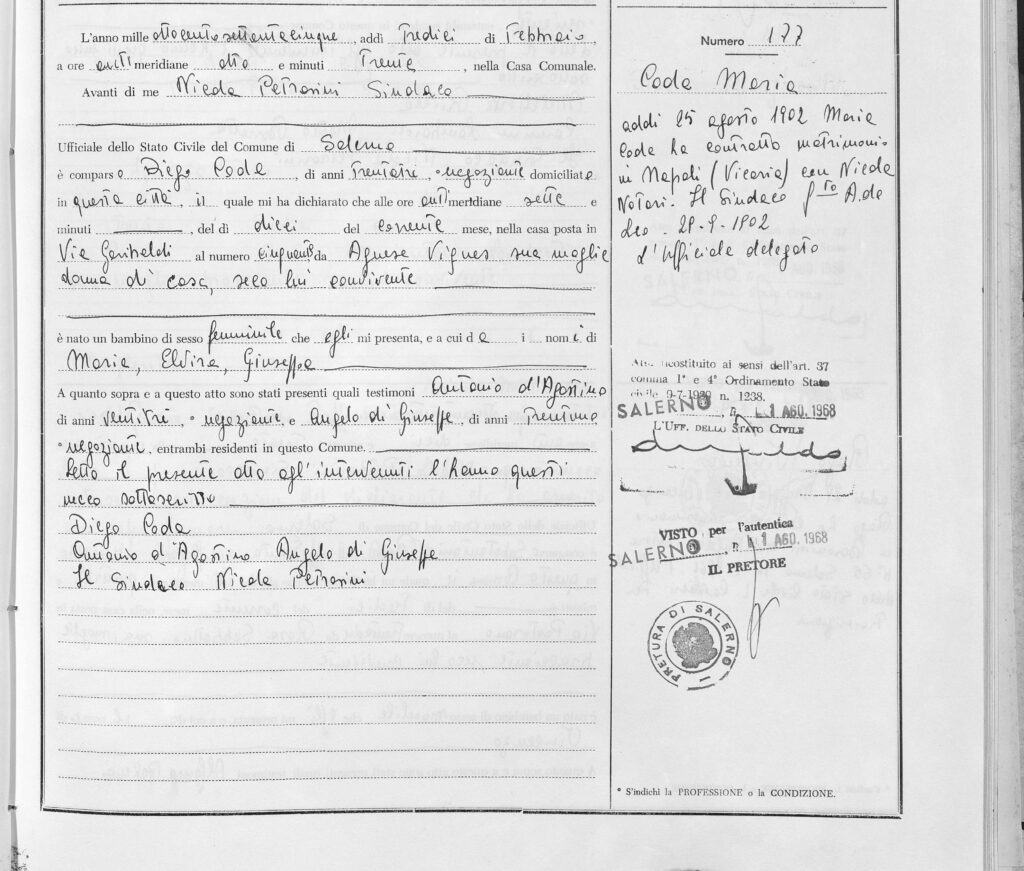
Maria Elvira Giuseppa Coda, later married Notari, was born in Salerno on February 10, 1875.
After graduating as a teacher, she devoted herself to teaching in schools for a few years. Until she moved to Naples, where she met her future husband, Nicola Notari, a photographer, whom she married in 1902.
He began by assisting him in the hand-coloring of film frames and films, and gradually the two expanded their business: since Naples was at the time a very sensitive area for film culture, they decided to open a production company, Dora Film, which was destined to be an international success.
Elvira, endowed with a pronounced creativity and entrepreneurial spirit, became its de facto coordinator, directing between 1906 and 1930 over 60 scripts, including films and documentaries.
His favorite subjects were drawn from the reality of the Neapolitan slums: he staged-often with nonprofessional actors-true life stories, dramatic plots and vicissitudes in which the audience could mirror themselves.
Beyond verism, Notari also showed special attention to the psychology of the characters, demanding acting that was as realistic as possible, far from the emphasis and forcing of international cinema.
Dora Film‘s intense production was a widespread success, even to the point of landing in New York, where a branch was opened, given the great demand and participation among Italian migrants.
However, within a few years, this way of filmmaking entered a crisis: the severe restrictions of the Fascist regime and the slow change of fashions and trends hindered the production of Neapolitan cinematography in favor of the far more spectacular and magniloquent national one.
Thus, despite numerous attempts to survive the crisis, Dora Film finally closed its doors in 1930.
Elvira Notari retired to Cava de’ Tirreni, where she died on December 17, 1946.
You can consult thebirth certificate on the Ancestry Portal: Salerno State Archives > Italian Civil Status > Salerno > 1875
For more on the figure of Elvira Notari, see the entry of the Biographical Dictionary of Italians edited by Antonella Pagliarulo.
Salerno State Archives > Italian Civil Status > Salerno > 1875
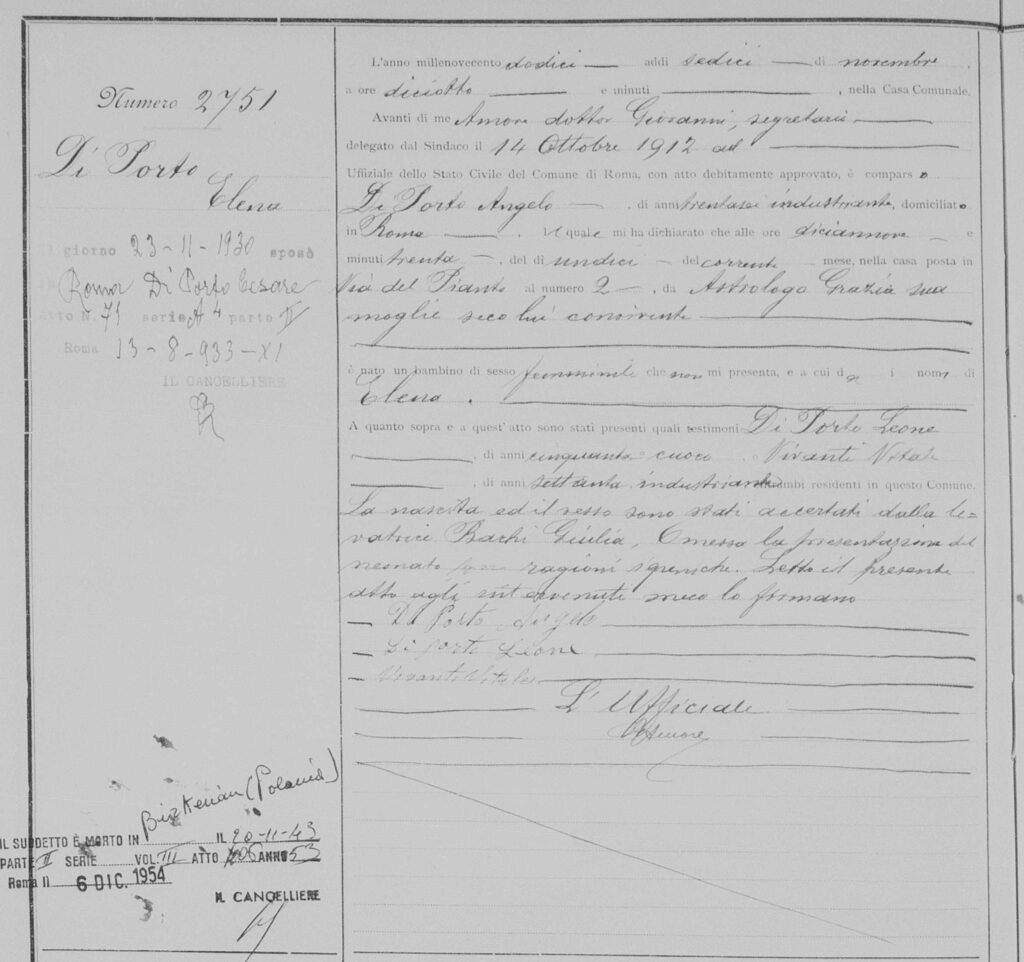
Elena Di Porto was born in Rome on November 11, 1912, to Angelo and Grazia Astrologo. A Jewish family residing in the Roman ghetto, at number 2 Via del Pianto.
Known as the “madwoman of Piazza Giudia” for her fuming and rebellious temperament, she was known for an incident involving her when, after the promulgation of the racial laws, she witnessed the beating of a Jew by two fascists and, unable to keep quiet, physically intervened to defend the man.
The act did not go unpunished, costing her imprisonment and police confinement from 1940 to 1942.
When she was liberated, she began the struggle again, organizing riots and assaults against the Germans. During the “Black Saturday” of Roman Jews on October 16, 1943, Elena managed to escape the roundup, but after learning that her sister and nephews had been captured, she decided to give herself up.
She was thus deported to Auschwitz, where she was murdered on an unknown date.
You can consult the birth certificate on the Ancestors Portal: Archivio di Stato di Roma > Stato civile italiano > Roma > 1912
Giacomo Debenedetti was inspired by her figure in his book 16 ottobre 1943 for the character of Celeste, a Jewish woman who raised the alarm of the impending roundup by the Germans, but who-because she was considered “crazy” by many-was not believed.
A more careful and extensive biographical profile is sketched by Gaetano Petraglia in the volume La matta di piazza Giudia. History and Memory of the Roman Jewess Elena Di Porto, published by Giuntina (2022).
Archivio di Stato di Roma > Stato civile italiano > Roma > 1912
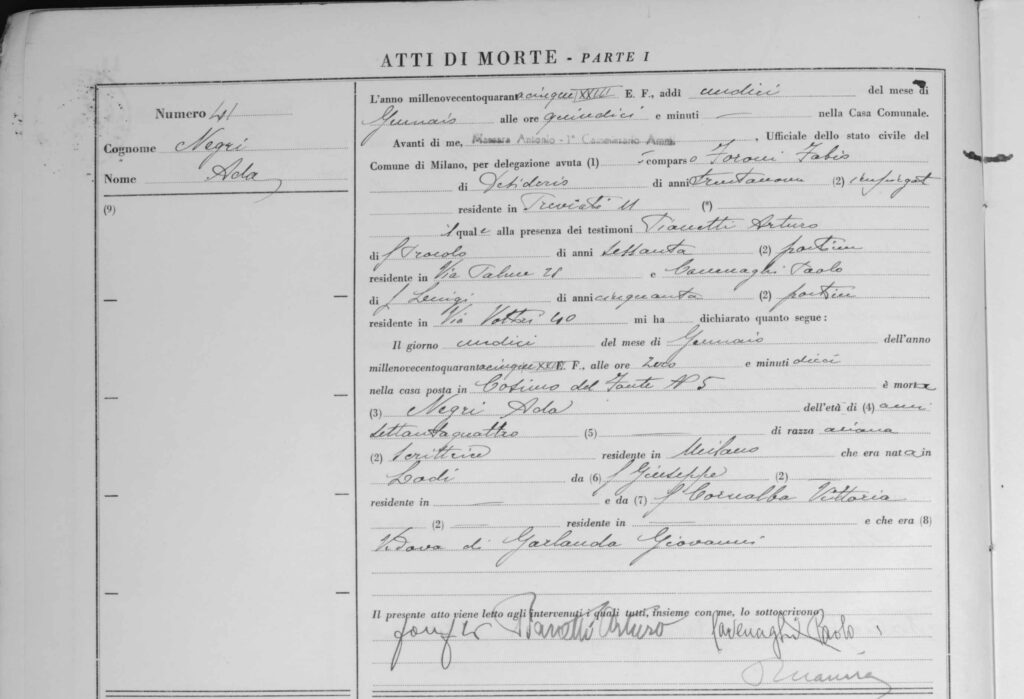
Ada Negri was born in Lodi on February 3, 1870, into a family of humble circumstances.
Her father, Giuseppe, died when she was only one year old, and it was thanks to her mother, Vittoria Cornalba, that Ada was able to complete her studies and obtain her elementary school teacher’s diploma.
Parallel to her teaching activities, she began to publish her first poems. First in local magazines and then, in 1892 saw the light of her first collection, Fatality, which brought her immediate success.
Moving to the Lombard capital, she came into contact with the Socialist Party, intensifying her commitment to various social causes. Following her marriage to Giovanni Garlanda and, above all, the birth of her two daughters, Bianca and Vittoria, the latter of whom died after a month of life, social issues gave way to other, more introspective and autobiographical ones.
The collections Maternità (1904) and Dal Profondo (1910) date from this period.
Separating from her husband in 1913, she moved to Zurich.
It was, compositionally, a prolific period in which he wrote about exile, patriotism and autobiographical events.
Returning to Italy, she reached the pinnacle of her career with her nomination for the Nobel Prize in 1927 – later won by Grazia Deledda – and the award by the Duce of the “Mussolini Prize,” which consecrated her as the “intellectual of the regime,” becoming the first woman member of the Academy of Italy.
Ada Negri died in Milan on January 11, 1945, at almost seventy-five years of age.
You can consult the death certificate on the Ancestors Portal: Archivio di Stato di Milano > Stato civile italiano > Milano > Registro 7440, Parte I (1-398), Registro 3
Personal archive of Ada Negri is preserved in several institutions. The largest fund (5500 letters, 30 documents, 30 photographs) is at the Banca Popolare di Lodi foundation. The fund has been digitized and is freely available on Manus online.
For more on the figure of Ada Negri, see the entry of the Dizionario Biografico degli Italiani edited by Rossana Dedola.
Archivio di Stato di Milano > Stato civile italiano > Milano > Registro 7440, Parte I (1-398), Registro 3
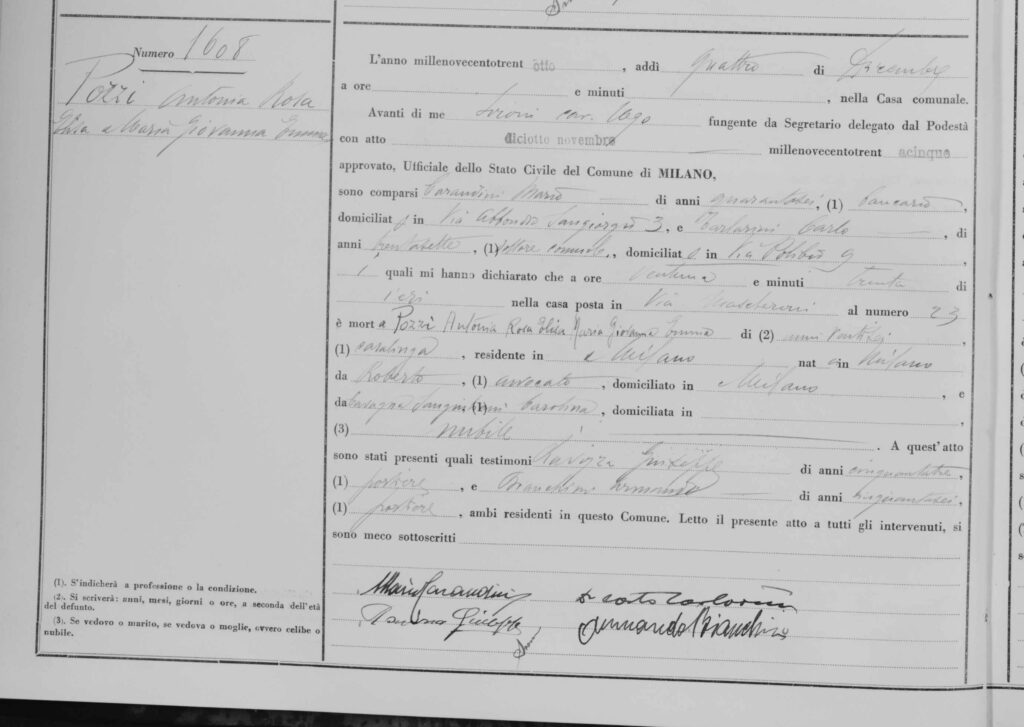
Antonia Pozzi was born in Milan on 12th February 1912 to Roberto, a lawyer, and Countess Carolina Lavagna Sangiuliani di Gualdana.
She received a solid and rigorous education. As a teenager she began writing poetry, finding inspiration in the nature surrounding her beloved home in Pasturo, at the foot of the Grigne Mountains (LC), which was a place of refuge and peace for her.
Once she graduated from the ‘Alessandro Manzoni’ classical high school, she began a relationship with her Latin and Greek teacher, Antonio Maria Cervi, despite her family’s firm opposition.
Enrolled in the Faculty of Modern Philology at the University of Milan, she had the opportunity to get to know many intellectuals of her time, including Vittorio Sereni, who became a close friend of hers. In particular, during Antonio Banfi’s lectures on aesthetics, she came into contact with several philosophers, poets and publishers of the time, including Remo Cantoni, Enzo Paci, Maria Corti, Alberto Mondadori, Livio Garzanti and many others. Banfi’s influence proved so profound that under his guidance Pozzi graduated in 1935.
Despite his modern and progressive schooling and academic training, his path clashed with family expectations, still bound to the rigid traditional roles of upper-class society.
After finishing university, she devoted herself to sports and travelling, until she was called to teach at a technical institute, an experience she saw as a way to emancipate herself and break away from her family of origin.
However, the poor appreciation her poems received among her friends and her own professor fuelled a growing restlessness in her. Added to this was a bitter disappointment in love and the expatriation of friends forced to leave Italy due to the Racial Laws, thus aggravating her sense of isolation.
Overwhelmed by what she described as ‘mortal despair’, Antonia Pozzi chose to take her own life at the age of only twenty-six, on 3 December 1938, near Chiaravalle.
All of his poems were published posthumously: despite his discrete output during his lifetime, Pozzi never attempted publication. Due to the special circumstances of his death, his father considered it appropriate to rework some of his writings, to obscure the more personal and controversial passages, before agreeing to publication (1939).
The first full, uncensored publication by Onorina Dino dates back to 1989.
You can consult the death certificate on the Ancestors Portal: Archivio di Stato di Milano > Stato civile italiano > Milano > Registro 7440, Parte I (1587-1750), Registro 3
For more on the figure of Antonia Pozzi, see the entry in the Dizionario Biografico degli Italiani edited by Sara Lorenzetti.
Archivio di Stato di Milano > Stato civile italiano > Milano > Registro 7440, Parte I (1587-1750), Registro 3
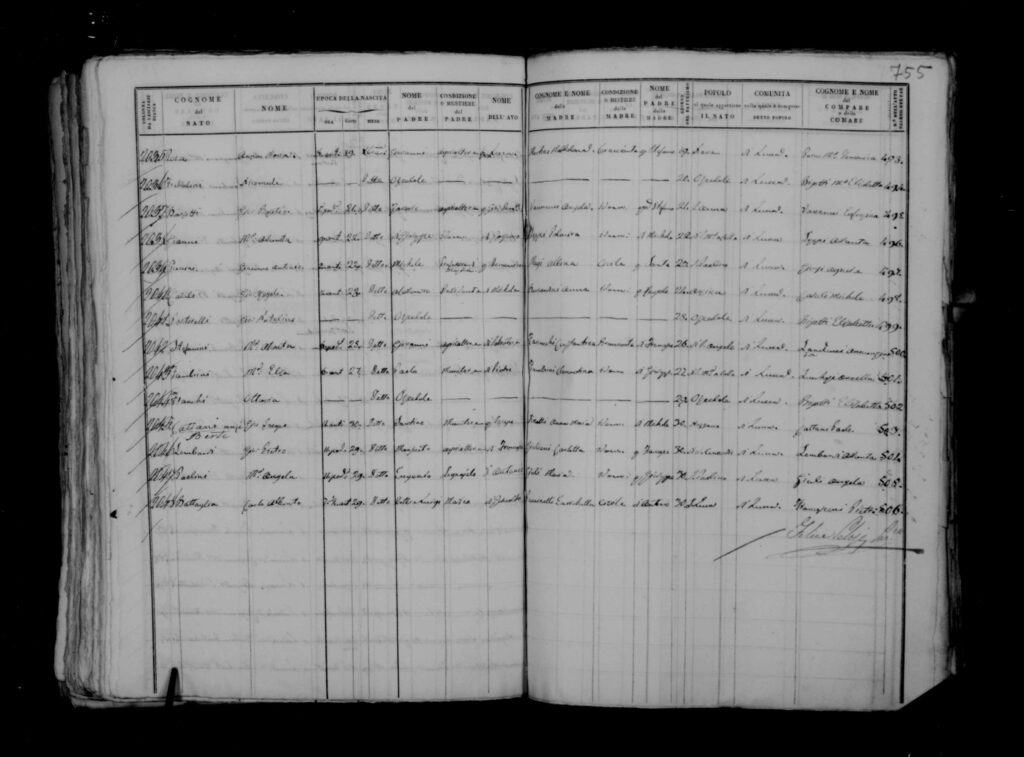
Giacomo Puccini was born in Lucca on 22th December 1858 to Michele and Albina Magi.
The sixth of nine children in a family that had been chapel masters and organists at the cathedral of Lucca for four generations.
The early death of his father (1865) placed the Puccinis in financial straits, so that Giacomo’s education was entrusted to Fortunato Magi, his maternal uncle and musician, who initially did not see in his nephew a particular artistic predisposition.
However, the child was initiated into organ and choral singing, coping with everything with little success and a fair amount of indolence. It was only when he enrolled in his city’s music institute, under the guidance of Carlo Angeloni, that he began to reveal an unexpected talent.
During his formative years in Tuscany, he devoted himself to compositional trials of little resonance. The turning point came in 1880, when he moved to Milan, where he perfected his studies and met friends and masters from whom he drew stimuli, inspiration and teachings.
After fluctuating years, once he had graduated from the conservatory, his first timid successes began, which then gave rise to an operetta production of great value: La Bohème (1896), Tosca (1900), Madama Butterfly (1904) and Turandot (performed posthumously in 1926) to name the best known.
A leading figure on the Italian opera scene, Puccini dedicated himself exclusively to music for the theatre. Although his operatic production counts only twelve titles, the meticulous care with which he developed each opera, both musically and dramaturgically, allowed him to create masterpieces that were able to establish themselves firmly in the international repertoire.
Throughout his life, he was deeply attached to Tuscany and, in particular, to Torre del Lago, a hamlet of Viareggio, which was a place of peace and inspiration for him, so much so that he had a villa built there in which several of his works saw the light of day. There he lived together with Elvira Bonturi, who – despite his various liaisons – was his life companion and mother of his only son, Antonio.
Giacomo Puccini, who fell ill with a tumour of the larynx, died in Brussels on 29th November 1924.
You can read his name among the monthly extracts from the baptism registers of the parish of S. Martino in Lucca: Archivio di Stato di Firenze > Stato civile preunitario (1815-1865) > Lucca > 1858 (nr. 2034)
For more on the figure of Giacomo Puccini, see the Dizionario Biografico degli Italiani entry edited by Dieter Schickling.
Archivio di Stato di Firenze > Stato civile preunitario (1815-1865) > Lucca > 1858
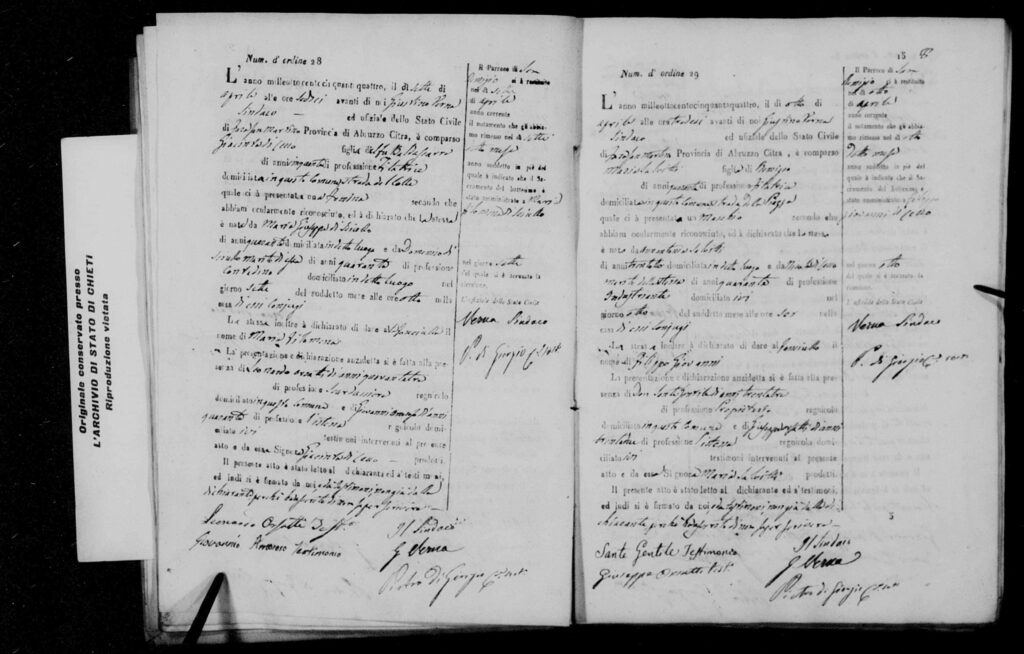
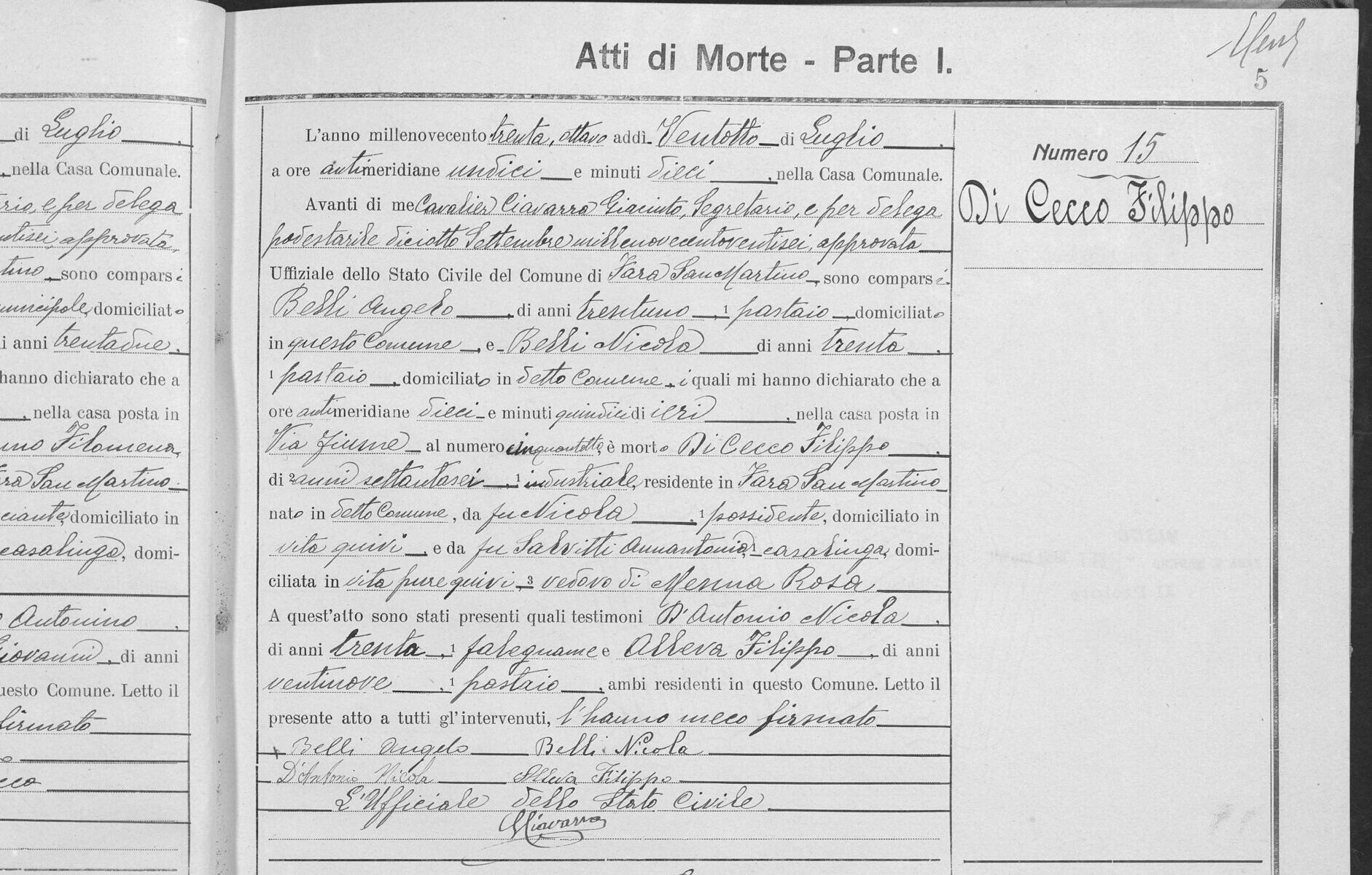
Filippo Giovanni De Cecco (or Di Cecco, as he was known at the registry office) was born in Fara San Martino (CH) on 8th April 1854 to Nicola, a miller, and Annantonia Salvitti.
After finishing secondary school, he joined his father in the management of the communal mill, immediately starting to introduce small innovations to increase production and the quality of work.
Although initially everything remained confined to the Chieti area, De Cecco was not long in realising the great potential of this sector, and he himself developed methods and machinery that enabled better preservation of the pasta produced in the newly founded ‘Pastificio De Cecco’ (1896).
He bought the mill that his family was running and expanded the factory, setting up a facility for artificial hot-air drying of pasta, using a machine that would be patented in 1889.
This invention allowed him to progressively expand the market, also participating in national and international fairs: L’Aquila (1888), Palermo (1892), Monaco, Rome, Chicago (1893), San Francisco (1894), Antwerp (1895), Hamburg (1898) and many others.
This resulted in a surge in sales, thanks also to exports to the United States – started in 1904 – where the Italian migrant community overseas represented a solid base for the pasta factory’s market.
Only the First World War was able to hinder its international expansion and production. However, once the conflict was over, activity resumed with such momentum that in 1920, a second location was opened in Pescara, a young city in the midst of economic and commercial development.
After the many successes, the final handover was made in 1924 between the founder, who was appointed president for life of the company, and his sons, who became its managing directors.
Filippo De Cecco died in Fara San Martino on 27th July 1930.
After his death, the company continued to grow, alternating moments of prosperity with others of crisis. However, even in the most difficult times, the De Cecco factory remained a point of reference for pasta production nationwide and beyond. In the years that followed, the pasta factory expanded and modernised, with a spirit that was always ready to meet the challenges of the global market, but without ever forgetting the link with its origins and traditions.
You can consult birth and death certificates on the Ancestors Portal, respectively: Archivio di Stato di Chieti, Stato civile della restaurazione, Fara San Martino, 1854 and Archivio di Stato di Chieti, Stato civile italiano, Fara San Martino, 1930
Archivio di Stato di Chieti, Stato civile della restaurazione, Fara San Martino, 1854Archivio di Stato di Chieti, Stato civile italiano, Fara San Martino, 1930
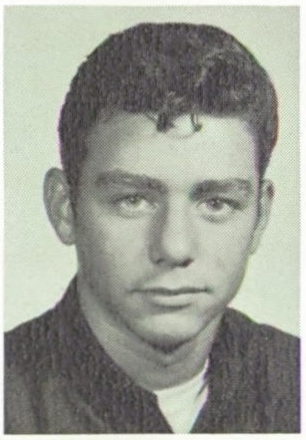
John Vincent Tomassi in 1963
My father died this year. His name was John Vincent Tomassi and he was 76.
In 2027, he would have been turning 80, I would be 60 and if we would have followed through with our plan, we would be walking in the Italian towns from whence our ancestors hailed 300 years after our piece of the Tomassi family is recorded to have lived there.
But together, we didn’t do any of the things we talked about when we started researching our Italian heritage five years ago. Time, health, distance, and reality overshadowed and eventually overcame our initial excitement.
I wrote about this goal for the Ancestors Portal in March 2021: 300 years a Tomassi. Truth be told, I think I was more excited about it than he was. I was captivated by the old Italian script and fell in love with the romantic stories of ancestors conjured in my head.
I personally had delusions of us returning to Italy, as Italian citizens, to our ancestry roots, walking the streets, meeting the people, and speaking Italian.
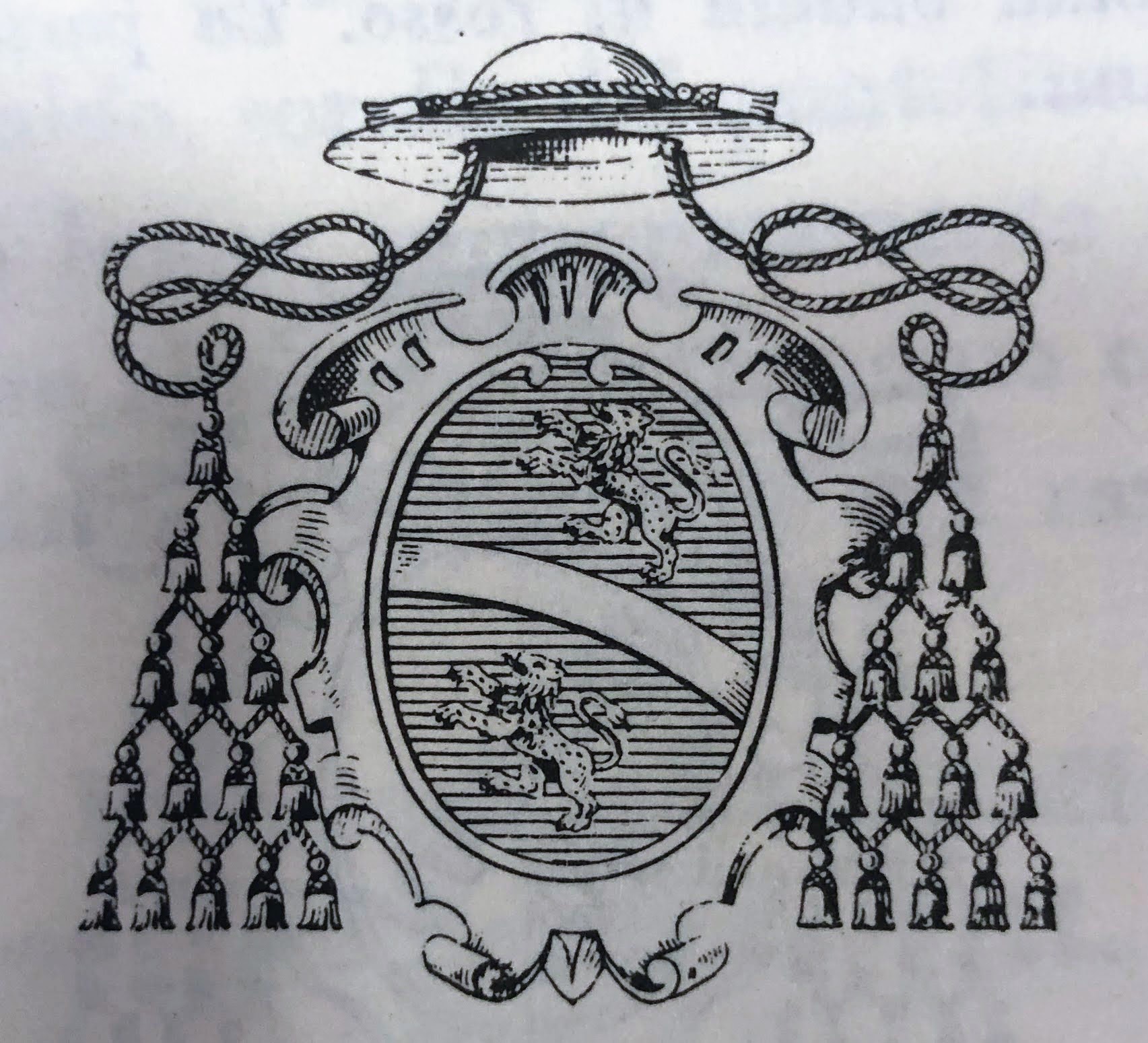
The Tomassi Family Crest as represented in the book “Storie di Guarcino”
Unfortunately I’m no closer to speaking Italian, but in October 2022, my brother and I ventured on a trip through our ancestry towns that allowed us to experience a small part of our family history.
The journey we took connected us physically, mentally and emotionally to our roots. Just before we departed on our quest, I connected with a direct cousin of my father’s. At 82 years old, she is an incredible wealth of knowledge, an inspiration, and an all around beautiful person. Although she and my father weren’t able to reconnect before he died, we continue to speak often and I cherish the moments and memories she provides to fill in small holes of our family lore.
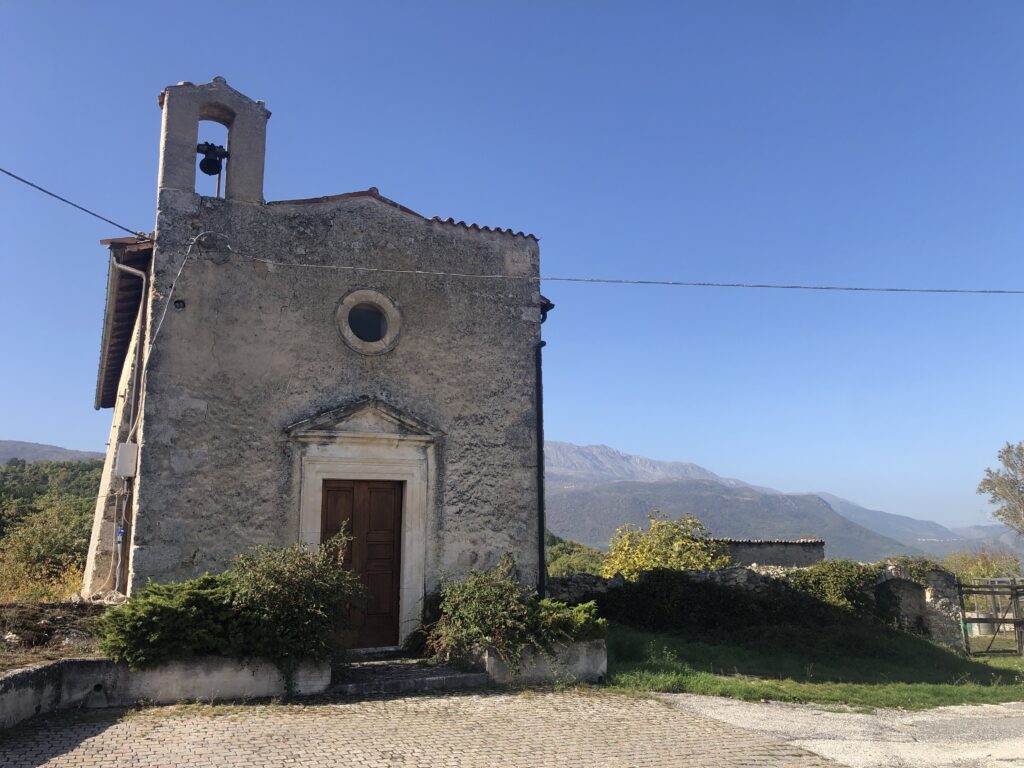
The church in Fagnano Alto (AQ)
She introduced me to another Tomassi, in Rome, who, when I met him at the end of our 2-week trip, relayed to me his philosophy that all Tomassi’s are “cousins.” I continue to use that term often. He even showed me a book from 1971, entitled “The History of Guarcino,” with one page highlighting the Tomassi Family.
It illustrated the family crest, highlighted our ancestor, Cardinale Giacomo Tomassi, who died in 1304, and had a palace named after him, and reflected the names of many Tomassi nuns who wore the monastic habit in the 16th and 18th centuries at the monastery San Luca, in Guarcino. I’ve contacted the monastery with hope of more information, but continue to await their response.
As well, the page states the Tomassi name is “extinct,” which of course I know not to be true; I’m proof of that. But also through my research with the Ancestors Portal, my 6th great grandfather was born in Fagnano Alto, L’Aquila, Abruzzo in 1727.
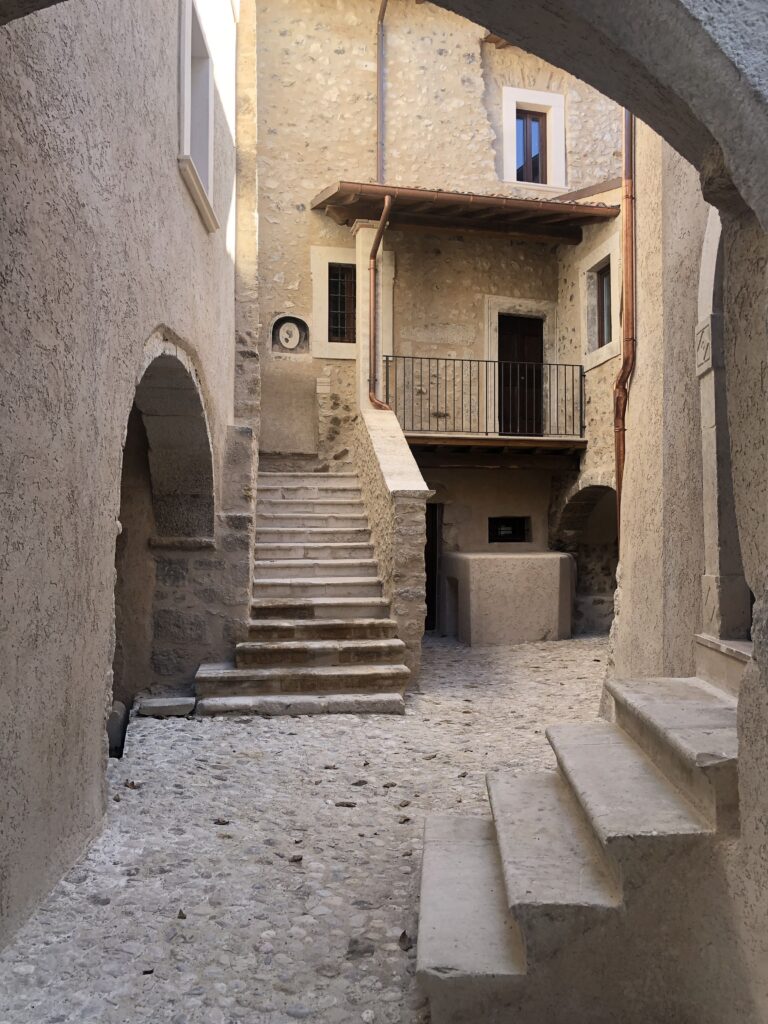
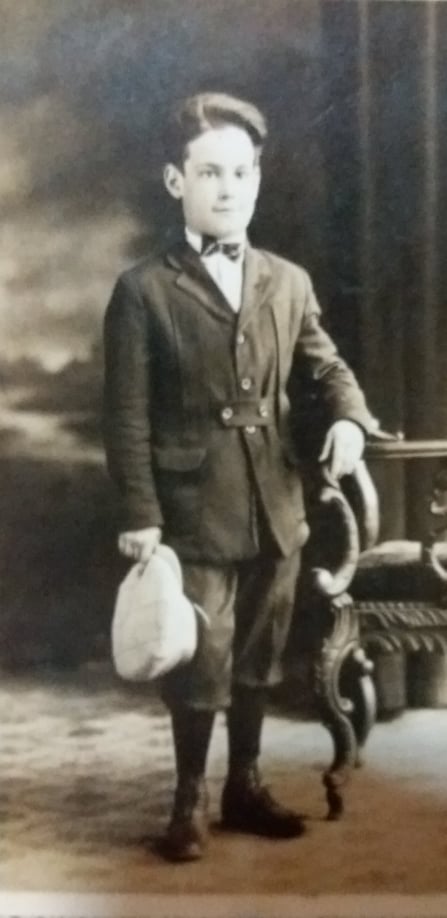
The oddly abandoned yet fully renovated buildings and streets in Fagnano Alto(AQ)Alberto Pisterzi in 1923
Before meeting our cousin in Rome, my brother and I arrived in Italy two weeks earlier in Amaseno, Frosinone, Lazio. It was there we met with our cousin from the Pisterzi side of the family.
My father’s uncle was Alberto Pisterzi and was a direct relation to the Pisterzi’s in Amaseno. Another part of our quest in Amaseno was to obtain a certified copy of my great grandfather’s birth certificate. With a bit of waiting and a short lesson in why we should speak Italian, we accomplished our first mission.
In Amaseno, we were also able to meet and thank Don Italo Cardarilli, whom I credit with setting me on the path to find our family roots.
Just before entering Abruzzo, we made a short stop in Guarcino to visit the birthplace and palace of Cardinale Giacomo Tomassi. We secretly expected some sort of fanfare as we drove into the small, quiet village, but nothing of the sort happened. Instead we enjoyed the beautiful sights, walked the small paths and stood in the archway named after our most famous ancestor – Cardinale Giacomo Tomassi.
We moved on to Bugnara seeking to fulfill our next mission of retrieving a certified copy of our great grandmother, Anna Incorvati. While there, we stayed in the beautiful town of Sulmona. It was there we met with another cousin from the Incorvati side of the family. She was a wonderful host and showed us the historic city with its amazing intact Roman aqueduct and world famous confetti candies.
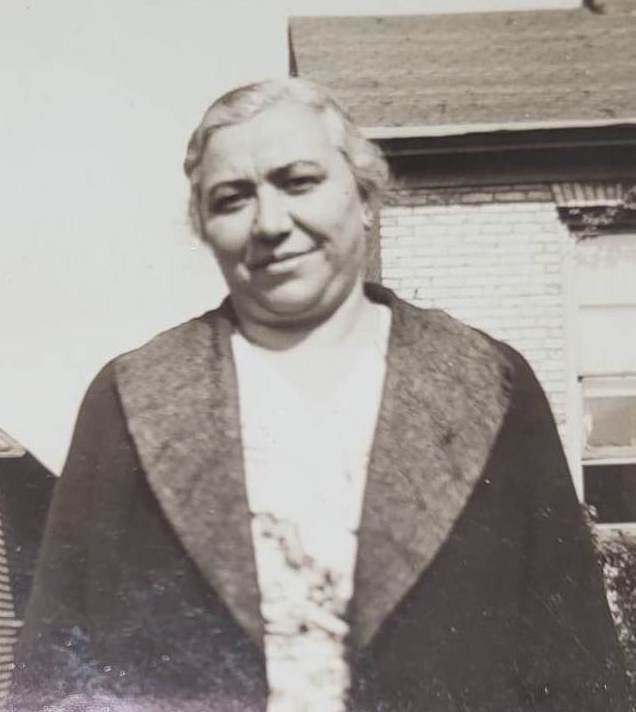
Anna Incorvati in 1931
Also while staying in Sulmona, we ventured to the small town of Cerchio to retrieve a certified copy of the birth certification of our other great grandmother, Adalgisa Mastrantonio. The comune worker in Cerchio was one of a kind. He not only found the original birth certificate (and offered to assist further), he let me come behind the counter to actually touch the 122-year old document. I stood in awe at the large page and wondered why it wasn’t locked away somewhere, but thankful it wasn’t so I could personally witness it.
My great grandmother Ada was the only great grandparent on my father’s side that I actually had the honor of knowing as a child and touching her birth certificate brought back faint memories of her.
To end our amazing trip, we finally entered the small town of Fagnano Alto, L’Aquila, Abruzzo; the place that started my ancestral journey and sparked my interest to find the roots of the Tomassi family.
Oddly we found the town totally abandoned. However about 80 percent of the buildings were fully renovated as if they have been built yesterday. In the town and municipality we found Castello di Fagnano, a stone bridge from the 1st century and the church where five Tomassi generations were baptized.
As I walked the empty streets I wondered which of the buildings my ancestors lived and worked in. I also wondered why it was so renovated and why nobody was living there. I asked at the municipality, but our language disparity was too great for any real understanding. But the feeling of standing in my ancestral town was breathtaking.
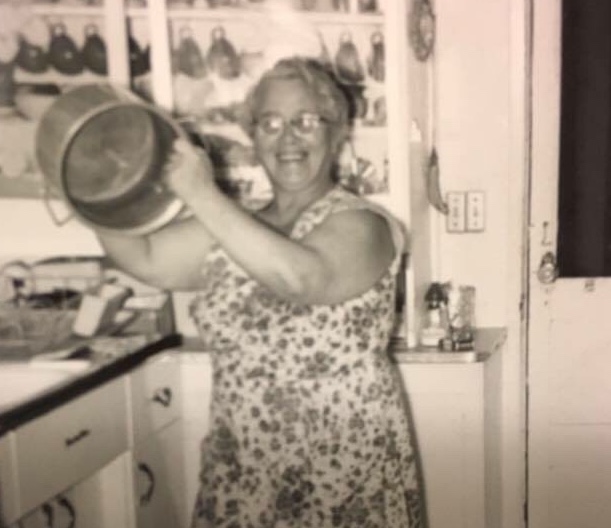
Adalgisa Mastrantonio in the 1960s
I know my father would have loved the trip, but at the time his poor health didn’t allow him to take the adventure.
Of course we visited many other sights during the entire 2-week trip and my brother and I spoke with our father daily to update him on our progress. We also spoke with cousins, aunts and uncles who became acutely interested in our quest to discover family roots, and we connected with family members in Italy of whom we would have never had the opportunity to meet without this trip.
I don’t know if my original goal of attaining Italian citizenship will ever come to fruition, but I am thankful I found the Ancestors Portal that allowed us the opportunity to peek into our past and mine gems of information that sat undiscovered for many, many years.
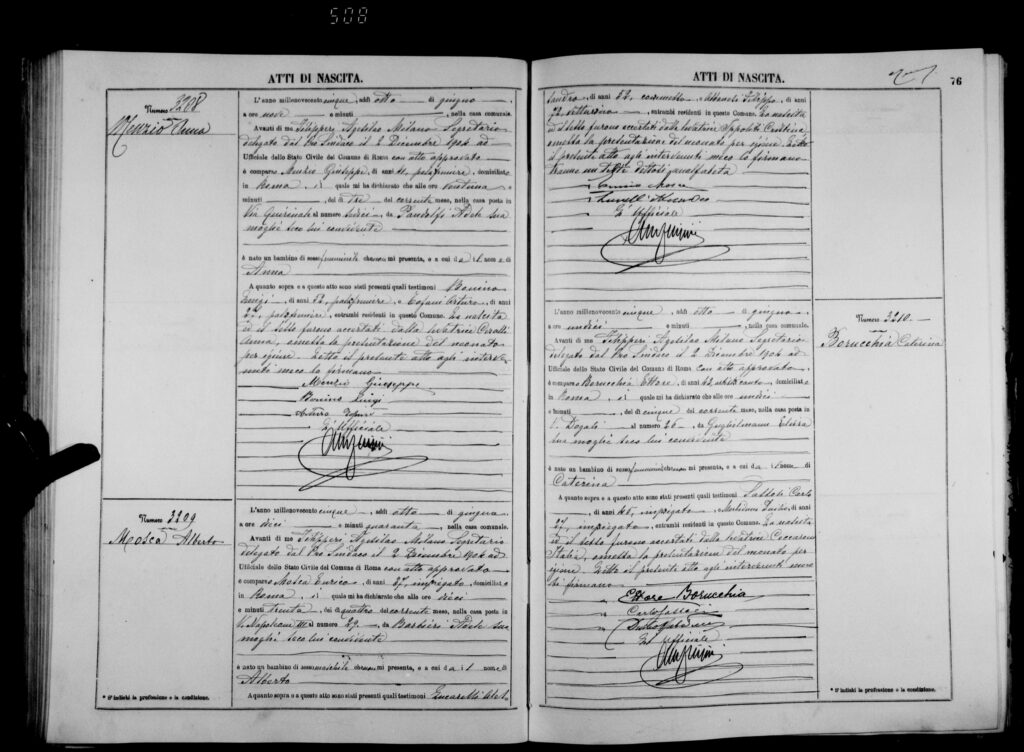
Wanda Osiris – born Anna Menzio – was born in Rome on June 3rd, 1905, to Giuseppe, groom to the king, and Adele Pandolfi.
Her early interest in show business led to her debut in 1923 as a soubrette at the Eden Cinematheater in Milan, where she began her climb to success. She soon became an iconic figure, with her artificially ochre skin, marked makeup, bleached hair, feathers, sequins, heels and rivers of Arpège perfume, always clad in glitz and sensuality.
Her first real triumph was in the early 1930s, at the Excelsior in Milan, alongside Totò in Il piccolo café. With the advent of notoriety, her nicknames were also coined, the Wandissima and the Divina, which only Fascism would attempt to curb by italianizing her stage name into “Vanda Osiri.”
She worked alongside such great figures of the time as Carlo Dapporto, Macario, Nino Taranto, Walter Chiari, Renato Rascel and many others. But above all, her revues became famous for the eccentric sets and huge staircases she descended with grace and ease, always surrounded by a large corps de ballet that she chose herself.
Among his major successes are: Tutte donne (1939), Che succede a Copacabana? (1943), Grand Hotel (1948), Made in Italy (1953) and Festival (1954), which were joined by songs of great resonance, such as Sentimental (1949) and Ti parlerò d’amor (1944).
However, the advent of television slowly contributed to the fading of Wanda’s myth, also aided by the diffusion of a new prototype of beauty and variety making. Yet, even today Wanda Osiris embodies the emblem of the Italian soubrette of the first half of the twentieth century and for this reason recognized by the general public as the first true national diva.
She died in Milan in 1994, at the age of 89.
You can consult the birth certificate on the Ancestors Portal: Archivio di Stato di Roma > Stato civile italiano > Roma > 1905