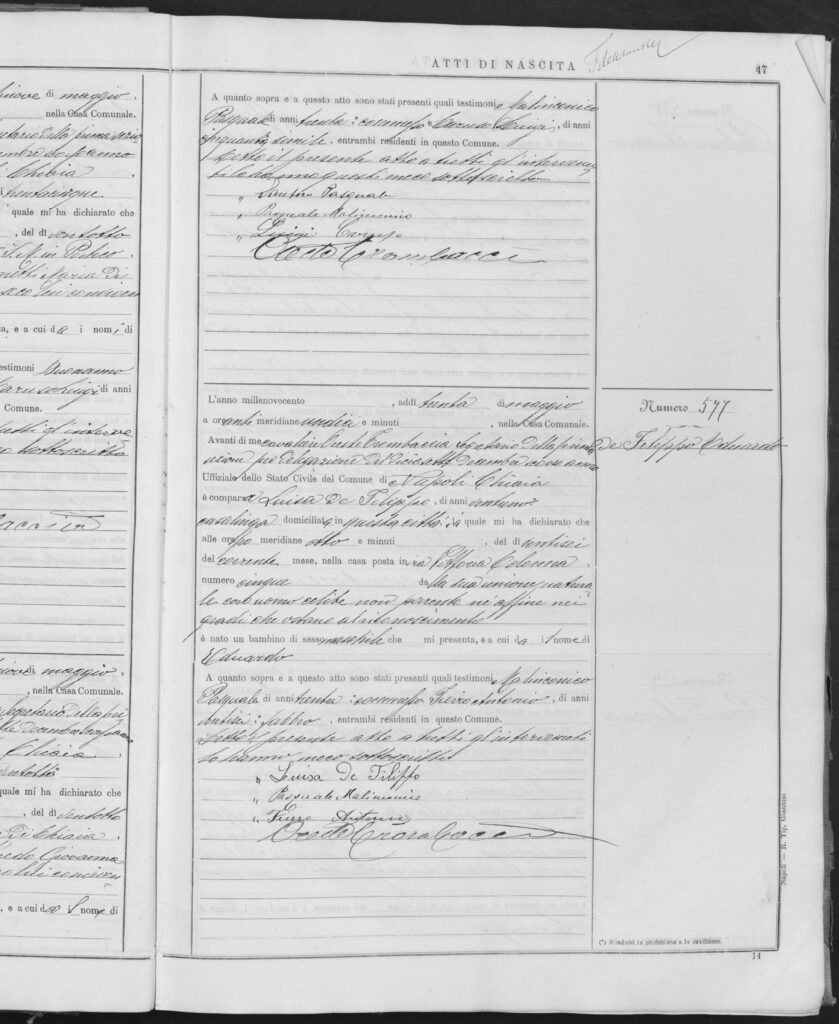
Eduardo De Filippo was born in Naples, at 5 Via Vittoria Colonna, on May 26th 1900.
The illegitimate son of Luisa De Filippo and the well-known actor Eduardo Scarpetta, he was not recognized at birth.
The union of the two also gave birth to Titina and Peppino, and all three were introduced from an early age to Neapolitan stages, participating as extras or in minor roles in the company of their half-brother Vincenzo Scarpetta.
To this company, mainly engaged in the staging of his father’s comedies or in reinterpretations of tradition, Eduardo remained linked until the early 1920s, signing his first plays such as, for example, Ho fatto il guaio, riparerò…, which would later become famous under the title of Uomo e galantuomo, one of his most successful works.
Rigorous and strict, but endowed with comic sagacity and original inventiveness, De Filippo struggled not a little to obtain an independent space in Neapolitan theaters. With his siblings Titina and Peppino he founded his own company, through which he staged several of his plays, sometimes under pseudonyms and with alternating success. Until, on December 25, 1931, he debuted with Natale in casa Cupiello, marking the successful start of the “Humorous Theater Company I De Filippo.”
The following years were characterized by an intense and fruitful activity-between his own works and adaptations-that gradually led De Filippo to approach the world of cinema as a director and actor as well. Among his many works, in 1950, he directed and starred alongside Totò in Napoli milionaria! and collaborated with Vittorio De Sica, writing some screenplays for him, including L’oro di Napoli (1954) and supervising the adaptation of Matrimonio all’italiana (1964), a remake of Filumena Marturano.
In 1948, he dipped into all his savings and bought the half-destroyed San Ferdinando theater, which, opened in 1954, was the place where Neapolitan dialect was elevated to the status of an artistic language, thus contributing to the recognition of “dialect theater” as “art theater.” This was, perhaps more than any other, the stage of excellence where Eduardo staged his vision of society, creating a portrait of the Neapolitan petty bourgeoisie, always central to his works.
His writing and staging have profoundly influenced modern theater, dramaturgy and comedy, actualizing the legacy of Punchinello’s theater-thanks in part to his acting finesse-and taking it all over the world.
After receiving two honoris causa degrees from Birmingham (1977) and Rome (1980), he was appointed senator for life by President Sandro Pertini in September 1981.
Eduardo De Filippo died in Rome on October 31th, 1984.
You can consult the birth certificate on the Ancestors Portal: Archivio di Stato di Napoli, Stato civile italiano (quartieri di Napoli), Chiaia, Registro 33, suppl. 2
For more on the figure of Eduardo De Filippo, see the entry of the Biographical Dictionary of Italians edited by Stefano De Matteis.
Archivio di Stato di Napoli, Stato civile italiano (quartieri di Napoli), Chiaia, Registro 33, suppl. 2
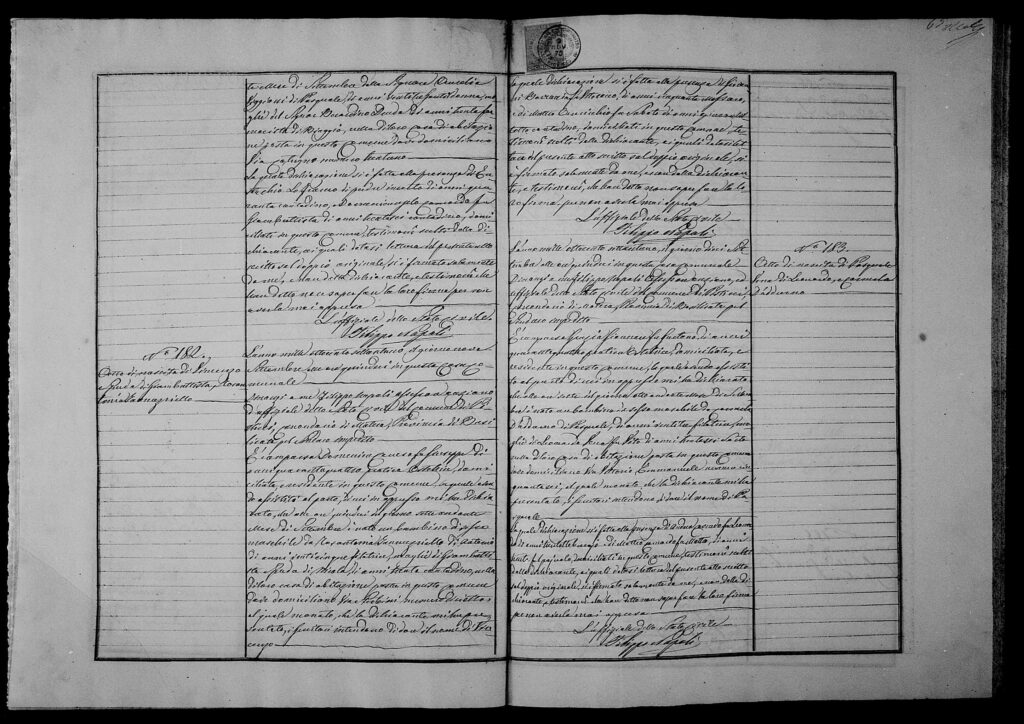
Pasquale Vena was born on 8th September 1871, in Pisticci (MT).
He left while still very young along with his brothers to embark for America. However, he stopped in Naples, where at the “Scaturchio” pastry shop he learned the first rudiments of the confectionery art.
When he returned to his native town, he opened Caffè Vena, in whose backroom in 1894 he began working on various herbal blends in search of the perfect liqueur. Thus was born Amaro Lucano, which was immediately so successful that it reached as far as the House of Savoy, for which Vena became a regular supplier.
The company grew, increasing the production quantity and becoming a full-fledged business.
Pasquale Vena died in Pisticci in 1937.
After his death, despite the forced interruption due to World War II, the legacy was collected by his sons, who fostered the flourishing of the family business, which in 1965 reached over 110 thousand liters of bitters sold.
You can consult the birth certificate on the Ancestors Portal: Archivio di Stato di Matera > Stato civile italiano > Pisticci > 1871
Archivio di Stato di Matera > Stato civile italiano > Pisticci > 1871
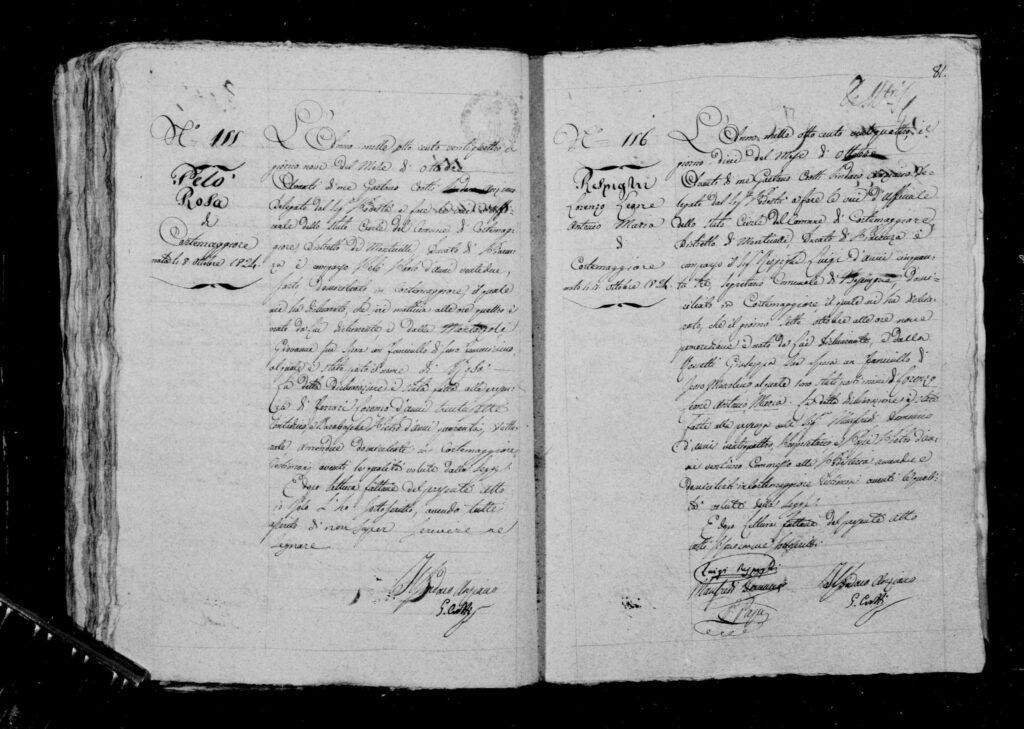
Lorenzo Leone Antonio Maria Respighi was born in Cortemaggiore (PC) on 7th October 1824.
Being orphaned of both parents at an early age, he was placed in the care first of his brother and then of a great uncle.
After completing his high school studies, he enrolled in the Faculty of Mathematics and Physics in Bologna, where he received an honorary degree in 1847 and where, in 1851, he was appointed professor of Optics and Astronomy. A few years later he was entrusted with the direction of the city’s astronomical observatory.
In 1864, Respighi, a practicing Catholic, refused to take the oath of allegiance to the Savoy government, probably for reasons of conscience and loyalty to the pope, thus being dismissed from all official positions.
However, the following year Pontiff Pius IX appointed him holder of the chair of Optics and Astronomy at “La Sapienza” college in Rome and, later, director of the Capitoline Observatory.
During his long career, he was involved in numerous researches in various fields of astronomy, including the solar chromosphere and the relationships between spots and protuberances, daily measurements of the sun’s diameter, the sunspot spectrum, the analysis of various cometary phenomena, the latitude of the Capitol and Monte Mario, the longitude of Rome and Milan, and compiled a valuable catalog of more than 2534 stars.
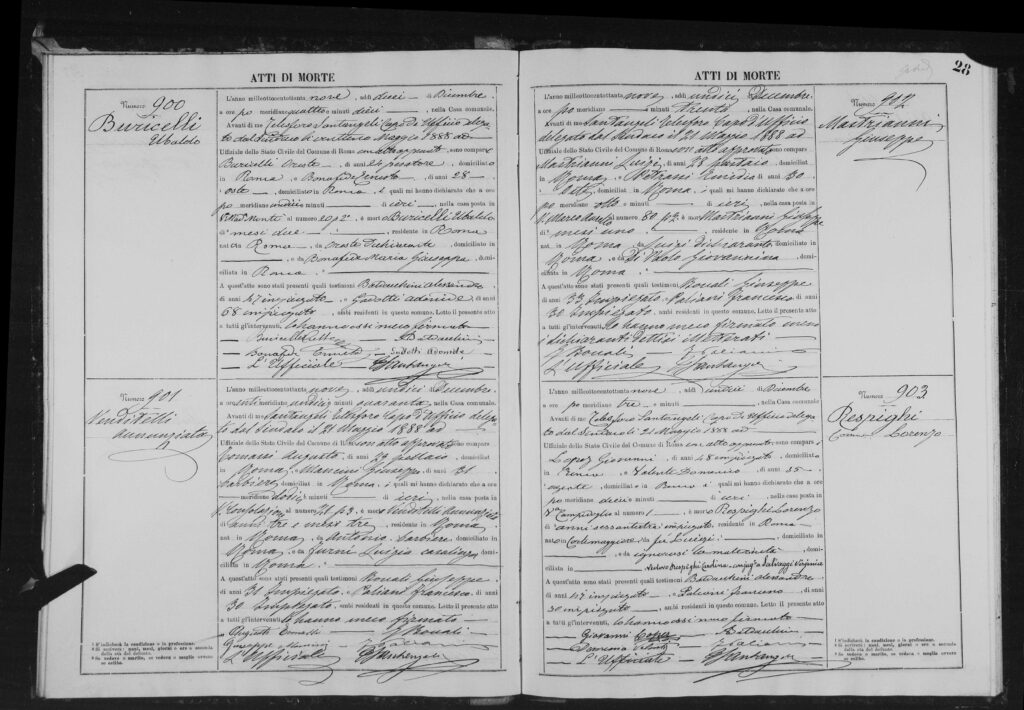
Lorenzo Respighi died in Rome on December 10, 1889.
You can consult birth and death records on the Ancestors Portal, respectively: Archivio di Stato di Piacenza, Stato civile della Restaurazione, Cortemaggiore, 1824 and Archivio di Stato di Roma, Stato civile italiano, Roma, 1889
Archivio di Stato di Piacenza, Stato civile della Restaurazione, Cortemaggiore, 1824Archivio di Stato di Roma, Stato civile italiano, Roma, 1889
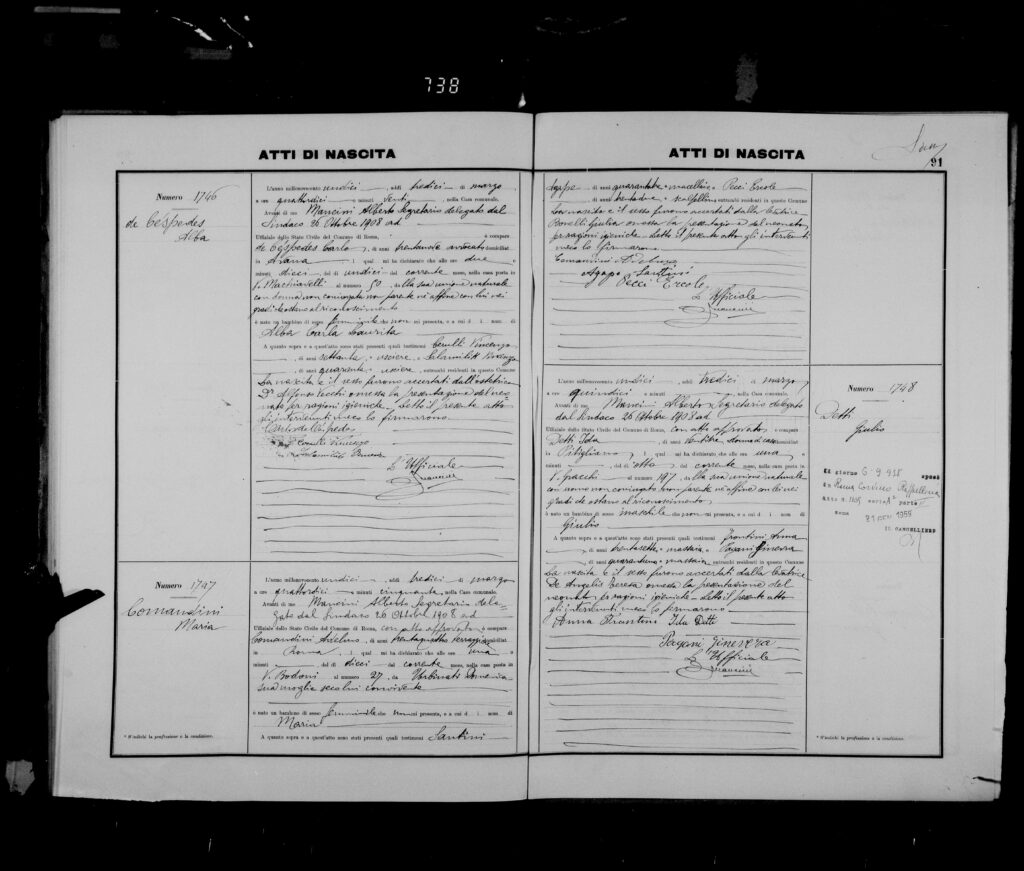
Alba Carla Laurita de Céspedes was born in Rome on 11th March 1911, to Laura Bertini Alessandrini of Rome and Carlos Manuel de Céspedes y Quesada, ambassador for Cuba in Italy. Her grandfather was Carlos Manuel de Céspedes, a revolutionary who from 1869 to 1873 was president of the Cuban Republic and a proponent of the abolition of slavery.
When she was only 15 years old, in 1926, Alba married Roman Count Giuseppe Antamoro, only to separate from him in 1931.
The affluent and cultured environment in which she grew up fostered an education of excellence, nurturing her vocation for writing and interest in politics, with an anti-fascist orientation.
Although he was perfectly bilingual in Italian and Spanish, and knew several other European languages, he chose Italian as his predominant language for his literary production. He made his debut in 1935 with the publication of his first collection of poems, L’anima degli altri, fostered in part by his strong friendship with Arnoldo Mondadori. In 1938, however, she published her first novel, Nessuno torna indietro, with which she won the Viareggio Prize the following year, which, however, was revoked at Mussolini’s behest because of her anti-fascist militancy, which had also cost her several days in jail.
His writings were animated by careful stylistic care, striving for quality literature in which form was always accompanied by depth of content and deep reflection on ethical and social issues.
During World War II, he was an active part of the partisan resistance, operating under the battle name “Clorinda.”
Beginning in 1944, he founded and edited the journal Mercurio, which became an important point of reference for Italian intellectuality during the postwar years, thanks in part to the collaboration of distinguished pens. The magazine closed four years later, in 1948. From then on, de Céspedes began to collaborate with various newspapers, such as Epoca and La Stampa di Torino.
In the following years, between Rome, Cuba and Paris, she devoted herself intensively to writing, publishing numerous novels, often rich in autobiographical elements: sentimental dissatisfaction, female education and the struggle for personal and collective identification. Among her many titles are: Dalla parte di lei (1949), Quaderno proibito (1952), Prima e dopo (1955) and Il rimorso (1962).
His last work, which remained unfinished, is an autobiographical account written between the 1980s and 1990s, dedicated to Fidel Castro and the Cuban Revolution, published posthumously in 2011 by Mondadori to mark the centenary of his birth.
Alba de Céspedes died in Paris on 14th November 1997 after a long illness.
You can look up the birth certificate on the Ancestors Portal: Archivio di Stato di Roma, Stato civile italiano, Roma, 1911
His personal archive (1876-1997), which consists of 136 envelopes, about 2100 photographs and 4122 books and pamphlets, is kept at the Fondazione Arnoldo e Alberto Mondadori.
Archivio di Stato di Roma, Stato civile italiano, Roma, 1911
Gino Coppedè was born in Florence on 26th September 1866, to Mariano, a carver by trade, and Antonietta Bizzarri.
After the Professional School of Industrial Decorative Arts, where he was able to hone his skills in woodworking, he enrolled in the Academy of Fine Arts, graduating in architectural drawing in 1896.
His first major commission was the design and construction of the MacKenzie Castle in Genoa, which he worked on from 1897 to 1906.
The building, inspired by Florentine architecture, included a mixture of exuberant elements, somewhat unusual for the architectural style of the Ligurian city, but which won him the favor of the wealthy local bourgeoisie.
The so-called “Coppedè style” was based, in fact, on the amplification of architectural elements from different periods, reworked in an original but harmonious way.
A novelty in the building scene that, nevertheless, managed to win the appreciation of critics and the public, launching the architect to a brilliant career, which made him famous far beyond national borders.
Numerous, in fact, were the projects that bore his signature in a variety of Italian cities: many in Genoa, but also in Naples, Rome, as well as in numerous cities in central and southern Italy, such as Messina, where he contributed to post-earthquake reconstruction.
After World War I, Coppedè’s activity continued vigorously, thanks in part to the numerous awards and academic appointments he received.
It was only following the death of his wife Beatrice, daughter of sculptor Pasquale Romanelli, whom he had married in 1889, that he decided to move to Rome to devote himself to the completion of the famous Dora residential neighborhood, now better known as the “Coppedè district.”
The Cerruti firm-with which he had a strong professional bond-had commissioned him to build a stately neighborhood intended to satisfy the sophistication desired by the upper middle-class Romans of the 1920s.
Here his style reached the height of eclecticism, with a fusion of architectural languages that, though seemingly irreconcilable, found an astonishing balance.
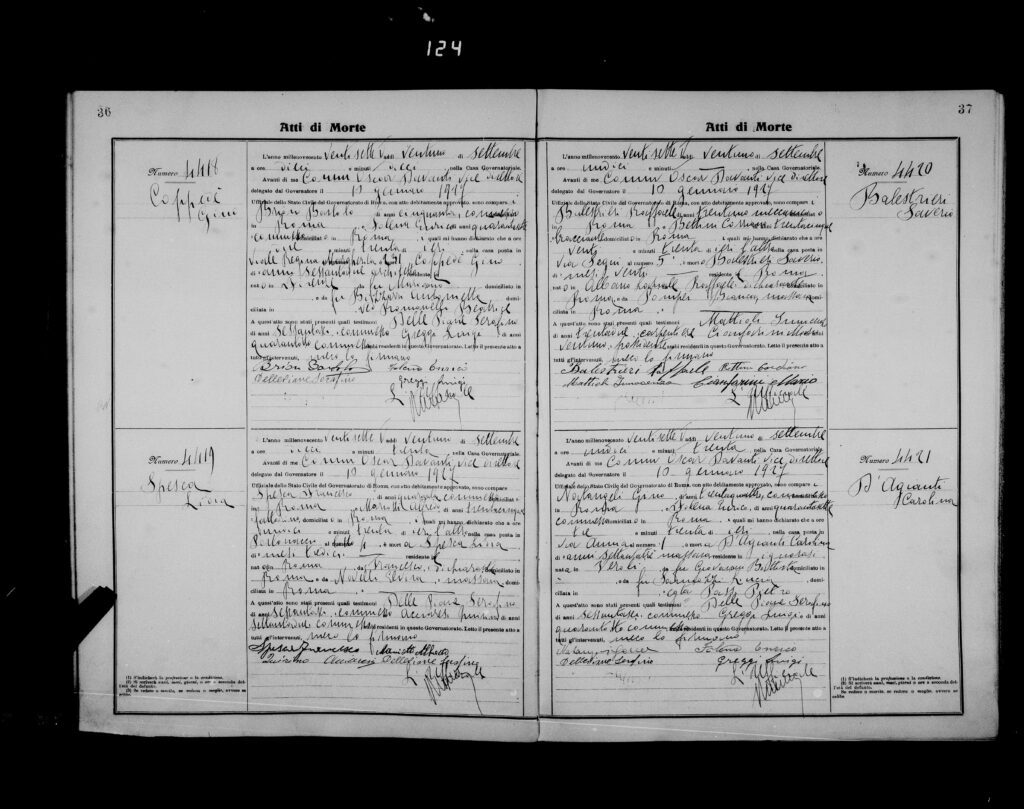
Gino Coppedè died in Rome on 20th September 1927.
You can consult thedeathcertificate on the Ancestors Portal: Archivio di Stato di Roma, Stato civile italiano, Roma, 1927
Archivio di Stato di Roma, Stato civile italiano, Roma, 1927
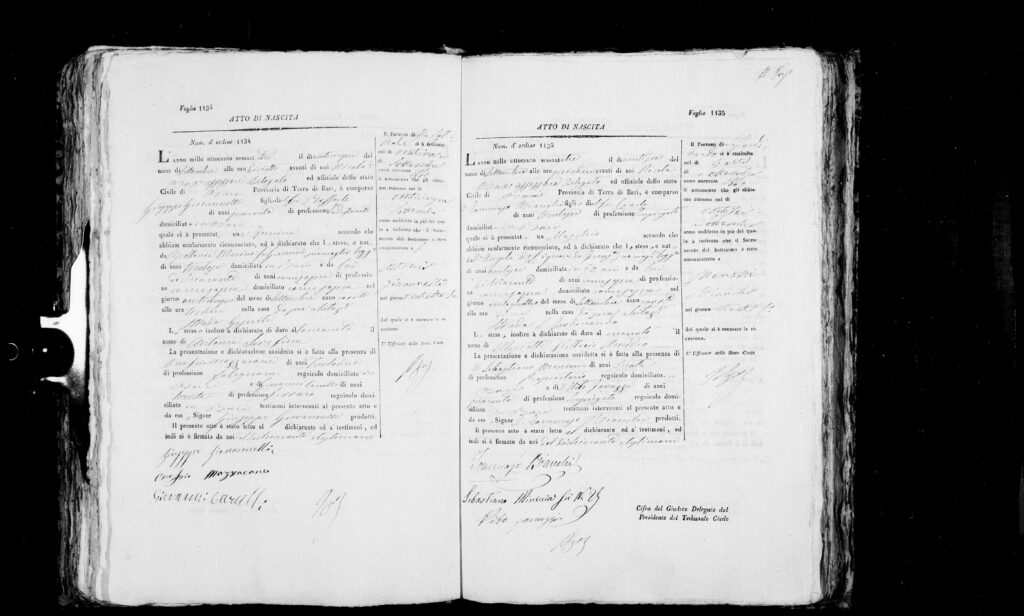
Menotti Vittorio Amedeo Bianchi, aka Friar Menotti, was born in Bari on 24th September 1863, to Tommaso and Angela de’ Liguori.
It is believed that it was his father who taught him the art of drawing, which he practiced by making caricatures and satirical drawings that drew inspiration from the events, characters, rumors and gossip of his city. He published his first illustrations in Bari’s humorous weekly Fra Melitone, where – starting in 1888 – he adopted the pseudonym “Frate Menotti,” with a strongly anticlerical flavor. Next he collaborated with Il Figaro(1900-1902) and from 1902 joined the editorial staff of Don Ferrante until 1907. Of particular note was also his collaboration with the Bari daily L’Oggi.
Meanwhile, as early as 1885 he had found employment with the Bitontina Bank, where he worked until 1892, when he was hired by the Bari Chamber of Commerce.
He continued his activity as a draftsman in parallel, especially in his downtime, often spent in the central cafes of Bari, favorite places where he loved to sit to portray his fellow citizens in biting caricatures and biting depictions, which not infrequently turned out to be harsh criticisms of the society of his time.
Other brief collaborations included those with the Piccolo giornale d’Italia and the Gazzetta di Puglia, from which he was soon ousted, unable to conceal his contempt for the fascist conformism that was beginning to spread even among the Bari bourgeoisie.
In the last years of his life, he thinned out his publications; however, shortly before his death, he expressed his wish that his illustrations would not be lost and that his memory would be preserved through those very drawings.
His request was granted by a group of friends, which included the publisher Giovanni Laterza, the archaeologist Michele Gervasio, the deputy director of the then Consorziale Library, Francesco Colavecchio, and his friend and poet Armando Perotti. The latter, after acquiring most of his works, created the Menotti Bianchi fund, a collection including more than 800 watercolor plates and drawings, and made a gift of it to the “Sagarriga Visconti Volpe” National Library in Bari, where it is still preserved today, along with about 350 books that belonged to him.
Frate Menotti died in Bari on 11th September 1924.
You can look up the birth certificate on the Ancestors Portal: Archivio di Stato di Bari, Stato civile italiano, Bari, 1863
Archivio di Stato di Bari, Stato civile italiano, Bari, 1863
Una vecchia cappelliera marrone, di quelle antiche, di cartone… da piccola era sempre un piacere aprirla e sfogliare le vecchie foto di mia nonna, che, a quei tempi, mi raccontava di persona “i fatterelli” legati a quelle immagini.
Ora sono pensionata e con piacere le ho riscoperte, cercando di dare un nome, delle date, un luogo… e così si sono rianimate. Con pazienza ho ricostruito le nascite, i matrimoni, le morti… si è aperto un mondo fino ad allora sconosciuto.
Scetáteve, guagliune ‘e malavita
Ca è ‘ntussecosa assaje sta serenata
Io sóngo ‘o ‘nnammurato ‘e Margarita
Ch’è ‘a femmena cchiù bella da ‘Nfrascata
(Libero Bovio, Guapparia)
Orsola Bruno forse non sarà stata “a’femmena cchiù bella da ‘Nfrascata”, ma certamente lo era agli occhi di Antonio De Cesare, che la scelse per sé, e visse a lungo con lei e i loro otto figli in questa strada, intorno al 1806.
I due erano nati all’incirca nel 1780.
In origine, la strada dell’Infrascata era un’ombrosa e impervia salita, fra alberi e arbusti, con un gran traffico di carretti e contadini che portavano derrate alimentari alle case signorili. Nel quartiere Avvocata, questa strada congiungeva il popolare centro storico con il nuovo quartiere del Vomero, dove la nobiltà̀ si era fatta costruire ville e palazzi. Dal 1869, i napoletani identificarono “l’Infrascata” con via Salvator Rosa.
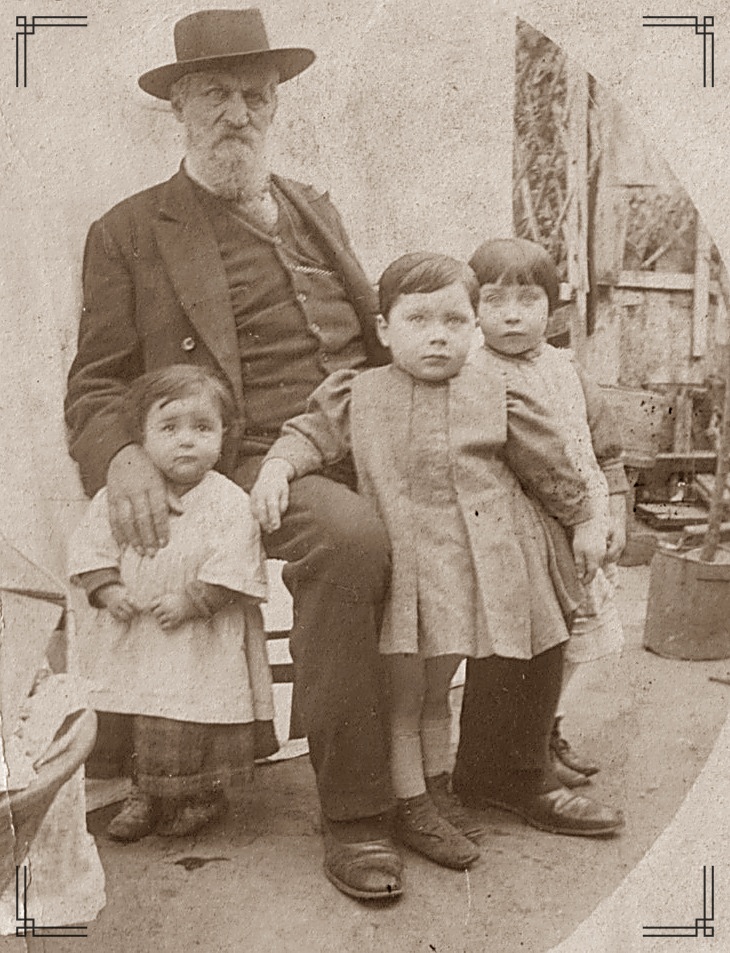
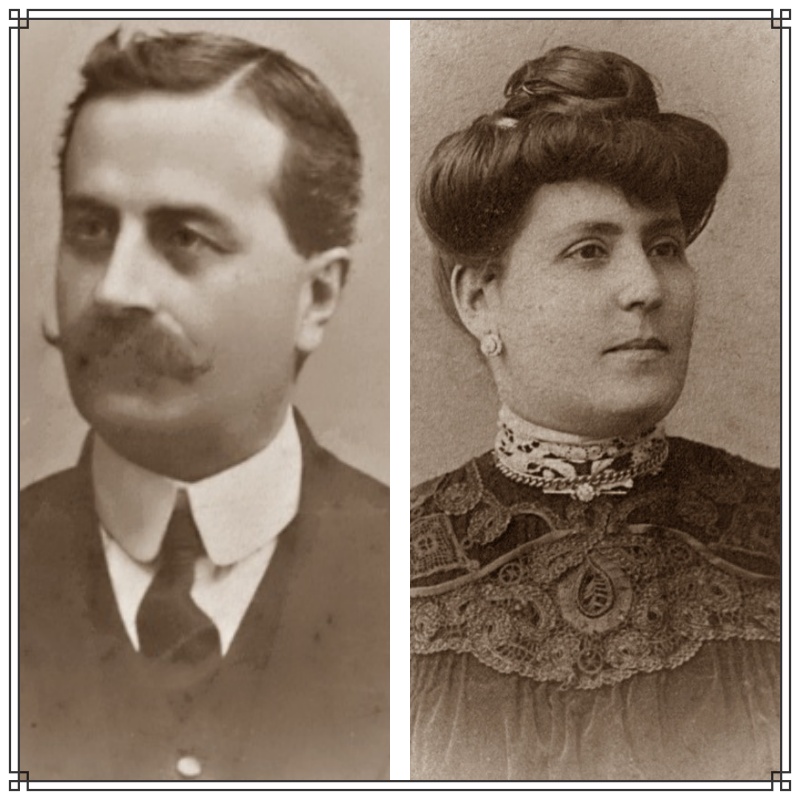
Il trisavolo Giovanbattista Terzini e con la nonna Ester – la piccola a sinistra – nel 1893
Al tempo di Antonio, probabilmente la strada aveva già̀ perso il suo aspetto “bucolico” e si era ormai riempita di alti palazzi, botteghe, commercianti, bancarelle, con vivace e allegro vociare… Antonio aveva una bottega di calzolaio, dove lavorava insieme ai figli, Vincenzo, Giuseppe e Raffaele. Mentre per le figlie femmine – Irene, Francesca e Maria – aveva avuto progetti diversi: Irene fu la prima a convolare a nozze; l’8 novembre del 1828 sposò un suo coetaneo, Giuseppe Ravallese, un giovane tipografo (“compositore di caratteri”), benestante, da cui ebbe cinque figli.
Mentre nel 1838, Francesca sposò Costanzo Mellino, gioielliere, figlio di una Gusumpaur, antica famiglia di orafi e mercanti in pietre preziose. Lo sposo aveva 40 anni e la sposa 26, e andarono ad abitare a Largo Materdei, casa dei Mellino.
Tuttavia, la famiglia De Cesare poté gioire per poco, poiché qualche anno più tardi, nel 1844, morì Giuseppe Ravallese, lasciando la moglie Irene De Cesare, incinta, con quattro figli piccoli. Due di questi, Nunzia e Carolina, moriranno poco dopo.
Nel 1851, infine, si sposò Maria, a 33 anni, con un calzolaio, Gennaro Saggiomo. Anche loro, purtroppo, persero presto uno dei loro gemelli, Vincenzo.
Degli altri figli di Antonio De Cesare, Giuseppe si sposò nel 1855, ormai quarantottenne, con Luigia Ambrosio, che però morì quattro anni dopo. Si risposò, così, a 53 anni con la vedova Angela Martone, che abitava nel Fondaco Santa Monica, al Cavone, una zona sovraffollata già a quei tempi, oggi corrispondente a via Francesco Saverio Correra – dove, al civico 22, nel 1861 era nato il generale Armando Diaz.
Nel 1853, a 32 anni, il mio avo Raffaele De Cesare sposò Carmela Santangelo, di diversi anni più giovane, che gli darà sette figli. Di questi, Luigi ed Anna moriranno rispettivamente nel 1861 e 1863. Ma l’evento più drammatico accadde nel 1864, quando la giovane moglie Carmela morì a 34 anni, dopo aver vagato da un ospedale all’altro, lasciando il marito con sei figli piccoli: Antonio, Gennaro, Luigi, Anna, Mariano e Concetta.
I bisnonni Giuseppe De Cesare e Carolina Terzini nel 1890
A quel punto, Raffaele decise di lasciare l’attività del padre per seguire quella di orafo del cognato Mellino, marito della sorella Francesca, che fortunatamente si rivelò redditizia. La bottega venne aperta prima nel Borgo Orefici, ma dopo il Risanamento fu trasferita in una traversa di via Toledo.
Nella strada dell’Infrascata c’era una bottega di barbiere, appartenente alla famiglia De Pascale. Fu gestita prima dal vecchio Vincenzo, poi ereditata dai figli Ferdinando e Raffaele, che arrotondavano facendo i “salassatori”.
Ferdinando De Pascale e Michela, vicini di casa e di bottega di Antonio, avevano sei figli. Tre maschi (Vincenzo, Francesco e Pasquale) e tre femmine (Teresa, Maria e Giuseppa).
Dopo pochi mesi dalla nascita dell’ultima rampolla Giuseppa, Ferdinando morì (a causa dell’epidemia di colera del 1854) a soli 43 anni, lasciando la vedova Michela a doversi occupare della numerosa prole. Così entrò in gioco la famiglia De Cesare…
Napule è mille paure,
Napule è a voce de’ criature ,
che saglie chianu chianu,e tu sai ca’ non si sulo…
(Pino Daniele, Naplule è)
Il nostro incisore-argentiere Raffaele De Cesare, anch’egli rimasto vedovo con cinque figli, sposò l’orfana Teresa De Pascale, che si fece carico dei suoi piccoli, dando allo sposo altri cinque pargoli: Giuseppe, Giovanni, Francesco, Assunta ed Eduardo.
La vedova De Pascale riuscirà̀ anche a portare all’altare altre due figlie: Giuseppa e Maria.
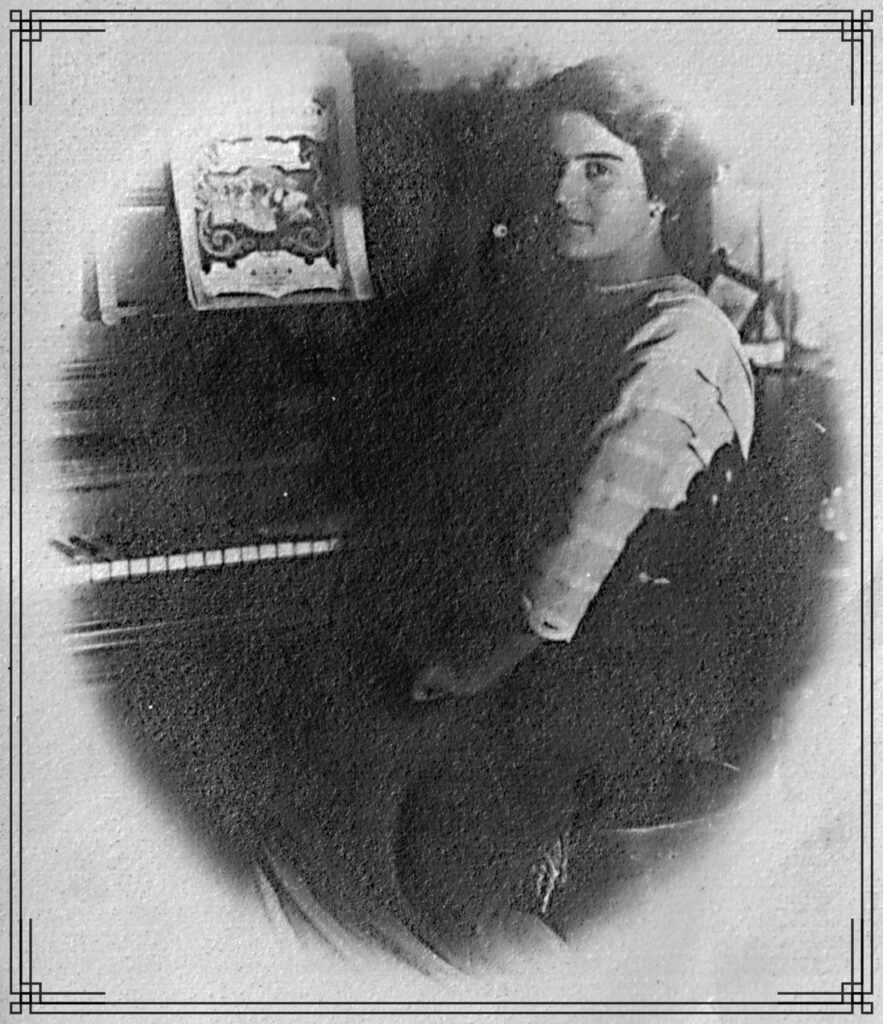
Nonna Ester e il suo pianoforte nel 1912
Nel 1877, la prima sposò Gennaro De Cesare, figlio di primo letto di Raffaele. Gennaro faceva il barbiere, ma preferì imbarcarsi da Napoli sulla Tartar Prince il 1° febbraio 1899 con l’amata Giuseppa De Pascale ed i suoi sette figli per cercare fortuna a New York. Maria invece sposò il vedovo Gianbattista Terzini, calzolaio a Borgo Orefici.
Gli altri fratelli, Giuseppe, Giovanni, Francesco, Assunta ed Eduardo prenderanno altre strade: Giovanni partirà per il Belgio, dove, oltre a svolgere la sua attività di “orafo incisore”, sposerà nel 1898 Jeanne Marie Louise Fontaine, dalla quale avrà almeno sei figli. All’inizio del 1900, però, ritornerà nell’amata Napoli.
La saga di questa grande famiglia continua, fra nomi che si ripetono e legami matrimoniali fra parenti.
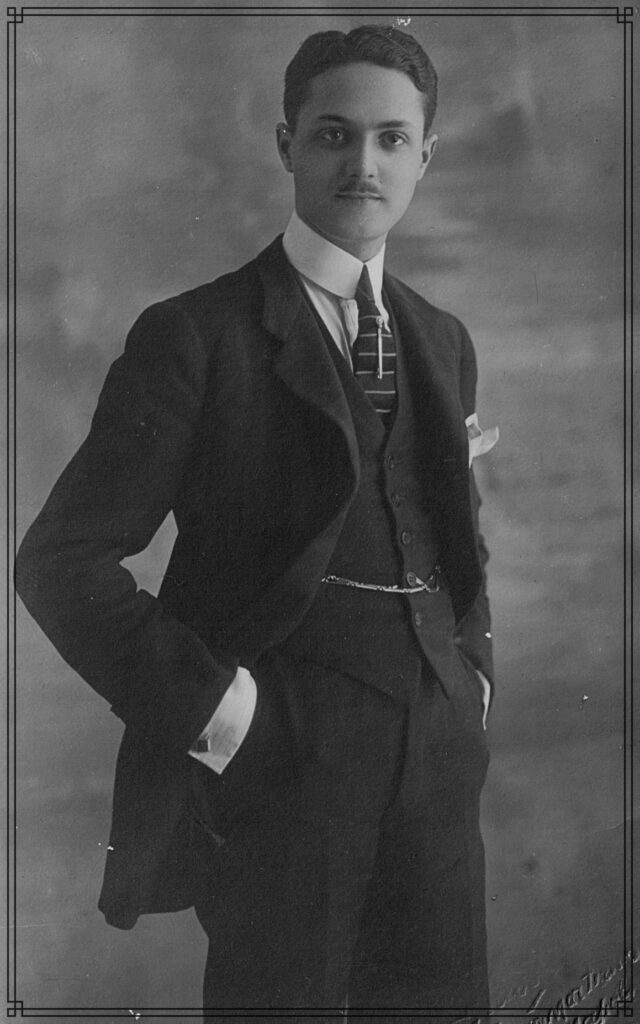
Il marito di nonna Ester: il nonno Mario Albore nel 1912
ll giovane Giuseppe De Cesare, figlio di secondo letto di Raffaele, che aveva intrapreso con passione l’attività del padre nell’oreficeria, si innamora e sposa la prima figlia di Gianbattista Terzini (il vedovo che aveva sposato Maria De Pascale): sua cugina Carolina, detta Carlotta. Donna simpatica, socievole e concreta, ottima cuoca, ma che non riuscì a dare a Giuseppe tutti i figli che avrebbe voluto… fermandosi alla dolcissima Ester, che dal padre eredita lo spirito artistico, diplomandosi al conservatorio come pianista.
Francesco De Cesare sposò Concetta, restando nel suo quartiere con i suoi due figli maschi: Raffaele e Giuseppe. Assunta non si sposò. Eduardo sposò Gilda.
Da questo momento, la ricostruzione storica si fa personale e nostalgica, legata a racconti e ricordi personali, ma purtroppo meno precisa per mancanza di documenti utilizzabili per via della privacy.
La memoria riporta alla mente affettuose immagini: il grande appartamento a Santa Maria Ognibene, dove ad ogni angolo trovava posto un anziano parente, dove profumi di manicaretti prelibati si alternavano all’odore acre dei colori ad olio usati da zio Peppino per i suoi quadri ottocenteschi.
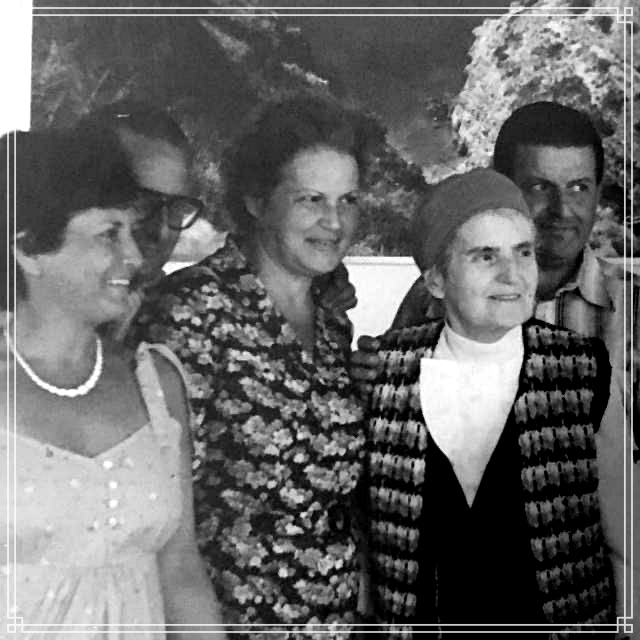
Nonna Ester e i suoi figli nel 1979: da sinistra Adriana, Italo, Maria e Amergo
Intanto la vita riserva ad Ester altri progetti: non farà mai la concertista, ma sarà moglie affettuosa e madre premurosa. Incontrerà Mario Albore e lo sposerà nel 1920 all’età di 29 anni (quando lui ne aveva 23). Andranno ad abitare insieme ai genitori di lei, Giuseppe e Carolina, nella zona della Stazione Centrale.
Dalla loro unione, nasceranno 4 figli: Maria, Adriana, Italo e Amerigo.
Italo era… il mio papà.
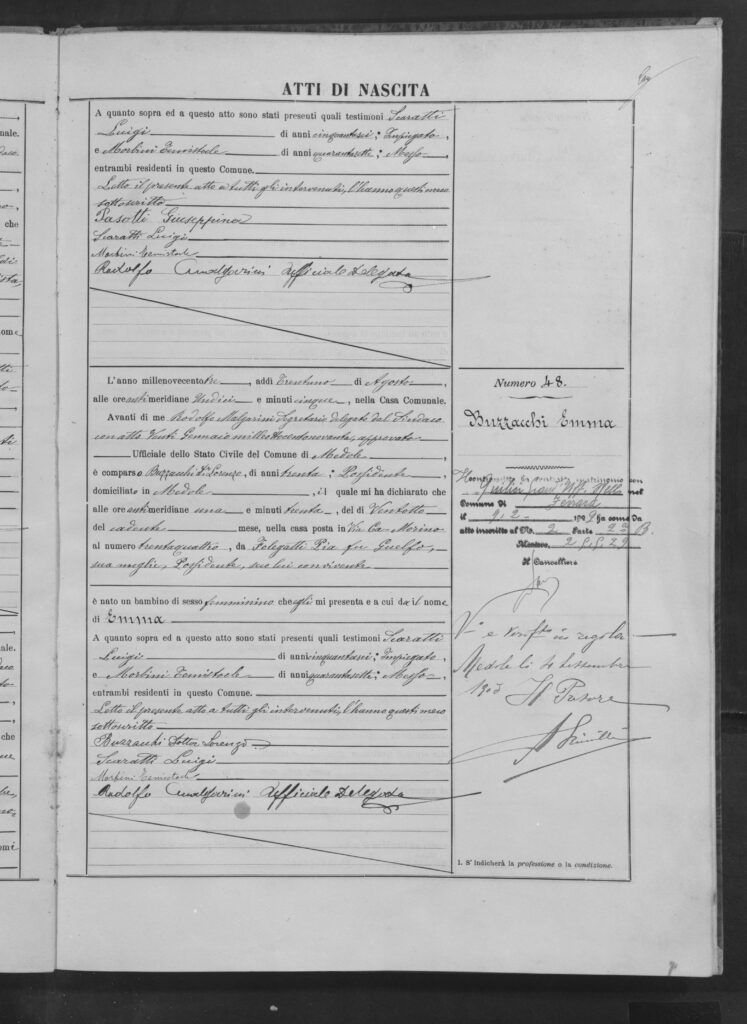
Emma Buzzacchi, better known as Mimì, was born in Medole (MN) on August 28, 1903, to Lorenzo and Pia Folegatti, who belonged to the agrarian bourgeoisie of Mantua.
From an early age, thanks to the learned influences of his family and the teachings of Edgardo Rossaro, his first drawing teacher, he developed an early passion for the arts, particularly painting and engraving.
During her teenage years, she moved to Ferrara with her family, where she was profoundly influenced by the local artistic environment and became acquainted with the principles of the Novecento movement. This path led her, in her early twenties, to her first solo exhibitions, until she was invited to exhibit at the Venice Biennale in 1928, an event in which she participated continuously until 1950. Translated with DeepL.com (free version)
In 1929, she married Nello Quilici, journalist and director of the Corriere Padano, with whom she actively collaborated, becoming the coordinator of the Third Page. From their union two sons were born, Folco, who later became a film director, and Vieri, a well-known architect. However, the marriage was tragically interrupted by Nello’s death during the plane crash of 28th June 1940 in Tobruk, in which Italo Balbo, who was driving the aircraft, and for whom Quilici was acting as press officer in Libya, also lost his life.
Widowed, Mimi moved to Rome.
There, his artistic life received a new impetus: he began to devote himself even more intensively to depicting landscapes, coastal in particular, evolving into a more expressive and tormented painting, thanks to the skilful and dialogic use of light and colour, which created highly suggestive results. His referent in painting remained Cézanne, but reinterpreted through Morandi.
It was not until 1958 that his pictorial executions began to subside, coinciding with his return and frequent trips to the Comacchio Valleys, where he began pictorial cycles and works that later flowed into exhibitions and displays between Rome and northern Italy.
Throughout the next three decades he worked tirelessly, earning international awards and recognition.
He died in Rome on June 16, 1990.
Among his best-known works are: the portrait of his grandfather Giovanni Buzzacchi “Il nonno garibaldino” (1961), the fresco “La glorificazione delle sante Felicita e Perpetua” (1940) at the Corradini village in Libya, the exhibitions “Le Valli di Comacchio (Ferrara, 1960), “Paintings of the Tiber” (Rome, 1976), “Mediterranean, Light and Space” (Rome, 1979) to which must be added the curatorship of numerous book and magazine covers and the valuable engravings, and in particular woodcuts, to which he worked steadily from his beginnings.
Many of his works are now kept in the permanent collection at Medole’s “Civica Raccolta d’Arte Moderna e Contemporanea,” housed in the Palazzo Ceni building.
You can consult thebirth certificate on the Ancestry Portal: Mantua State Archives, Italian Civil Status (Mantua Court records) from 1901, Medole, 1903
Note in the margin of the deed the clerk’s note marking the marriage to Nello Quilici, February 2, 1929 in Ferrara.
State Archives of Mantua, Italian Civil Status (records of the Court of Mantua) from 1901, Medole, 1903
Non possiedo fotografie dei miei trisavoli da parte della nonna materna, mentre ne ho viste molte dei parenti della famiglia del nonno. Nella mente sono presenti solo i ricordi delle storie che mia nonna Lina riferiva sui propri nonni, che peraltro lei stessa non aveva conosciuto.
Poiché, tutti i parenti di mia nonna sono comunque di origine modenese, questo mi ha spinta e cercare altre informazioni e a consultare il sito dell’Archivio di Stato di Modena. Ho così appreso dell’esistenza del Portale Antenati e ho iniziato la ricerca.
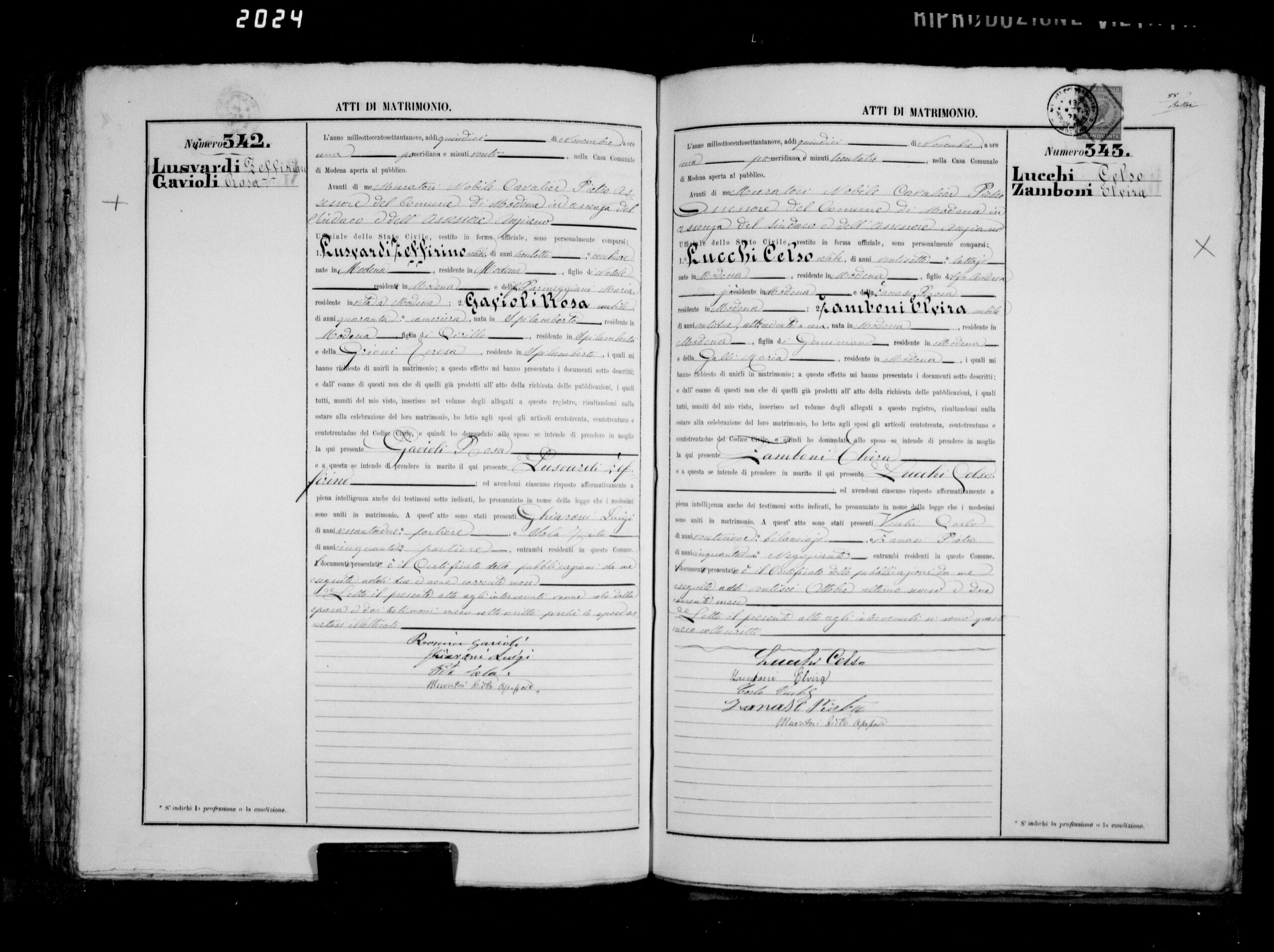
Atto di matrimonio di Zeffirino Lusvardi e Rosa Gavioli
Una parte delle date che volevo recuperare si collocavano esattamente negli anni dei registri consultabili on line sul Portale. Sono partita dai dati in mio possesso e devo ammettere di avere avuto molta fortuna. La bisnonna Pia Lusvardi, madre di mia nonna Lina, era nata nel 1880 da genitori un po’ avanti negli anni per la mentalità dell’epoca, ma non conoscevo nemmeno la data esatta di nascita, che ho ritrovato sfogliando il registro digitalizzato. Ho quindi provato a immaginare che Rosa e Zeffirino, questi sono i nomi dei miei trisavoli, si fossero sposati l’anno precedente, quindi ho consultato il Registro dei Matrimoni del 1879 e in data 15 novembre ho in effetti trovato i dati relativi alla registrazione del matrimonio di Rosa Gavioli e Zeffirino Lusvardi. La consultazione degli Indici relativi ai registri ha velocizzato la ricerca.
L’atto di matrimonio fornisce diverse informazioni sui genitori degli sposi e sugli sposi stessi. Così, incrociando i dati dell’atto di matrimonio con gli allegati necessari per le pubblicazioni ho recuperato una serie di informazioni interessanti: lo sposo, Zeffirino era nato l’11 settembre 1841 a Modena e qui si manteneva svolgendo l’attività di cocchiere. Il padre, Natale Lusvardi, viene definito nei documenti “inserviente”, cioè domestico a Bagno, mentre la madre, Maria Parmeggiani è indicata come “massaia”. Rosa invece è originaria di Spilamberto, anche se all’epoca del matrimonio era domiciliata a Modena, in qualità di cameriera. Il padre della sposa, Cirillo Gavioli svolgeva l’attività di veterinario e la madre Teresa Grioni è a sua volta indicata come massaia.
Un dato inaspettato riguarda Zefirino che non firma l’atto matrimonio, perché definito dall’impiegato comunale “illetterato”. Questo nuovo elemento probabilmente conferma la notizia in mio possesso che la famiglia di Rosa non fosse particolarmente soddisfatta di quest’unione: Zeffirino aveva trentotto anni e Rosa quaranta al momento del matrimonio. Questo elemento forse in parte spiega il motivo per cui Pia è l’unica figlia della coppia.
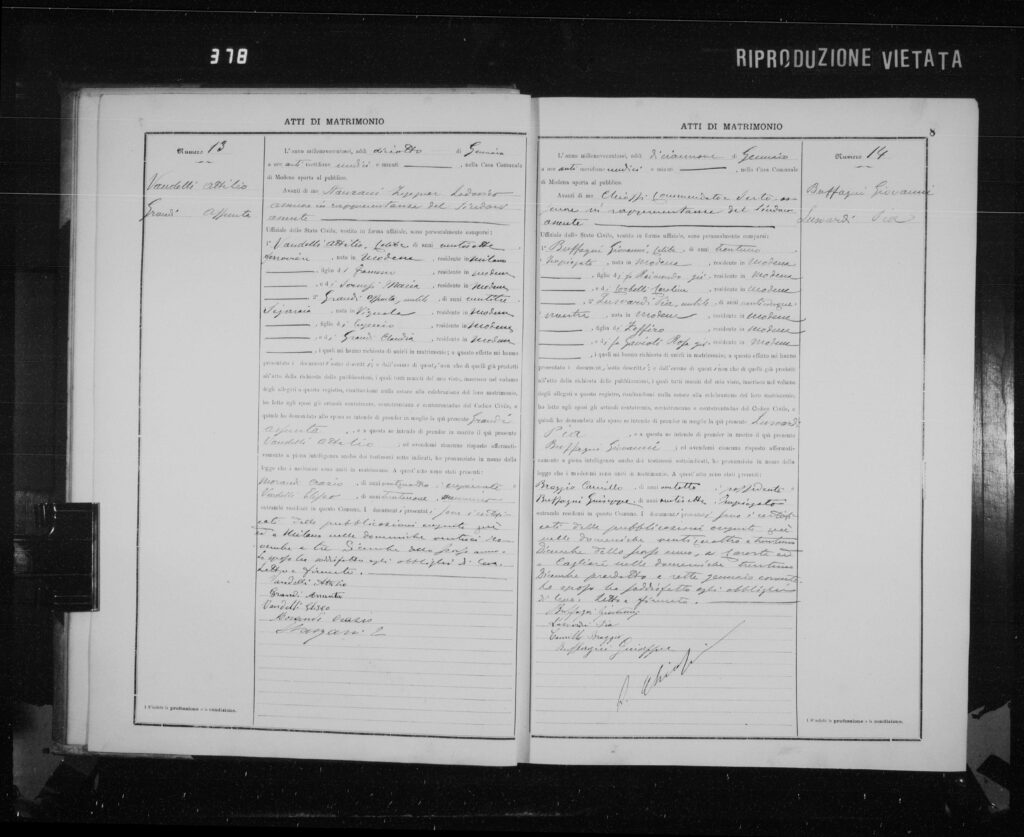
Atto di matrimonio di Giovanni Buffagni e Pia Lusvardi
La famiglia viveva in via San Cristoforo a Modena e qui viene registrata la nascita della figlia il 14 ottobre del 1880. I genitori fecero studiare la figlia Pia presso l’Istituto magistrale “Carlo Sigonio”, dove ottenne il diploma di maestra, professione che svolgerà fino alla pensione.
Pia Lusvardi sposò il 19 gennaio 1906 Giovanni Buffagni, giovane impiegato alle Poste. Al momento del matrimonio, la madre Rosa era già morta da quasi due anni. La coppia risiede in via Mascherella, dove il 23 dicembre 1906 nacque la loro primogenita Rosa Lina Buffagni, mia nonna. Zeffirino però non vide mai la sua prima nipote, perché è deceduto due mesi prima, il 25 ottobre, nella sua abitazione in via San Geminiano.
Una storia che racconta di persone semplici, che svolgevano attività manuali, ma che vollero che la loro unica figlia studiasse e diventasse maestra. Una storia semplice ma che riflette il cambiamento sociale in atto in quegli anni nel giovane Stato unitario.
Ringrazio il Portale Antenati per il lavoro di digitalizzazione dei fondi documentari, che mi ha permesso di colmare dei vuoti lasciati dalle memorie familiari.
Suso, stage name of Giovanna Cecchi, was born in Rome on 21th July 1914 to Emilio, a writer and literary critic, and Leonetta Pieraccini, a painter.
After his high school studies, he spent time in Switzerland and England, where he was able to deepen and perfect his knowledge of foreign languages and English in particular.
In 1938, she married Fedele D’amico, a musicologist and son of the well-known theatre critic Silvio D’Amico, by whom she had three children.
After the Second World War, he began to collaborate with his father on the translation of some plays. But his debut in the film world came with the screenplay for a film that never saw the light of day, Avatar, based on a story by Théophile Gautier, which he worked on together with his friends Alberto Moravia, Ennio Flaiano and Renato Castellani.
Despite the uncertain start, Cecchi D’Amico realised highly successful projects within a few years. Among many, L’onorevole Angelina (1947), written together with Piero Tellini for the direction of Luigi Zampa and, in the same year, Vivere in pace, which won her the Nastro d’argento as best subject.
He collaborated with the most influential exponents of Italian neo-realism. One of her most emblematic works is the film Ladri di biciclette (1948), written with Cesare Zavattini for Vittorio De Sica, in which she was the creator of the very famous final scene. He won, again, a Nastro d’argento for best screenplay.
From the 1950s onwards, there were numerous collaborations with well-known personalities of Italian cinema, including Luigi Comencini, Vittorio Gassmann, Mario Monicelli, Franco Zeffirelli, etc. But it was particularly with Luchino Visconti that he formed a strong artistic partnership. The latter, in fact, entrusted her with the screenplay of almost all his films, including Bellissima (1951), written for Anna Magnani, to whom Cecchi D’Amico was bound by a deep friendship.
Among the merits that are jointly acknowledged to this day is her ability to penetrate the psychology of characters and to transpose it into scripts that were always attentive to the needs and personal style of each of the many directors with whom she collaborated, thus managing to produce scripts with great heterogeneity, in which comedy and drama coexisted with a peculiar harmony, becoming her hallmark.
In 1994, she was awarded the Leone d’oro for Lifetime Achievement at the Venice Film Festival.
Suso Cecchi D’Amico died in Rome on 31th July 2010.
You can consult the birth certificate on the Ancestors Portal: Archivio di Stato di Roma, Stato civile italiano, Roma, 1914