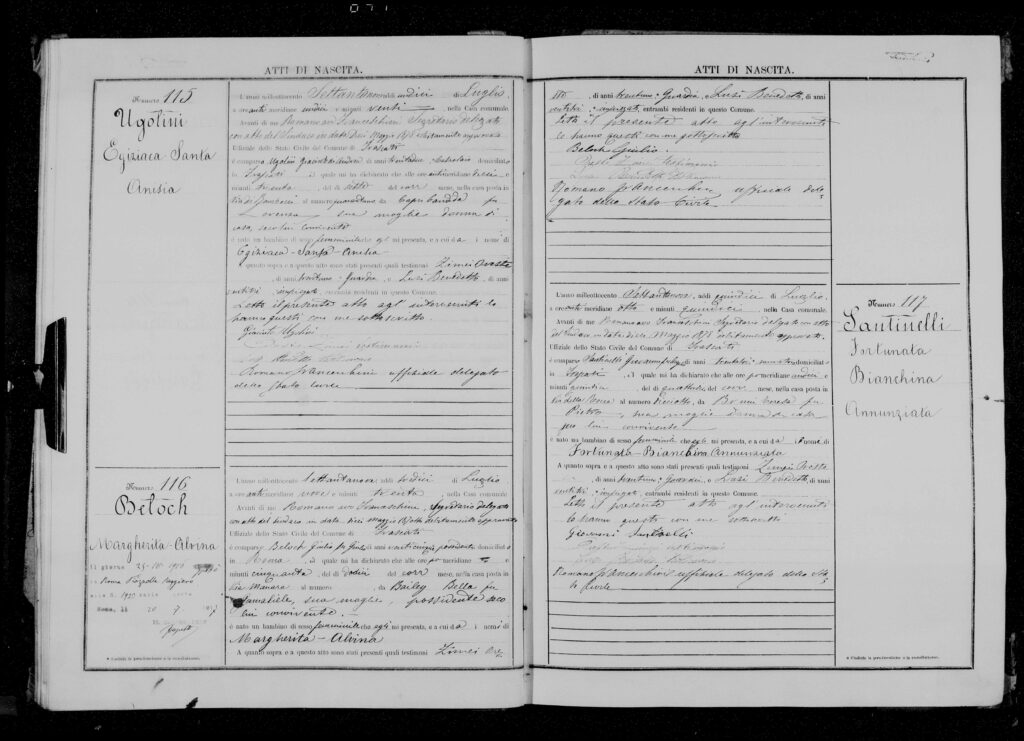
Margherita Albina Beloch – later married Piazzolla – was born in Frascati on 12th July 1879 to Bella Bailey, an American, and Giulio, a professor of ancient history of German origin.
She enrolled in the Faculty of Mathematics in Rome and graduated in 1908 with a thesis on ‘Birectional Transformations in Space’, which was published the following year.
At first, he was a voluntary assistant to the analytical mathematics chair of Professor Guido Castelnuovo, who had been his lecturer. He was then assistant professor in Pavia and Palermo, until he obtained a professorship in 1924 and, in 1927, the chair of Geometry at the University of Ferrara, where he remained until his retirement in 1955.
Throughout his career, he was particularly concerned with the practical-applicative value of mathematics and geometry. One of his main areas of interest was photogrammetry. Specifically, his studies were used in the field of medical radiology, allowing enormous progress in obtaining images of organs inside the human body by means of x-rays.
Added to this was the invention of the ‘precisometer’, an instrument that allowed the synchronous taking of two radiograms, providing the exact image and position of even organs capable of involuntary movements, such as the heart. In 1938, the ‘precisometro’ was awarded the silver cup of the Ministry of National Education at the ‘Leonardo da Vinci’ Exhibition of Inventions.
In 1955, Margherita Beloch Piazzolla was awarded the title of professor emeritus, thus being able to dedicate herself to research and study even after her retirement.
He died in Rome on September 28, 1976.
You can consult thebirth certificate on the Ancestry Portal: State Archives of Rome, Italian Civil Status, Frascati, 1879
Archivio di Stato di Roma, Stato civile italiano, Frascati, 1879
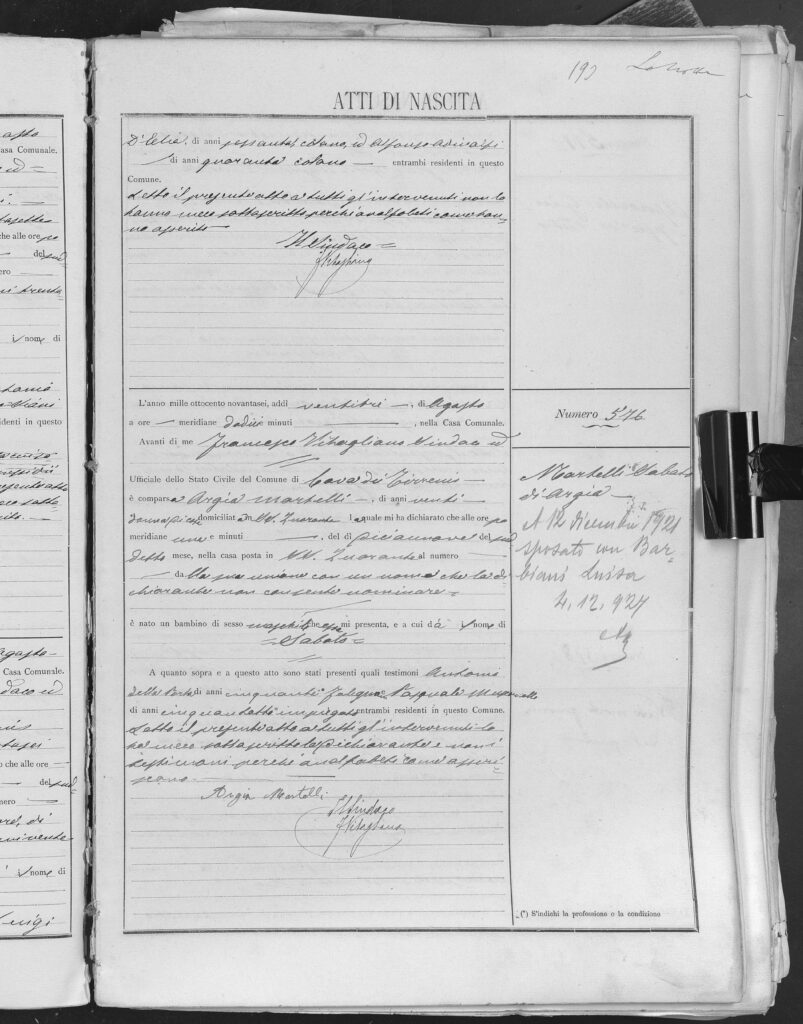
Sabato Martelli Castaldi was born in Cava de’ Tirreni (SA) on 19th August 1896.
After spending his childhood in Raito, on the Amalfi coast, he moved with his father to Rome where he continued his studies at the San Giuseppe di Merode, and then enlisted as a volunteer at the Royal Army Academy in Turin.
Appointed second lieutenant in the Engineer Corps, he took part in World War I on 9th April 1916.
In 1917, after passing selection, he obtained his military pilot’s licence in Foggia and was once again sent to the front, where he flew more than a hundred missions. He was assigned to the Aerial Reconnaissance Department, where missions for aerophotographic surveys and subsequent photo interpretation were carried out. In the course of his career, he progressively qualified to fly different aircraft, becoming a versatile pilot with great skill in the various specialities.
At the end of the Great War, he returned a silver and two bronze medals for military valour.
On 17th July 1931, he was promoted to colonel for ‘extraordinary merit’, and on 1st December 1932 he was called to take up the post of Chief of Staff to the Minister of Aeronautics, Italo Balbo, at a time when the armed force was in the period of raids and cruises.
On 28th October 1933, at only 37 years of age, he was appointed Brigadier General ‘by absolute choice’: he is still the youngest Italian General of all time, for all the Armed Forces.
In 1934, as a result of a series of circumstances brought about by his report to the Duce in which he denounced the real state of the air force, he was discharged and, persecuted by the OVRA, unable to get a job. After months of difficulties and searching, he managed to be hired as an exterminator at the Stacchini powder factory in Rome. He will soon become a manager.
During those years, he applied several times to the head of the government Benito Mussolini for reinstatement in the Regia Aeronautica, but each of his requests was rejected.
After 8th September, he was among the partisan fighters at Porta San Paolo in Rome. With the battle name ‘Tevere’, in memory of the river that had witnessed so many of his sporting successes in rowing, he worked hard for the Resistance, collaborating with both the political side of the anti-fascist parties and the military side of the Clandestine Military Front.
On 17th January 1943, the German police arrested Stacchini, Martelli Castaldi’s employer, accusing him of supporting the Partisans. Martelli Castaldi, with the intention of exonerating Stacchini, presented himself at the SS headquarters and was arrested by them.
He was taken to the Via Tasso prison, where he remained in the punishment cell for sixty-seven days and was subjected to various tortures. Even there, he never stopped working on behalf of his comrades: by bribing the guards, he managed to write to his family and get food and medicine to all the inmates on his floor. Of those days, traces and testimonies remain through the letters and notes he wrote to his wife, Luisa Barbiani, and the inscriptions he left, including a poem, on the wall of cell no. 2.
The evidence that the SS managed to gather against him, however, meant that he became ‘deserving of death’ without trial.
He was killed, along with 334 other martyrs, in the massacre of the Fosse Ardeatine on 24th March 1944.
His body rests in sarcophagus 117 of the Fosse Ardeatine Mausoleum together with those of the other victims. In perpetual memory, he was awarded the Gold Medal for Military Valour.
You can look up the birth certificate on the Ancestor Portal: Salerno State Archives, Italian Civil Status, Cava de’ Tirreni, 1896
The Conscription List and Matriculation Roll are also kept at the same Institute.
For more on the figure of Sabato Martelli Castaldi, see the volume by Edoardo Grassia, Sabato Martelli Castaldi. Il generale partigiano, Padova, Ugo Mursia Editore, 2016.
Archival and bibliographical sources:
Archives of the Air Force Historical Office, Fondo Medaglie d’Oro al Valor Militare, b. 20, fasc. 169;
Central Air Force Library, Emeroteca, Raccolta Personaggi, cart. 75, fasc. 1337
In addition, the Air Force Historical Museum in Vigna di Valle preserves – following a donation ceremony in 2017 – some Martelli Castaldi memorabilia.
Archivio di Stato di Salerno, Stato civile italiano, Cava de’ Tirreni, 1896
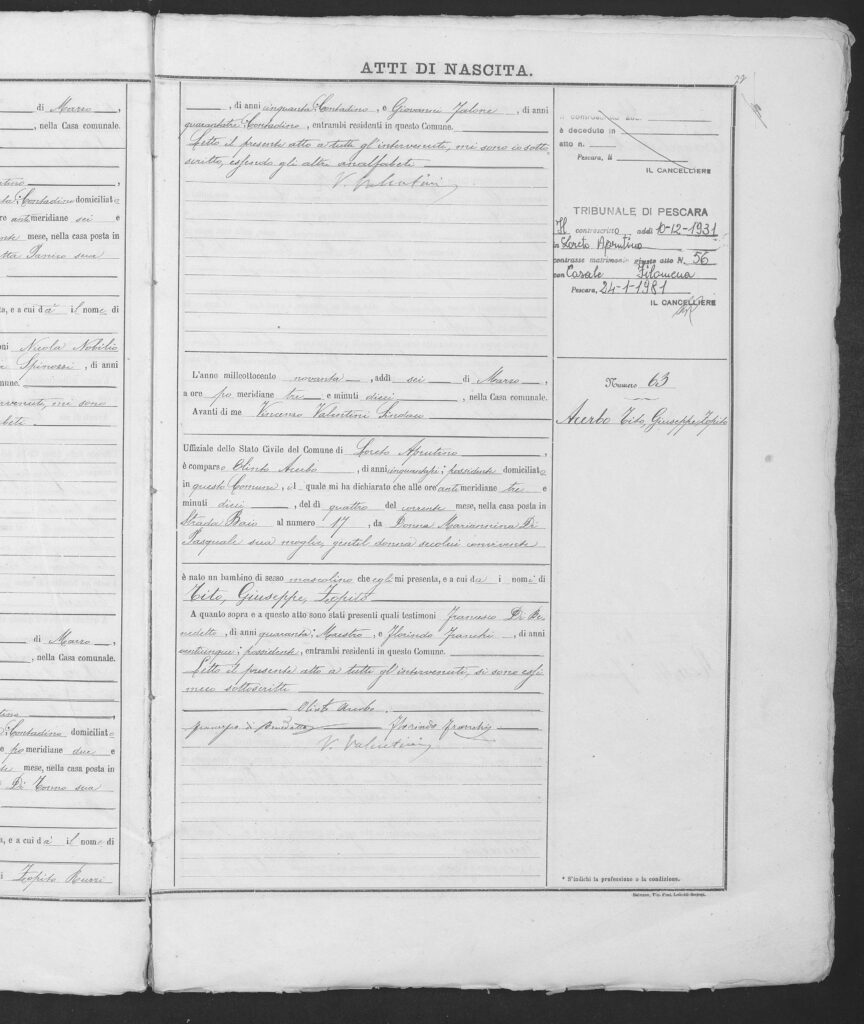
Tito Giuseppe Zopito Acerbo was born in Loreto Aprutino (PE) on 4th March 1890, to Olinto and Marianna De Pasquale.
Having received his initial education at the archiepiscopal seminary in Chieti and the royal high school in Fermo, he graduated in Florence and then enlisted as a volunteer in the army at the outbreak of the First World War.
For his skills in the field and deep sense of duty, he was promoted to Captain, being decorated with two silver medals for military valour. But it was his charisma and sense of sacrifice on the night of 15 June 1918 that earned him the Gold Medal of Remembrance, when, although wounded, he was one of the key figures in blocking the Austro-Hungarian enemy’s attempt to penetrate the Piave River.
He died in the field the next morning, 16th June 1918.
His brother Giacomo Vincenzo Aurelio was born in Loreto Aprutino (PE) on 25th July 1888.
He too completed his classical studies between Chieti and Fermo, while he graduated in Agricultural Sciences in Pisa in 1912.
He, too, completed his classical studies in Chieti and was active in the communal life of his town until he enlisted in the army as a volunteer, distinguishing himself in numerous battles for which he was decorated several times. while he received a degree in Agricultural Sciences from the University of Pisa in 1912. When Titus died, he was discharged.
From there, he devoted himself to a university and political career. First approaching the socialists and then favouring the birth of the Fascio provinciale di combattimento in the province of Teramo, obtaining increasingly important coordinating positions.
In 1921, he was elected to Parliament and in 1923 he linked his name to the well-known ‘Acerbo Law’, which aimed to reform the electoral system according to a majority principle.
During his political career he was Undersecretary of State to the Prime Minister’s Office (1922-24), Vice-President of the Chamber of Deputies (1929), Minister of Agriculture and Forestry (1929-1935), Minister of Finance (1943).
In 1942, he voted for the removal of Mussolini’s powers, calling himself the ‘humble servant of the king’ Victor Emmanuel III. However, when the armistice was signed on 8th September 1944, he was sentenced to death in absentia, but managed to escape, taking refuge in his birthplace in Loreto Aprutino.
After months on the run, he was arrested and sentenced to 48 years in prison.
He served a short time in the prison on the island of Procida, where he taught mathematics to inmates. When his sentence was overturned, he was freed, readmitted to vote and rehabilitated as a university lecturer, to which he devoted the last years of his life, working on numerous writings on economics and agrarian policy.
Giacomo Acerbo died in Rome on 9th January 1969.
The story of the two brothers is closely linked to the famous ‘Coppa Acerbo’, which Giacomo wanted to inaugurate in 1924 and named in memory of Tito, who died prematurely in the war. It was one of the most important car races of the time, a very difficult circuit through the hills of Pescara in which the most famous names of car manufacturers took part. The last edition was held in 1961.
You can consult birth certificates on the Ancestors Portal.
For Tito Acerbo: Archivio di Stato di Pescara, Stato civile italiano, Loreto Aprutino, 1890
For Giacomo Acerbo: Archivio di Stato di Pescara, Stato civile italiano, Loreto Aprutino, 1888
For more on the figure of Giacomo Acerbo, see the entry of the Biographical Dictionary of Italians edited by Antonio Parisella.
Archivio di Stato di Pescara, Stato civile italiano, Loreto Aprutino, 1890
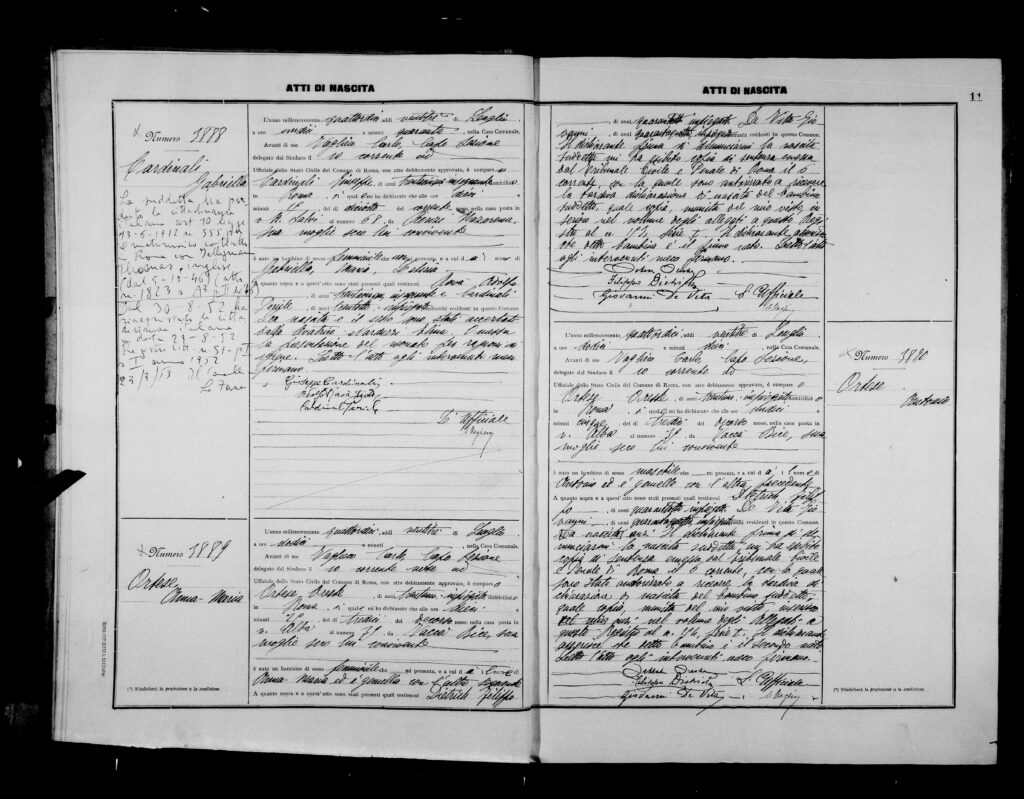
Anna Maria Ortese was born in Rome on 13th June 1914, to Oreste, a civil servant of Sicilian origin, and Beatrice Vaccà, who came from an old and wealthy family of Neapolitan sculptors.
During the First World War, the family moved from Rome to the south: first to Apulia, then to Campania, Basilicata and finally to Tripoli, where Anna Maria finished primary school. She was, in fact, predominantly self-taught: rather than schooling, it was her deeply imaginative mind and tendency towards introspection that gave her an innate propensity for the written word.
Later, after this period of strong geographical instability, from 1928, Ortese settled with her family in Naples, the city that most influenced her poetics.
In 1933, the loss of her beloved brother, Emanuele, inspired her to write some poems, which were first published in the magazine L’Italia letteraria. That event constituted a watershed, beginning her activity as a writer: in 1934, in fact, she published her first short story, Pellirossa, and, in 1937, her first collection of novellas came out for Bompiani.
In that same year, his twin brother, Antonio, was murdered in unclear circumstances. This induced a deep melancholy and restlessness in her, which resulted in her continually moving to northern Italy, where she supported herself first as a proofreader and then as a contributor to the most important national newspapers.
Following this long wanderings, he returned to Naples in 1945, where he resumed writing and publishing. Among the most famous titles from this period is the collection of short stories entitled Il mare non bagna Napoli, perhaps the most emblematic of his works, winner of the Premio Viareggio (1953). A few years later, having settled in Milan, she wrote L’iguana (1965) and Poveri e semplici, a novel, the latter, which won her the Premio Strega (1967).
The writing production of the latter years helped her to re-establish the favourable opinion of the critics, who had previously subjected her to silent ostracism due to her ill-concealed dislike of the cultural and intellectual world of the time. Despite this, Ortese continued to lead her withdrawn and modest life, even when, in 1975, she settled in Rapallo (GE) with her sister Maria.
There, economic conditions that were anything but rosy led her to agree to reprint some of her works, which brought her renewed success, even beyond national borders.
Anna Maria Ortese died in Rapallo on the night of 9th March 1998.
You can consult the birth certificate on the Ancestors Portal: Archivio di Stato di Roma, Stato civile italiano, Roma, 1914
For more on the figure of Anna Maria Ortese, see the entry of the Dizionario Biografico degli Italiani edited by Monica Farnetti.
Archivio di Stato di Roma, Stato civile italiano, Roma, 1914
Giacomo Matteotti was born in Fratta Polesine (RO) on 22th May 1885.
Son of Girolamo and Elisabetta Garzarolo, iron and copper merchants in the province of Rovigo who made their fortune and became wealthy landowners.
From a young age, Giacomo and his brothers – Matteo and Silvio, who died prematurely – joined the Italian Socialist Party and actively contributed to local politics. While still a boy, Giacomo signed his first articles for the magazine La lotta, which designated him as a political reference point in the area. It was during this period that his vision of social justice and civil commitment began to take shape, always accompanied by an anti-militarist view, opposed to Italy’s intervention in wartime conflicts.
After high school, he enrolled in the Faculty of Law in Bologna, graduating with top marks in 1907.
In the following years, he devoted himself to political activity: he was elected mayor in his home town and also in neighbouring towns, and then became a provincial councillor.
In 1919, he was elected to Parliament, where he distinguished himself for his uncompromising and combative temperament. Those years also saw the beginning of his fight against the fascist movement, whose abuses and irregularities he denounced.
After his expulsion from the PSI in 1922, he, together with Filippo Turati and others, founded the United Socialist Party, which became the second largest opposition party in the 1924 elections.
On 30th May 1924, Matteotti addressed the Chamber of Deputies, publicly denouncing the invalidity of the elections held the previous month, contesting the violence, illegalities and abuses committed by the fascists, who had managed to win the elections. His request to invalidate the vote was not granted and Matteotti was recognised by the press as the main opponent of fascism. That famous speech is historically remembered as a hymn to democracy, which marked his death sentence.
On the afternoon of 10th June 1924, he was kidnapped in Rome by a group of fascists lurking a few hundred metres from his home, as he walked towards Montecitorio. He died, by stabbing, a few hours later.
Due to the presence of witnesses and the poor handling of what will go down in history as the ‘Matteotti case’, within days the press made the backgrounds known along with the names of the main perpetrators.
His body was found on 16 August of that year in the Quartarella maquis, in Riano, a municipality a few kilometres from Rome.
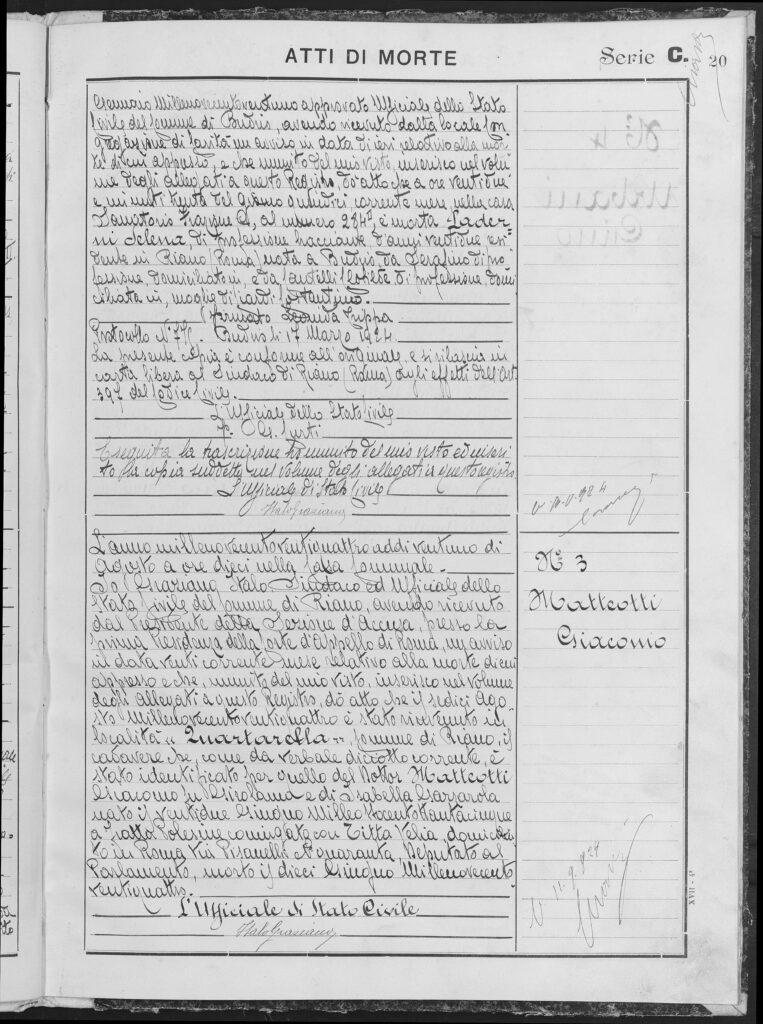
You can consult the death certificate on the Ancestors Portal: Archivio di Stato di Roma, Stato civile italiano (registri dei comuni), Riano, 1924
The deed was written (in part II, series C) in the register of the municipality of Riano, where the corpse was found. It should be noted that there is an annex with a rectification ruling, dated 12 October 1925, correcting the date of birth of the Hon. Matteotti, which was partially incorrectly reported in the death certificate.
For more on the figure of Giacomo Matteotti, see the entry in the Dizionario Biografico degli Italiani edited by Mauro Canali.
Archivio di Stato di Roma, Stato civile italiano (registri dei comuni), Riano, 1924
Francesco Buonanno was born in Solofra (AV) on 19th September 1858, the son of Michele and Carolina Savignano, into a well-to-do family of merchants dedicated to tanning by ancient tradition.
When their father died, it was his sons who inherited the family factory, but it was Francesco himself, a few years later, who took over the reins, transforming it into a full-fledged factory employing over 200 workers.
Thanks to savings and shrewd investments, he was able to significantly increase production over time. Not only that: endowed with great business acumen, he soon realised the importance of refining and modernising processing techniques, which gradually became more efficient and profitable. The resulting improvement in the quality of the goods produced led to national and international recognition, so much so that they received invitations to exhibitions and shows all over the world (Turin, Palermo, St. Louis in the USA, etc.).
Alongside his business activities, Buonanno also dedicated himself to local political life, distinguishing himself for his civic commitment and defence of community interests. He was elected mayor of Solofra from 1899 to 1902 and then again from 1911 to 1912, promoting important initiatives aimed at improving the local infrastructure and supporting the tanning industry, the economic pillar of the area.
The Buonanno company’s production specialised in chrome tanning – a highly innovative technique at the time, still used in Italy in very few factories – which, however, was ill-suited to the production of uppers, which were in great demand during the First World War. Despite this, Francesco was able to adapt and reinvent himself, managing to mechanise – thanks to a steam engine – at least part of his production, thus becoming the first factory in the south in the supply of war equipment.
After the war, the company managed to maintain its dominant position in the tanning industry throughout the 1930s. In the last years of his life, Francesco Buonanno was joined by his grandchildren, who inherited the company.
He died in Solofra on 26th May 1940.
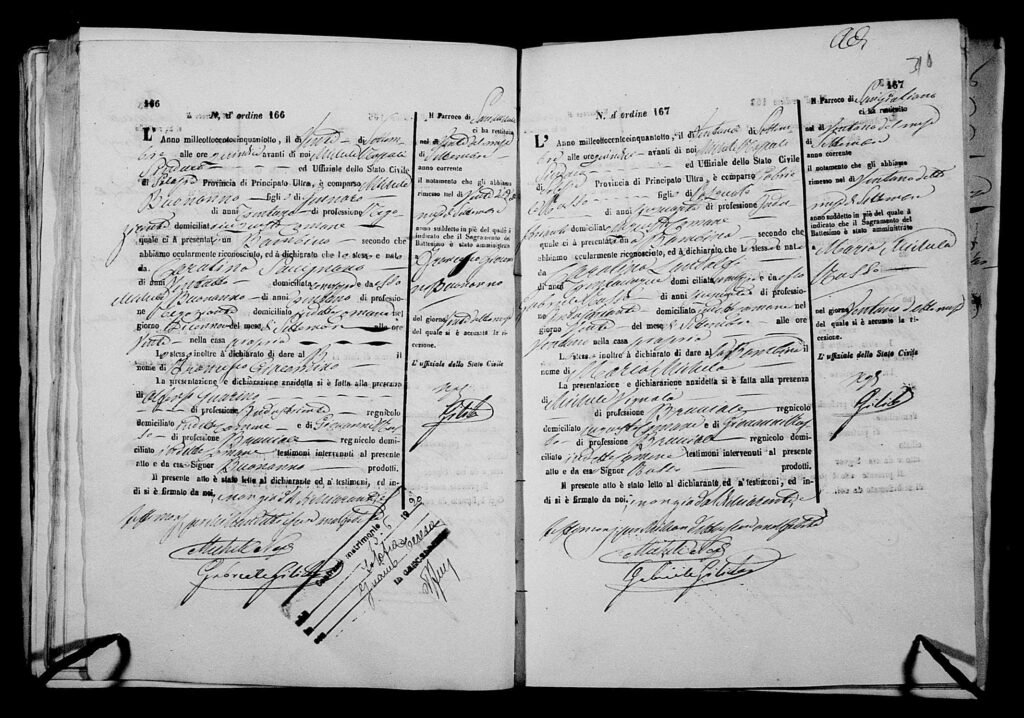
You can consult the birth certificate on the Ancestors Portal: Archivio di Stato di Avellino, Stato civile della restaurazione, Solofra, 1858
Archivio di Stato di Avellino, Stato civile della restaurazione, Solofra, 1858
Benedetta Cappa was born in Rome on 14th August 1897.
From an early age, she showed a particular flair for artistic expression in a broad sense: poetry, drawing, painting and creation in general. In his early twenties, he began attending Giacomo Balla’s studio, where he stood out for his talent and personality. There, in 1918, she also met Filippo Tommaso Marinetti, whose companion and wife she soon became.
The partnership between the two was long-lasting, artistic and professional, as well as emotional.
Several times and on several occasions Marinetti expressed his deep esteem for Cappa, emphasising his absolute genius. The two produced their first ‘tactile table’ in 1920, which was presented in Paris together with the Tactilism manifesto in January 1921.
In the 1920s and 1930s, Benedetta Cappa produced some of her most significant works. With painting characterised by the bold use of colour and the dynamic representation of movement, key elements of Futurism. Among his most famous works are ‘Motorcyclist’s Speed’ (1922) and ‘Iridescent Compenetration No. 2’ (1924). He also participated in numerous exhibitions and shows, taking his creations (paintings, sketches, studies and stage designs) around the world.
Among the most innovative aspects of his work was his participation in numerous wall decoration projects in public and private buildings, advancing the Futurist idea of integrating art and everyday life. His mural works, often large in size, were characterised by dynamic compositions and vibrant colours, with a strong sense of movement and modernity.
In the 1940s, Cappa continued to work and exhibit his works, despite the fact that the Futurist movement had by then lost some of its initial momentum. After Marinetti’s death in 1944, he continued to defend the legacy of that artistic movement, firmly believing in an art that was at the service of collective progress and modernity.
She died in Venice on 15th May 1977.
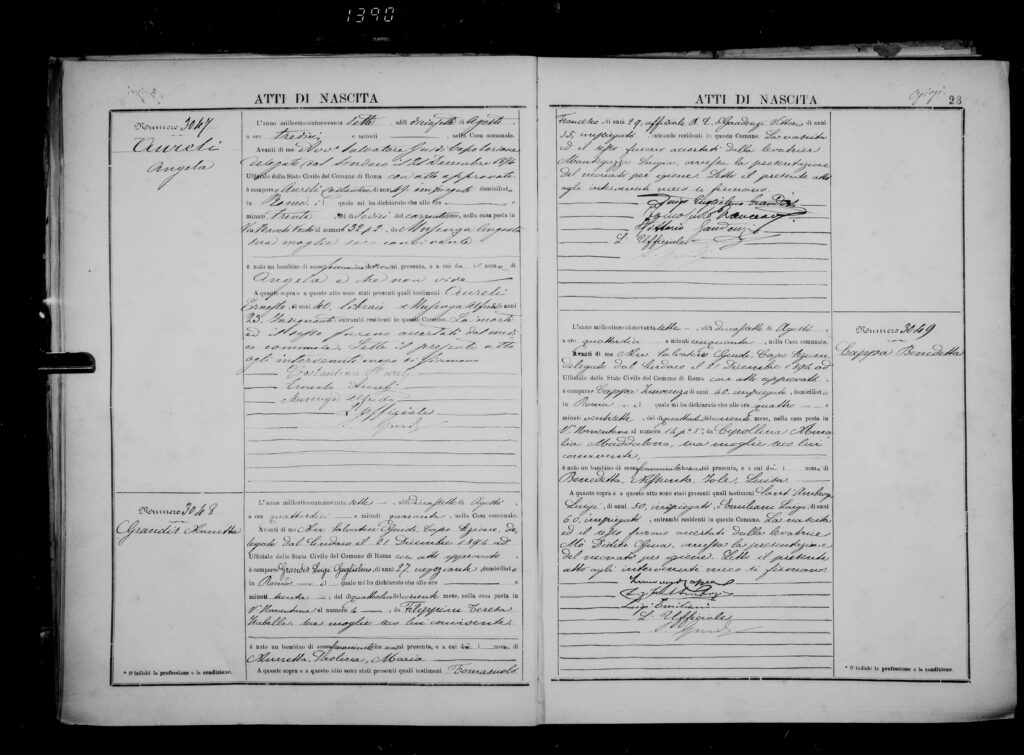
You can consult the birth certificate on the Ancestor Portal: Archivio di Stato di Roma > Stato civile italiano > Roma > 1897
For more on the figure of Benedetta Cappa, see the entry in the Dizionario Biografico degli Italiani edited by Luce Marinetti Barbi.
Archivio di Stato di Roma > Stato civile italiano > Roma > 1897
Margherita Kaiser Parodi was born in Rome on 16th May 1897, to Giuseppe and Maria Orlando.
His father was a Leghorn man of German origin, while his mother was the daughter of the well-known businessman and engineer Luigi Orlando.
At the outbreak of war, in 1915, aged just 18, Margaret wanted to enlist as a volunteer together with her mother and sister Olga. She was assigned to the Italian Red Cross hospital in Cividale del Friuli and then transferred to the mobile hospital in Pieris, in the Gorizia region.
There, in May 1917, the facility where she was staying suffered a heavy bombing, but she remained at her post, continuing to provide assistance with a spirit of sacrifice and self-sacrifice that earned her the bronze medal for military valour.
A few letters remain of her from which the firm conviction of her choice and total dedication to the cause shines through. He remained in service even after the end of the war, to deal with the Spanish flu epidemic that struck Europe between 1918 and 1920, causing millions of deaths.
She was also infected by it, dying in Trieste on 1st December 1918.
She was first buried at the Colle di Sant’Elia cemetery, and then moved to the Redipuglia military memorial, where she was given a place of honour: she is the only woman, in fact, among the many fallen soldiers whose remains were received there.
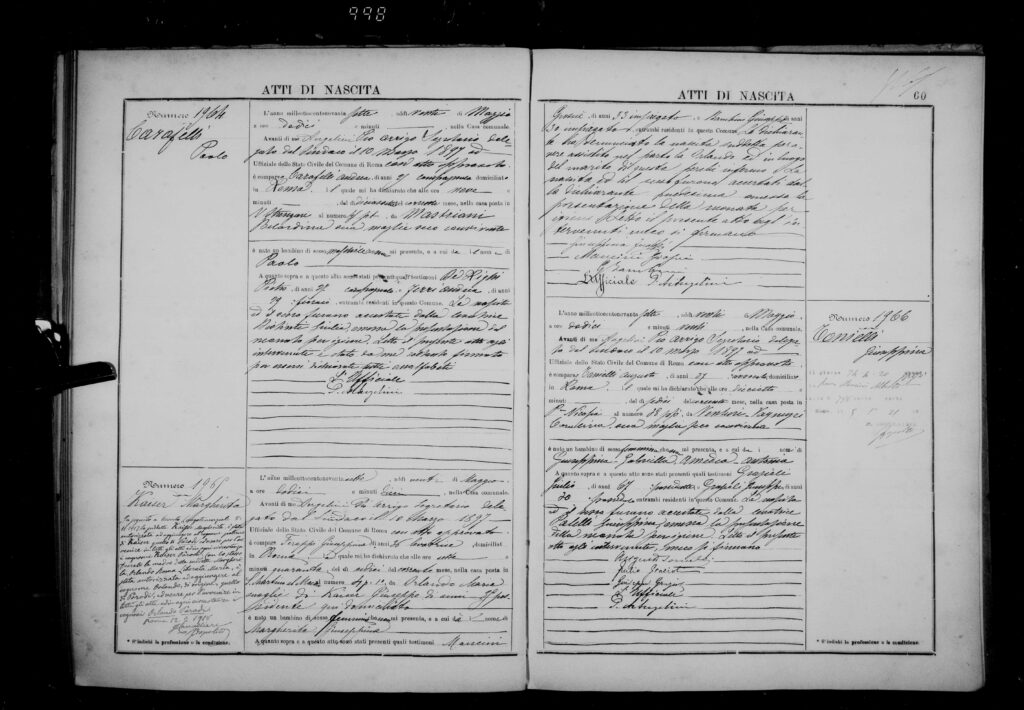
You can consult the birth certificate on the Ancestors Portal: Archivio di Stato di Roma > Stato civile italiano > Roma > 1897
Note the clerk’s note in the margin of the deed, which shows the luogotenential decree of 8th November 1917 authorising Margherita Kaiser to add the surname Parodi to her own surname, in all acts and circumstances.
Archivio di Stato di Roma > Stato civile italiano > Roma > 1897
Guglielmo Giovanni Maria Marconi was born in Bologna on 25 April 1874, to Giuseppe, a wealthy landowner, and Annie Jameson, an Irishwoman and granddaughter of the founder of the well-known Jameson&Son distillery.
He spent his childhood in the family villa near Sasso Marconi (BO), where he received a mainly private, occasional and highly experimental education. This, together with his acquaintance with the scientist Augusto Righi, indelibly marked his path. While still very young, in fact, he began self-taught experiments in transmitting signals at a distance, until, in the summer and autumn of 1895, the device he was working on succeeded in transmitting and receiving signals for over a mile, even in the presence of natural obstacles.
The sensationality and usefulness of his inventions made it necessary for him to move to the United Kingdom in order to more easily obtain funding to perfect his work. He moved to London and there, on 2 July 1897, obtained a patent for a wireless telegraphy system. At the same time, he also inaugurated the first company he owned, the Wireless Telegraph and Signal Company.
As his fame grew, his inventions also became more and more refined, to the point of enabling the transmission of signals overseas. These experiments were finally fine-tuned in 1907, so much so that in October of that year his company, renamed the Marconi Company, inaugurated the first public radiotelegraphy service across the Atlantic Ocean, allowing ships to launch wireless SOS.
The usefulness of radio rescue at sea became apparent on 23 January 1909, when thanks to the efficiency of this device, the more than 1,700 passengers of the ocean liner Republic, which was about to sink due to a ramming, were saved.
This event of worldwide resonance was also decisive for the awarding of the Nobel Prize in Physics that same year, which Marconi shared with the German physicist Carl Ferdinand Braun.
The following years continued to be full of experimentation and progress, especially from 1919 onwards when he purchased the yacht ‘Elettra’, which he set up as a station for his research, resulting in some of the most famous experiments in signal transmission between one continent and another.
In the following years, Marconi was appointed to various institutional positions: in 1927, he was appointed president of the National Research Council and, in 1930, of the Royal Academy of Italy, automatically becoming a member of the Grand Council of Fascism.
Moreover, when the Vatican Radio station was inaugurated on 12 February 1931, the opening greeting of which was given by Marconi himself and the then Pope Pius XI, this service earned him the appointment of Pontifical Academician and the award of the Grand Cross of the Order of Pius IX.
Following a severe heart attack, Guglielmo Marconi died in Rome on 20 July 1937.
The national importance of his figure and the consideration of his genius were manifested with the celebration of his state funeral, attended by eminent personalities of the time, including Benito Mussolini himself, along with a crowd of over 500,000 people. His face was also engraved on the 2000 lire banknotes issued between 1990 and 1992.
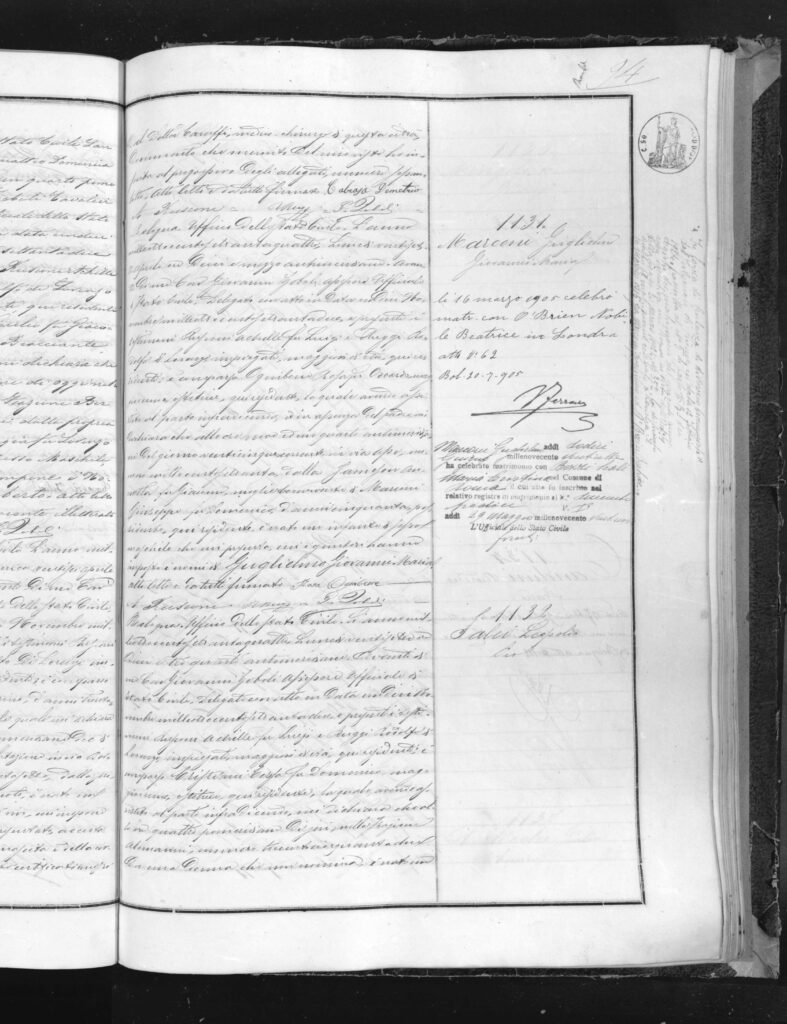
You can consult thebirth certificate on the Ancestry Portal: Bologna State Archives > Italian Civil Status > Bologna > Register 287
In the margin, there is a stationery note marking the marriage to his first wife, the Irishwoman Beatrice O’Brien, which was celebrated in London on 16th May 1905 and from whom Marconi divorced in 1924. Just below, the marriage deed with his second wife, Maria Cristina Bezzi-Scali, which took place in Rome on 12th June 1927, is marked.
For more on the figure of Guglielmo Marconi, see the entry in the Dizionario Biografico degli Italiani edited by Maria Grazia Ianniello.
Archivio di Stato di Bologna > Stato civile italiano > Bologna > Registro 287
Mi chiamo Angelo Gallardi, vivo in Argentina e come molti altri discendenti di immigrati, il mio interesse per la genealogia si è risvegliato raccogliendo i documenti per la cittadinanza italiana, poco più di 4 anni fa. L’interesse non si è fermato a quei documenti e partendo da un piccolo e limitato albero che ho fatto da bambino come compito per la scuola, ho aggiunto lentamente innumerevoli nomi e ho scoperto molte persone e eventi che li circondavano, di cui sono sicuro che né i miei nonni e forse neanche i miei bisnonni, conoscevano. Nel corso del tempo, ho scoperto a casa di mia nonna una scatola piena di fotografie antiche con alcune persone che conoscevo e altre no. A poco a poco, e grazie alle annotazioni sul retro di alcune fotografie, ho associato volti a persone che avevo già nel mio albero.
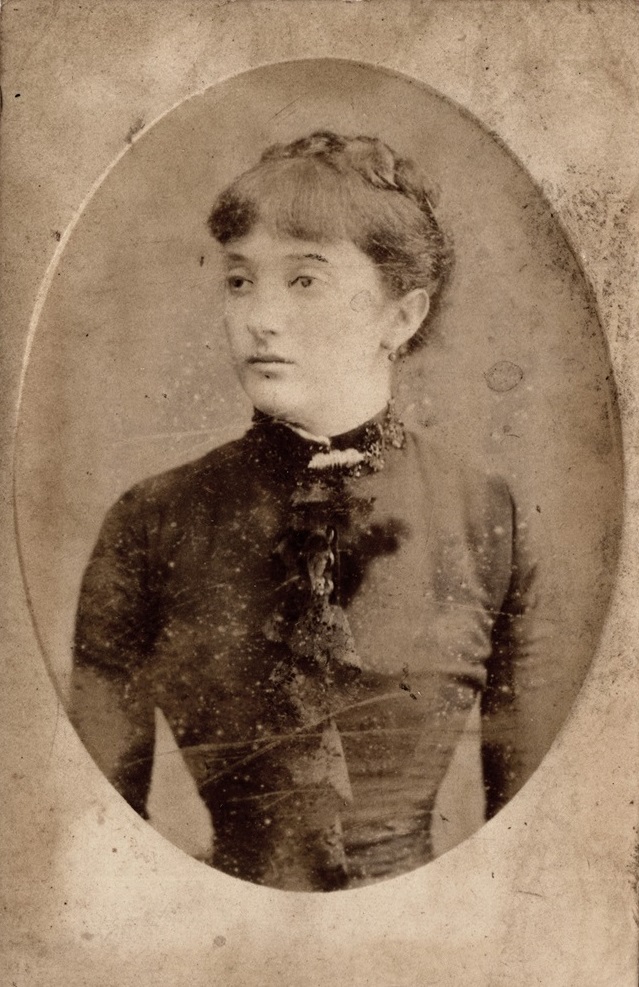
Questa storia è legata alla mia trisnonna, Maria Gaja (o Gaia, come compare in alcuni documenti, anche se Gaja è come è stata annotata nel suo atto di nascita ed è quello che considero valido), e in particolare a una fotografia nella scatola.
Maria Gaja (o Carolina Gallardi, come la chiamavano per il suo cognome da sposata) nacque il 3 ottobre 1868 ad Alpignano, e ho scoperto che suo padre, Carlo Gaja, morì appena 3 giorni dopo, alla giovane età di 30 anni. Nell’atto di nascita di Maria si può leggere in riferimento a Carlo e non stato presentato da quest’ultimo il detto bambino attesa la grave di lui malattia. In questo modo, Marietta Spinoglio, moglie di Carlo e madre per la prima volta, rimase vedova all’età di 20 anni con una bambina appena nata.
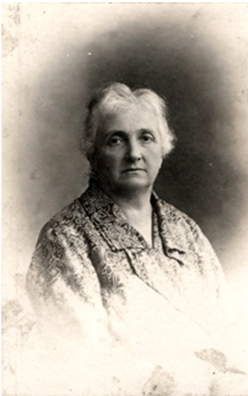
Maria Gaja at 16
D’altra parte, c’è la foto della scatola, piuttosto rovinata e maltrattata, anche se (per fortuna) con tutti i volti intatti: in essa si trova Maria Gaja, di circa 28 anni, insieme a 6 bambini (alcuni già adolescenti). Conoscevo alcune foto di Maria già anziana, e quindi non è stato difficile riconoscerla da giovane. Ma… chi erano gli altri 6 bambini e perché erano tutti nella stessa foto? Qual era la relazione della mia trisavola con loro? A peggiorare le cose, le annotazioni sul retro, dove erano chiaramente indicati i nomi di ognuno, erano scarsamente leggibili e incomplete dove la carta era strappata. Marietta rimase vedova molto giovane, quindi non potevano essere figli suoi con Carlo. E se si fosse risposata e avesse avuto altri figli? Era la cosa più probabile, ma dovevo verificarlo e non sapevo né dove cercare, né in quali date.
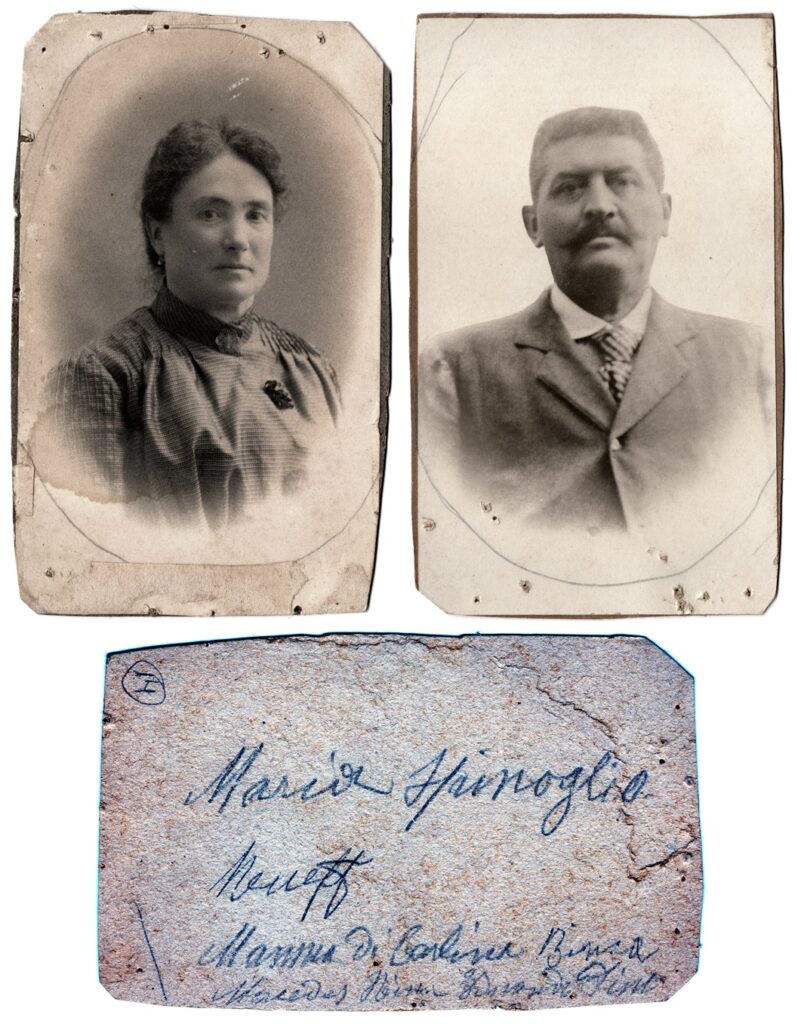
La risposta su chi fossero me l’ha data un’annotazione sul retro dell’unica foto che ho di Marietta, che dice “Maria Spinoglio Rueff / Mamma di Carolina, Bianca, Mercedes, Rina, Edmondo, Dino”. Attualmente vedo chiaramente i nomi, ma in quel momento non capivo del tutto la calligrafia, anche se vedevo chiaramente “Mamma di…” seguito da 6 nomi. Un problema era risolto: erano fratellastri di Maria! Marietta si sposò con un uomo di cognome Rueff e ebbe altri figli. Quest’uomo era Antonio Rueff, del quale c’era anche una foto con il suo nome sul retro.
Marietta Spinoglio and Antonio Rueff (above); back of Marietta’s photo (below)
Ora, c’erano altre domande: Quando e dove si sono sposati Marietta e Antonio? Quando e dove sono nati i loro figli? Beh, è passato molto tempo prima che potessi sapere tutto questo. La risposta alla seconda domanda è stata ciò che ho trovato per primo. Ho cercato senza successo ad Alpignano (dove è nata Maria), Moncalvo (dove sono nati Marietta e Carlo Gaja) e dintorni. Poi ho cercato, parrocchia per parrocchia, tra i numerosi archivi parrocchiali su Family Search relativi a Vercelli, città dove Maria Gaja e Giuseppe Gallardi si sono sposati e dove Marietta risultava vivere nell’atto di matrimonio di entrambi. Ho avuto la fortuna di trovare i nati di 3 dei bambini: Romualdo (1887, qui ho capito che “Dino” era in realtà Romualdo), Edmondo (1888) e Rina (1893). Per quanto abbia cercato, non ho trovato né Bianca né Mercedes.
Il successivo progresso significativo nella ricerca è avvenuto quando, con date approssimative e grazie all’aiuto dell’Ufficio di Stato Civile di Vercelli, ho trovato gli atti di morte di Marietta Spinoglio (1907, a 58 anni) e Antonio Rueff (1911, a 68 anni) in quella città. Nell’atto di Marietta si trovava un dato chiave per avanzare con la ricerca: uno dei dichiaranti era suo figlio Romualdo, che al momento risiedeva a Torino. Pertanto, l’indagine è proseguita a Torino e nei suoi indici di nascita, matrimonio e morte. Lì, ho scoperto che Bianca aveva sposato nel 1905 con Beniamino Giuseppe Panigata. A sua volta, i documenti allegati al matrimonio mi hanno fornito il dato che cercavo: Bianca era nata a Biella nel 1879. Grazie al portale Antenati, ho potuto accedere al suo atto di nascita. Mancava solo Mercedes.
Risulta che tra i nati a Torino c’era un nome che ha attirato la mia attenzione: Teresio Romualdo Mario Beniamino Rueff, nato nel 1907. Risultava essere figlio di Mercedes “dalla sua unione con uomo celibe non parente, nè affine di essa” (il nome del padre non era indicato). Nel registro di nascita di Teresio c’era un’annotazione sul suo matrimonio con Clara Carlotta Toffano nel 1941, a Padova. Infine, tra gli allegati di tale matrimonio, ho scoperto che Mercedes era nata a Intra, Verbania, nel 1884. Nuovamente, grazie ad Antenati, ho potuto vedere questo atto. Finalmente, avevo trovato tutti i bambini.
Ora mancava solo rispondere alla prima domanda: Quando e dove si sono sposati Marietta Spinoglio e Antonio Rueff? Penso che trovare queste informazioni sia stato più difficile che trovare le nascite di tutti i bambini, ma lo riassumerò: dopo aver cercato ad Alpignano, Moncalvo e Vercelli, ho deciso di cercare a Milano, poiché nell’atto di morte di Antonio figurava come suo luogo di nascita (un altro dato chiave). Limitando gli anni tra la morte di Carlo Gaja e la nascita di Bianca Rueff e grazie agli indici di Milano, sono riuscito finalmente a trovare il tanto cercato matrimonio: entrambi si sposarono a Milano alla fine del 1874. Finalmente, la famiglia era completa.
Cosa è successo alla vita di ciascuno dei bambini? Bene, ho continuato a cercare e attualmente so che:
Bianca (il cui secondo nome era Maria) è rimasta vedova nel 1921 alla morte di Beniamino a 51 anni, dopo 16 anni di matrimonio. Nel 1924 si è risposata, questa volta con il Dott. Desiderio De Stefanis. È morta a Bordighera nel 1944, a 64 anni.
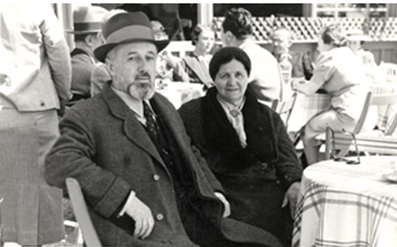
Desiderio De Stefanis and Bianca Rueff in Bordighera (1938)
Mercedes (il cui secondo nome era anche Maria) si è sposata a Venezia nel 1931 con il “dottore in legge” Giacomo Roncali, e probabilmente ha vissuto lì fino alla sua morte. Giacomo ha adottato Teresio (il figlio di Mercedes) nel 1937. Recentemente sono riuscito a parlare con una nipote di Teresio e Clara (figlia di un fratello di Clara) che vive in Messico, la quale gentilmente mi ha fornito ulteriori dettagli sulle loro vite e sul loro periodo trascorso in quel paese.
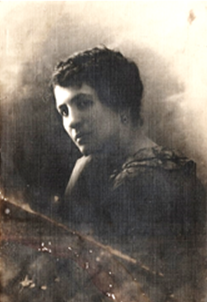
Mercedes Rueff in Padua (1921)
Romualdo (nome dato in onore del suo padrino Romualdo Spinoglio, fratello di Marietta, e il cui nome completo nel suo atto di battesimo è Romualdo Carlo Aristide Antonio Rueff) si è sposato con Elvira Prat (non so dove né quando) ed emigrarono in Argentina intorno al 1910. A Buenos Aires sono nati due figli (1912 e 1914). Poi, nel 1920, hanno emigrato e si sono stabiliti in Brasile. Che sia per divorzio o per la morte di Elvira, Romualdo si è risposato con Maria Wobeto nel 1952, e hanno avuto, per quanto ne so, 2 figli. Ho trovato attualmente discendenti dal primo e dal secondo matrimonio, ma sono riuscito a parlare solo con un discendente del secondo. Non ho mai saputo cosa sia successo a Elvira né al suo figlio nato nel 1914. Romualdo è morto in Brasile nel 1961, a 74 anni.
Edmondo (il cui vero primo nome era in realtà Placido, probabilmente in onore di Placida Spinoglio, sua madrina e sorella di Marietta, e il cui nome completo nel suo atto di battesimo è Placido Edmondo Giovanni Rueff) morì all’età di soli 26 anni nel 1915, durante la Prima Guerra Mondiale, e fu decorato nel 1916 con la Medaglia di Bronzo al Valor Militare. Nel sito dell’Istituto del Nastro Azzurro si descrive la motivazione di tale distinzione: “Mentre combatteva strenuamente per mantenere una posizione di grande importanza, veniva colpito a morte”. In una delle sue foto della scatola si legge sul retro: “Nella grande guerra colpito morto mentre portava un ordine al comando”. Infine, nell’Albo d’Oro dei militari italiani caduti nella Grande Guerra si legge a suo riguardo: “Sottotenente in servizio attivo 12° reggimento bersaglieri, nato il 5 ottobre 1888 a Vercelli, distretto militare di Vercelli, morto il 1° giugno 1915 nel Settore di Tolmino per ferite riportate in combattimento”.
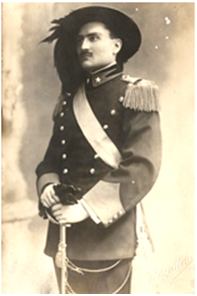
Edmund Rueff (1913)
Di Rina (il cui nome completo nel suo atto di battesimo era Rina Margarita Luigia Rueff, probabilmente in onore del suo padrino Luigi Spinoglio, un altro fratello di Marietta), non hotrovato altro che il suo certificato di battesimo. L’ho vista solo nominata nel 1941 nell’obitorio di Giuseppe, marito di Maria Gaja, insieme a Bianca e Mercedes:
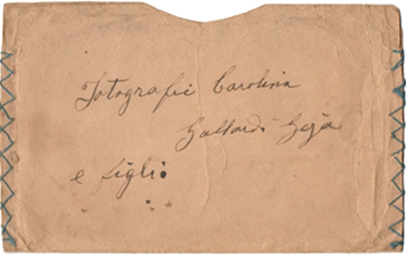
Envelope that contained some photos
Alcuni potrebbero chiedersi, ma… non erano 6 i bambini sconosciuti? Fino ad ora ho parlato solo di 5. Beh, la questione è che non sono mai riuscito a sapere chi fosse la ragazza a destra nella foto, quella che si trova di profilo. Tutto indica che non sia figlia di Marietta (nei nomi della foto di lei non compare come sua figlia).
Io penso che fosse figlia di un matrimonio precedente di Antonio Rueff, dato che sembra essere più grande di Bianca. Questa è stata una delle domande che ho fatto all’unico discendente di Romualdo con cui ho potuto parlare (una persona del Brasile). Lui si impegnò a chiedere nella sua famiglia, ma la sua risposta non mi è mai arrivata.
Finalmente, sapere tutto questo sarebbe stato impossibile senza le note dietro alle foto. La scatola delle foto conteneva una vecchia busta con scritto “Fotografie Carolina Gallardi Gaja e figli”, che suppongo Maria, ormai anziana, abbia inviato a suo figlio (il mio bisnonno) in Argentina, dato che fino a quanto ne so, non c’era nessun altro a cui lasciarle in Italia una volta che lei non ci fosse più (i suoi due figli erano emigrati in Argentina). Le calligrafie sulla busta e sulle foto sono molto simili, ed è molto probabile che tutte siano state scritte da Maria. Penso che lei non volesse che questa storia si perdesse, e oggi, a quasi 72 anni dopo la sua morte, ha contribuito a evitare che ciò accadesse.