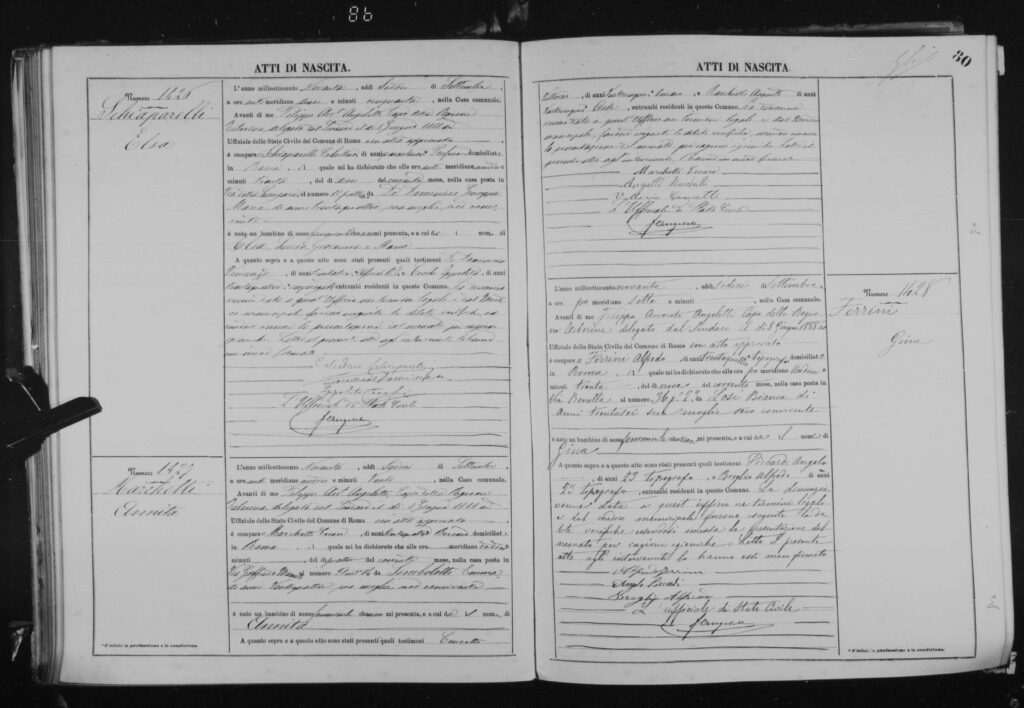
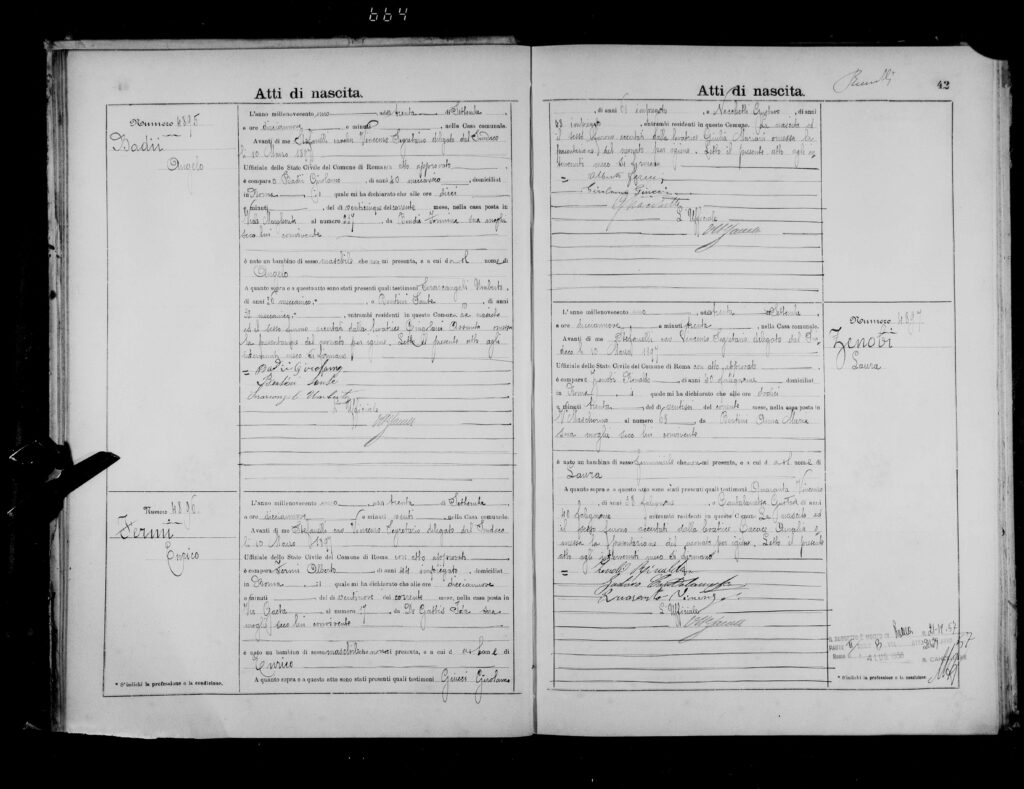
Elsa Schiaparelli was born in Rome on 10th September 1890 to Giuseppa Maria de Dominicis, a Neapolitan aristocrat, and Celestino Schiaparelli, a professor of Arabic literature and language at Rome’s La Sapienza University and the first librarian at the Accademia dei Lincei.
To the paternal branch of his family – of Piedmontese origin – belonged several well-known names, firmly established in the academic field: among them, his uncles Ernesto and Giovanni Schiaparelli, respectively Egyptologist and astronomer, and the latter’s son, Luigi, famous palaeographer and diplomatist.
After her initial studies in Philosophy, her family opposed Elsa’s early poetic aspirations, sending her to a convent in Switzerland.
However, determined to follow her ambitions, she went to London: from there, after a failed marriage and a daughter, she emigrated to the United States, where she met the fashion designer Paul Poiret, whose pupil she became, and then embarked on a personal career, establishing her own name.
The 1930s were his golden age: her Maison came to count 8 atelier in Paris with a total of over 800 employees and it was at this flourishing time that he produced his most iconic fashion collections: remember, for example, the with double knot or the invention of the suit in shocking pink, as well as accessories that concealed real works of art, thanks also to valuable collaborations with the protagonists of Surrealism and Dadaism (Dalì, Picasso, Giacomelli, Fini and many others). This marriage of art and fashion will result in avant-garde creations characterised by extraordinary originality, the fruit of research and experimentation with colours, materials, textures and techniques.
World War II, however, hit her fashion house hard, which was forced to significantly reduce its production capacity and Elsa had to take refuge in New York.
Later, once the war was over, she returned to Paris, but the fashion world was no longer the same: in fact, despite some awards she was given, she was no longer able to achieve the pre-war success and recover from the economic crisis. Thus, Maison Schiaparelli was closed.
The well-known fashion designer died 19 years later, in the French capital, by then her adopted city, on 13th November 1973.
You can consult the birth certificate on the Ancestors Portal: Archivio di Stato di Roma > Stato civile italiano > Roma > 1890
For more on the figure of Elsa Schiaparelli, see the entry in the Dizionario Biografico degli Italiani edited by Giovanna Uzzani.
Archivio di Stato di Roma > Stato civile italiano > Roma > 1890
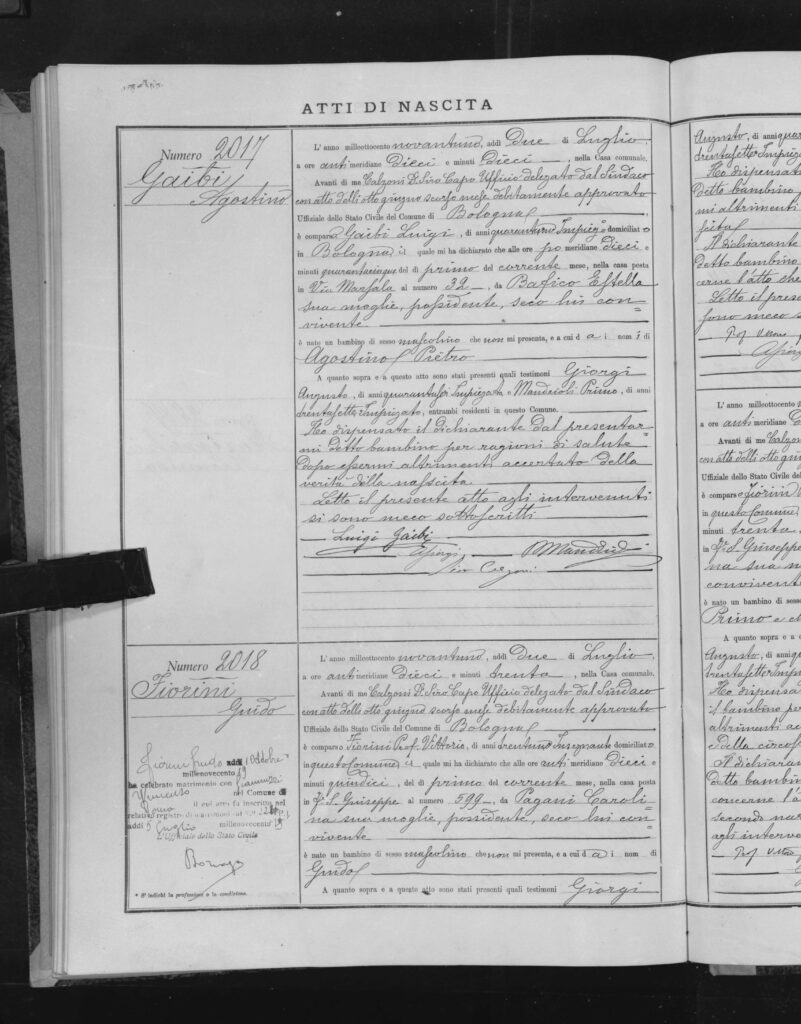
Guido Fiorini was born in Bologna on 1st July 1891.
After graduating in Engineering, he specialised in Architecture in 1919.
During the early days of his career, he devoted himself to both teaching and the practice of his profession, even gaining recognition for some of his work.
During the 1920s, while in Paris, he got to know Le Corbusier, the famous Swiss architect with whom he formed a long-standing friendship and professional collaboration.
As part of the building renovation debate, which was particularly lively in those years, Fiorini focused his attention on the use of metal structures, culminating in the invention of the tensile structure (1928-1935), with the aim of creating a union between building construction and architectural culture.
This sense of innovation earned him involvement in numerous projects, some of which remained on paper.
However, he found great support from the Futurist current, which saw in his ideas and works a concrete symbol of progress.
Starting in 1932, he began working on film set designs: he worked extensively in the field, winning several awards, including a Nastro d’Argento for best set scenography in the film Miracolo a Milano (1951) under the direction of Vittorio De Sica.
He died in Paris on 28th December 1965.
You can consult the birth certificate on the Ancestors Portal: Archivio di Stato di Bologna > Stato civile italiano > Bologna > Registro 1057, suppl. 2
Archivio di Stato di Bologna > Stato civile italiano > Bologna > Registro 1057, suppl. 2
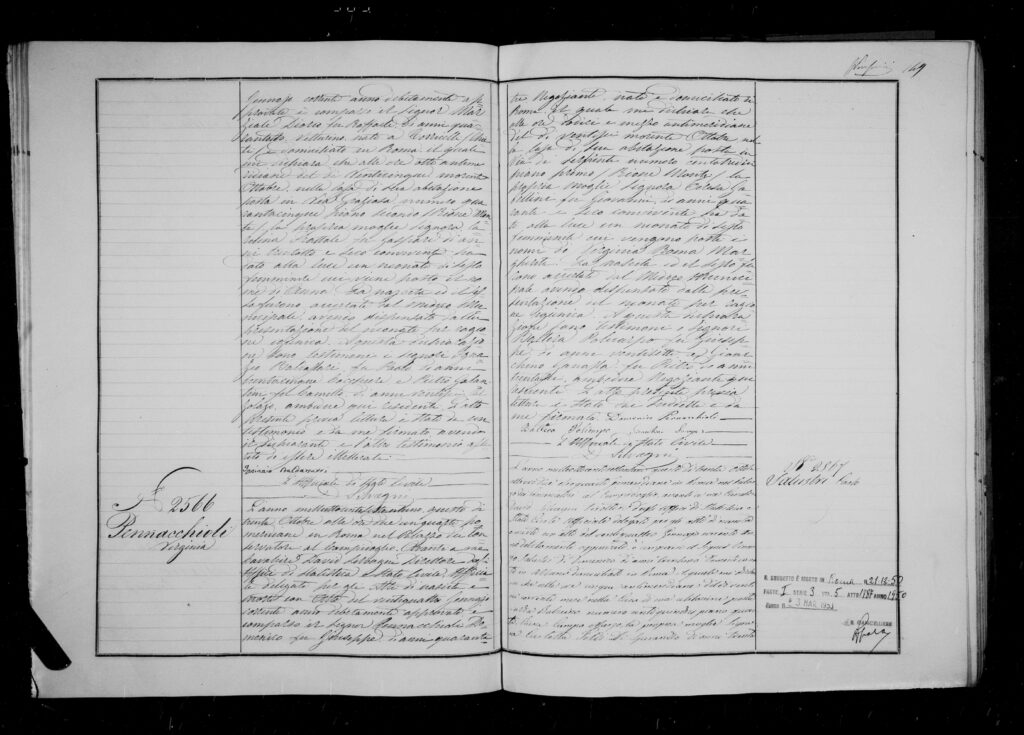
Carlo Alberto Camillo Salustri was born in Rome on 26th October 1871.
The son of Vincenzo, a waiter, and Carlotta Poldi, a dressmaker, he was soon orphaned by his father and became deeply attached to his mother, with whom he lived until her death in 1912.
Despite his lack of inclination for school studies, Salustri showed a keen interest in poetry from an early age, devoting himself especially to composing verses in the Roman dialect.
As early as 1887, his first sonnet, published in the celebrated magazine Il rugantino, bore the signature ‘Trilussa’ at the bottom, an anagram of his surname, which accompanied him for the rest of his life.
His poetry was inspired by the Romanesque tradition, adapting, however, to the themes of the turn of the century, in a light, easygoing manner, never explicitly vulgar. At the same time, alongside his poetic production, he also produced prose, characterised by revisitations of classic and popular fables and the invention of new modern fables.
With the turn of the century, his success also consolidated, making him a poet-commentator, a frequent visitor to the salons and cafés of Rome. During the war period, he distanced himself from the regime, although he was never clearly opposed to it. His more committed poems of a socio-political nature, in which the crepuscular imprint is stronger, also date from this period.
In 1947 he refused the post of mayor of Rome that had been offered to him.
Three years later, he was appointed life senator by the President of the Republic, Luigi Einaudi.
He died in Rome on 21th December 1950.
You can consult the birth certificate on the Ancestor Portals: Archivio di Stato di Roma > Stato civile italiano > Roma > 1871
His paper and photographic archive was kept intact by Rosa Tomei, the woman with whom he cohabited in the last twenty years of his life and with whom he formed an emotional and working partnership. Today, Trilussa’s archive is kept at the Museo di Roma in Trastevere.
For more on the figure of Trilussa, see the entry in the Dizionario Biografico degli Italiani edited by Gabriele Scalessa.
Archivio di Stato di Roma > Stato civile italiano > Roma > 1871
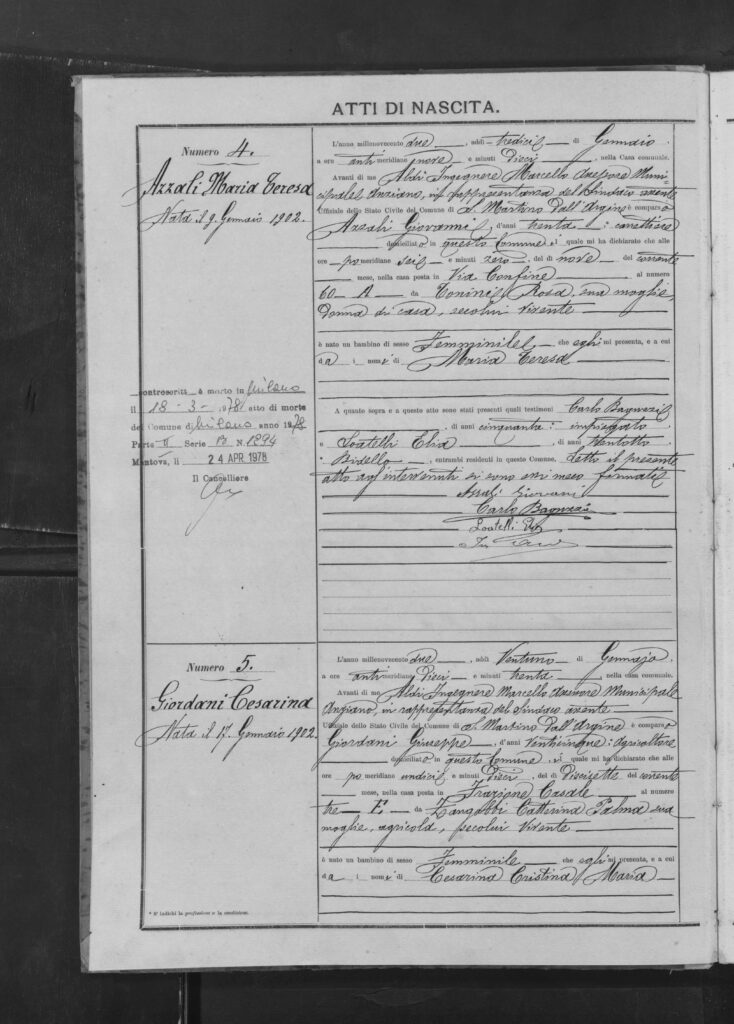
Maria Teresa Azzali was born in San Martino dell’Argine (MN) on 9th January 1902.
As soon as she came of age, she moved to Milan to dedicate herself to the anti-fascist struggle, making a decisive contribution to the Women’s Defence Groups – multi-party associations, a symbol of women’s contribution to the fight against the regime -, especially among the middle classes and within the factories.
To his work we owe the first clandestine circulation of the magazine Noi Donne, in 1944, thanks also to the supportive collaboration with Giovanna Molteni.
Once the war was over, Azzali’s commitment continued as secretary of the UDI (Italian Women’s Union) in Mantua and then in the trade union, as an exponent of the Women’s Commission of the Milan Chamber of Labour. In these capacities, she fought at length to demand better working conditions for women, crèches, breastfeeding rooms and equal pay.
She died in 1978 in Milan.
You can consult the birth certificate on the Ancestors Portal: Archivio di Stato di Mantova > Stato civile italiano (registri del Tribunale di Mantova) > San Martino dall’Argine > 1902
Archivio di Stato di Mantova > Stato civile italiano (registri del Tribunale di Mantova) > San Martino dall’Argine > 1902
Armando Lodolini was born in Rome on 26th March 1888, to Alessandro, a grocery store owner, and Laura Diamantini.
After graduating from high school, he enrolled in the Faculty of Law, at the same time winning a competition in the administration of the State Archives.
He began his career by serving in Modena (1909-11), at which time he also graduated from the School of Palaeography at the State Archives in Parma.
Later, he was transferred to the State Archives in Rome where he worked until the outbreak of World War I, in which he participated and was decorated several times for military merit.
Once the war ended and work resumed, the following years were marked by an intense involvement in both scientific and popular production – extensive and extremely varied – and in political activity, which had seen him actively involved from a very young age, first through revolutionary syndicalism, then through his closeness to Mazzini’s party, and finally through his adhesion to fascism.
At the State Archives in Rome, he was the closest collaborator of director Eugenio Casanova and it is no coincidence that Lodolini’s name is linked to many activities of reorganisation and inventorying of important archival fonds.
In 1933-35, he succeeded Casanova as regent of the State Archives, but was soon transferred to Bologna, where he was dismissed due to reports of abuse by some employees. He was only reinstated many years later, in 1948, with retroactive effect and, two years later, he became director of the State Archives in Rome and related institutions, i.e. the former Kingdom Archives and the School of Archivistics, Palaeography and Diplomatics.
In 1953 he was the first superintendent of the newly founded Central State Archive, while in 1956 he left the direction of the State Archive in Rome, being ‘retired’.
From his marriage with Ada Francioni, his son Elio (1922-2023), also a famous archivist, was born.
During the last decade of his life, he continued to be active as an archivist, journalist, lecturer and author of numerous publications in the fields of history, literature, law and, of course, archives. His particular industriousness and intense eclecticism made him one of the best-known names in 20th century Italian archival work to this day.
He died in Rome on 2nd August 1966.
You can consult the birth certificate on the Ancestors Portal: Archivio di Stato di Roma > Stato civile italiano > Roma > 1888
For more on Armando Lodolini, see the entry in the Dizionario Biografico degli Italiani edited by Anna Lia Bonella.a
Archivio di Stato di Roma > Stato civile italiano > Roma > 1888
Anna Magnani was born in Rome on 7th March 1908.
Daughter of Marina Magnani, seamstress, and father unknown.
She grew up with her grandparents and aunts in a house between the Capitol and the Palatine Hill, living a peaceful childhood despite the distance from her mother who left her in their care to go to Alexandria with her new husband.
He became passionate about the piano, attending the Accademia Nazionale di Santa Cecilia for a while, where he studied as a concert pianist. Her encounter with acting, on the other hand, was entirely coincidental: she started at the ‘Eleonora Duse’ school of dramatic art, directed by Silvio d’Amico, in 1924 and was soon noticed and engaged in Dario Niccodemi’s company.
Between 1926 and 1932, after a period of apprenticeships, minor parts and very long tours, the fame and importance of his roles on stage began to grow. Following this period, he turned to the more popular and spontaneous avant-garde theatre, which was instrumental in his growth and artistic eclecticism.
Her relationship with Goffredo Alessandrini, director, whom she married in October 1935, also dates back to these years.
In the meantime, sound cinema opened its doors to her, but it was not until 1941 that she achieved her first big success, as the star of Teresa Venerdì under the direction of Vittorio De Sica. This was followed a few years later by winning his first Silver Ribbon in Roberto Rossellini’s Roma città aperta (1945), with whom he formed an intense artistic and private partnership.
The pinnacle of her worldwide fame came in 1956, when she was the first Italian female lead actress to win an Oscar, for her performance in Daniel Mann’s film La rosa tatutata (1955).
There were many other films in which he took part, among them Bellissima (1951) by Luchino Visconti, Saggio è il vento (1957) by George Cukor, Mamma Roma (1962) by Pierpaolo Pasolini and Roma (1972) by Federico Fellini.
Nannarella was an actress endowed with uncommon humanity and spontaneity: with her mimicry and particular somatic and verbal traits, she was able to embody both the deepest despair and the lightest hopes of the post-war period, which neo-realist cinema intended to portray, thus becoming an emblem.
He died in Rome, fifty years ago, on 26th September 1973.
You can consult thebirth certificate on the Ancestry Portal: State Archives of Rome > Italian Civil Status > Rome > 1908
It should be noted that the deed presents the declaration of birth made by the mother alone, following her “natural union with an unmarried man, not related or kin to her in the degrees that preclude recognition”. It is no coincidence that the birthplace indicated is the maternity nursery at 126 Via Salaria, a place where pregnant women in difficulty or single mothers were protected and supported in giving birth to their children.
On the side is the chancellery note reporting the celebration of the marriage with Goffredo Alessandrini in Rome on 3rd October 1935.
For more on the figure of Anna Magnani, see the entry of the Dizionario Biografico degli Italiani edited by Giorgio Pangaro.
Archivio di Stato di Roma > Stato civile italiano > Roma > 1908
Mi chiamo Alberto Del Fra, vivo a Roma, ho il desiderio di lasciare ai miei figli e ai miei nipoti memoria dei nostri antenati, coloro che ci hanno trasmesso ciò che fa di noi ciò che siamo oggi.
Un anno fa ho avuto notizia da un mio amico dell’esistenza del Portale Antenati e da quel momento mi sono buttato a capofitto in un’avventura che giudico entusiasmante.
Il Portale mi ha fatto entrare in un mondo lontano, del quale avevo conoscenza solo dai libri di storia.
Com’è noto, la storia si avvale di documenti, attraverso i quali si ricostruiscono gli avvenimenti. Così è stato per me spulciando le iscrizioni di nascite, morti e matrimoni dei miei avi. Documenti in apparenza freddi e burocratici, che in realtà mi hanno fatto scoprire storie di caduta e di riscatto, liete e drammatiche dei miei avi, insieme al contesto generale nel quale essi sono vissuti.
Il paese d’origine dei Del Fra, per quanto ne sapevo, era Vasto (un paese del Chietino) in Abruzzo, quello della famiglia De Mauro di mia madre era Manfredonia in Puglia. Dalla conoscenza dei nomi dei miei nonni paterni, ho cominciato a cercare notizie negli archivi anagrafici di Vasto, ciò mi ha aperto un mondo. Ho trovato i miei bisnonni e poi i trisavoli, i quadrisavoli, i pentavoli, alcuni esavoli.
Credo di aver spulciato migliaia di documenti e al di là delle notizie trovate sui miei avi, mi si è presentato un quadro generale dei centri rurali del meridione, coerente con quanto narrato dai libri di storia.
I nostri avi maschi erano in gran parte braccianti, chiamati bracciali e contadini analfabeti, come si evince dalla dichiarazione dell’ufficiale anagrafico in calce a quasi tutti i documenti.
Dichiarazione di analfabetismo
C’erano anche alcuni artigiani (calzolai, barbieri, sarti etc.), anch’essi spesso analfabeti, e pochissime persone abbienti, che avevano diritto al titolo di don nei documenti anagrafici.
Le ave erano invece casalinghe, tessitrici, cucitrici, anche contadine. Le mogli dei don avevano diritto al titolo di donna.
Nei matrimoni erano necessari i consensi dei padri degli sposi o, in caso di morte degli stessi, dei nonni paterni. Solo se morti anch’essi, il consenso veniva dato dalle madri. Un chiaro indizio di sistema patriarcale.
Impressionante la mortalità infantile: i registri dei morti sono colmi di nomi di bambini di pochi anni e talvolta di pochi giorni. Questo portava a un fenomeno curioso: la ripetizione dei nomi. Per esempio nasceva un bambino di nome Francesco che moriva presto. Il successivo nato veniva chiamato di nuovo Francesco. In vari casi ho trovato ben tre fratelli con lo stesso nome. Tra l’altro ho scoperto una cosa che probabilmente nemmeno mio padre sapeva: era il secondo Ettore della famiglia.
Evidentemente le scarse condizioni igienico/sanitarie e la mancanza di farmaci efficaci facilitavano la mortalità infantile.
Ovviamente anche l’indice di natalità era altissimo. Non era raro arrivare a un numero di figli in doppia cifra, fenomeno presente anche tra i miei avi.
Piuttosto rimarchevole era il fenomeno dei trovatelli, indicati come proietti. Chi li presentava all’ufficiale anagrafico era spesso la levatrice del paese.
C’era anche qualche ragazza che presentava un proprio figlio naturale, scegliendo coraggiosamente di allevare un figlio in una società che l’avrebbe tenuta al margine.
Un caso di questo genere capitò anche tra i miei antenati e merita un racconto. Una certa Carolina Di Guglielmo, cucitrice, ha una figlia naturale che chiama Maria alla quale insegna il suo mestiere. Probabilmente Maria non poteva essere considerata un buon partito. Un mio bisnonno Giovan Battista Del Fra, calzolaio, mestiere ereditato dal nonno paterno, lascia il suo luogo di nascita Tufo (un paese dell’Aquilano), il vero luogo d’origine dei Del Fra, per trasferirsi a Vasto. Compie un trasferimento inusuale per quei tempi, data la distanza ragguardevole tra le due località. Pure lui ha un marchio disonorevole: è figlio di un contrabbandiere ucciso dalle guardie doganali.
L’unione di queste due persone sfortunate porta a una famiglia che vive dignitosamente. Evidentemente Maria è una brava cucitrice e Giovanbattista un valente calzolaio, come si desume dalla firma in calce all’atto del matrimonio non era analfabeta, visto che danno una buona condizione ai figli maschi, in particolare a mio nonno Pasquale.
Pasquale infatti mette su una caffetteria e riesce a far diplomare tutti i figli maschi e a laurearne uno. Naturalmente le figlie femmine non sono messe nelle stesse condizioni. Queste ultime notizie provengono da una conoscenza diretta dei miei zii.
In definitiva quella dei Del Fra è una storia di riscatto a lieto fine.
Per quanto riguarda le vicende dei De Mauro la famiglia di mia madre. Già nella prima metà del ‘700 sono padroni di mulini a Manfredonia. Si capisce che la loro fortuna va crescendo col tempo. Evidentemente, pur non essendo don, erano considerati dei buoni partiti, si uniscono con varie famiglie di don, quella dei Rizzi di Manfredonia e quelle dei Garamone e dei Rosati, provenienti da altri paesi della Puglia.
Un personaggio che merita una menzione particolare è Pietro Rizzi (1814-1897), farmacista di Manfredonia, mio trisavolo, personaggio di cui spesso mi parlava mia madre. Egli per un periodo doveva darsi alla latitanza poiché giudicato sovversivo dal regime borbonico. Questo però non gli impedirà di tornare spesso di nascosto a casa, mettendo regolarmente incinta sua moglie, sposata pochi mesi prima dalla nascita del primogenito.
Pietro Rizzi
Pietro Rizzi fu assolto in tribunale. Pare che una testimonianza a carico di Pietro sia quella del curato del paese, che racconta di discorsi sovversivi fatti dal trisavolo nella sua farmacia. L’avvocato dice all’usciere di far entrare il parroco. L’usciere torna dicendo che il prete alla sua chiamata non ha risposto. E allora è gioco facile per l’avvocato: Signor giudice, come può il parroco affermare di aver udito discorsi sovversivi se è sordo?
Poi, però, come testimoniano i documenti anagrafici, avviene la diaspora dei De Mauro da Manfredonia. Ci sono degli atti di nascita e di morte che li riguardano in altri paesi della Puglia, ma non sarebbero stati sufficienti a farmi avere un quadro comprensibile, se non avessi conosciuto direttamente da mia madre i fatti essenziali. Il mio bisnonno Francesco Paolo De Mauro avalla per un amico una cambiale di importo notevolissimo. L’amico non la onora e il bisnonno deve vendere tutto, compreso il palazzo in cui abita, trasferendosi a Cerignola. Il figlio Leonida, elettrotecnico, per trovare lavoro emigra a Milano con i figli tra cui mia madre.
Francesco Paolo De Mauro
Seguono purtroppo sciagure di tutti i tipi. Muoiono in rapida successione Leonida (di spagnola), mentre la moglie Nunzia e tutti i fratelli e le sorelle di mia madre, moriranno a causa di varie malattie. Mia madre a Milano incontra mio padre, trasferitosi là da Vasto come bancario. Pensate che io non ho mai conosciuto un parente di mia madre.
Alla fine ho individuato 59 cognomi diversi dei miei avi.
A proposito di cognomi, va osservato che talvolta cambiano col passare del tempo. Per esempio all’inizio trovo il cognome Del Frà e non Del Fra, in genere nella prima metà del secolo XIX i Di o i Del all’inizio dei cognomi sono scritti con la minuscola, poi l’uso cambia. Analogamente di Mauro è diventato De Mauro, di Guglielmo si è mutato in De Guglielmo. Sovente cambiano le finali dei cognomi: per esempio Annecchino che muta in Annecchini.
Lo stesso succede per i nomi: una Rosanna all’atto di nascita diventa Rosaria al matrimonio e alla morte. Il Giovan Battista già ricordato, al matrimonio è Giovanni, alla morte Giovanni Battista.
Forse perché le nascite e le morti venivano trascritte avvalendosi solo di testimonianze orali di persone spesso analfabete che parlavano in dialetto, con conseguente possibilità di equivoci con l’ufficiale anagrafico.
Poiché la mia ricerca mi ha portato a consultare una miriade di registri anagrafici di vari paesi dell’Abruzzo e della Puglia, ho potuto osservare come in ogni località si ripetano sempre gli stessi cognomi, differenti però da paese a paese. Un fatto che testimonia come quelle comunità fossero piuttosto chiuse, con rari spostamenti o comunque limitati a località vicine. Il nostro Francesco Del Fra, con il trasferimento da Tufo a Vasto, è l’eccezione che conferma la regola.
Questa mancanza quasi totale di mobilità mi ha senz’altro facilitato il compito: quasi tutti i miei antenati sono nati, si sono sposati e sono morti nello stesso posto. In tal caso è bastato quindi scorrere i registri di una sola località per ricostruire la loro storia.
Dall’inizio del ‘900 in poi una tale ricerca sarebbe molto più complicata: per esempio mio padre e i suoi fratelli si sono tutti allontanati dal luogo di origine, andando ad abitare in grandi centri. Termino con l’auspicio che il progetto del Portale continui ad essere alimentato con la pubblicazione di nuovi registri e con un ringraziamento di cuore a tutti coloro che vi collaborano.
Enrico Fermi was born in Rome on 29th September 1901.
From a very young age, he showed a marked propensity for algebra and physics. He then entered the Scuola Normale Superiore in Pisa, where he was able to deepen his knowledge of these disciplines and make a name for himself among the most illustrious professors of the time.
Having completed his studies abroad, he obtained his first chair in theoretical physics in Rome, at the institute in via Panisperna, where he began the most fruitful period of his scientific activity at the head of the group of young men named after the street of the same name.
He became a renowned teacher whose lectures and teachings were widely successful, even in America where he opened several other schools, increasing his notoriety through his innovative methods.
The years between 1927 and 1938 were marked by intense research activity by the entire Roman group on issues of international interest.
In 1938, he was awarded the Nobel Prize in Physics.
Even today, the influence of his work and his profound cross-disciplinary knowledge of the discipline are recognised worldwide.
Shortly before the outbreak of World War II, he emigrated to the United States with his entire family. There, in Chicago, at the age of 53, he died on 29th November 1954.
You can consult the birth certificate on the Ancestors Portal: Archivio di Stato di Roma > Stato civile italiano > Roma > 1901
For more on the figure of Enrico Fermi, see the entry in the Dizionario Biografico degli Italiani edited by Emilio Segrè.
Archivio di Stato di Roma > Stato civile italiano > Roma > 1901
Pietro Giovanni Ferrero was born in Farigliano (CN) on 2nd September 1898.
The son of farmers in the Piedmont Langhe, he soon decided to open a pastry shop in Alba (CN) and to launch innovative but inexpensive confectionery products on the market that could be affordable for everyone.
After much experimentation, he came up with a soft hazelnut paste, much cheaper than chocolate, sold in the form of a loaf, easy to transport and designed to be spread on bread. This was an optimal idea for the needs of the many workers in those areas, who lived in poor economic conditions.
The hazelnut cream was so successful among the many workers in Alba that it gave a boost to the Ferrero small pastry shop, which was established as an industry in 1946.
The work of the Ferrero family and the fame of that spreadable cream – which a few years later would be perfected, becoming known worldwide as Nutella – grew exponentially in the years that followed.
Pietro Ferrero died in Alba on 2nd March 1949.
You can consult the birth certificate on the Ancestors Portal: Archivio di Stato di Cuneo > Stato civile italiano > Farigliano > 1898
Archivio di Stato di Cuneo > Stato civile italiano > Farigliano > 1898
Elsa Morante was born in Rome on 18th August 1912 to Francesco Lo Monaco and Irma Poggibonsi. However, she was recognised at the registry office by her mother’s husband, Augusto Morante, from whom she took her surname.
She began writing at a very young age, devoting herself to writing fairy tales and short stories, many of which were published posthumously.
She began writing from a very young age, devoting herself to writing fairy tales and short stories, many of which were published posthumously. In 1936, she met Alberto Moravia, with whom she began a tormented relationship, but which led them to the altar on 14th April 1941.
In 1943, the intensification of anti-Semitic repression led Morante and Moravia (who was Jewish) to flee Rome and take refuge in the south, towards Fondi, where they stayed for a few months, experiencing a reality that was to become decisive for both of them in the writing of some later works.
In 1943, the intensification of anti-Semitic repression led Morante and Moravia (who was Jewish) to flee Rome and take refuge in the south, towards Fondi, where they stayed for a few months, experiencing a reality that was to become decisive for both of them in the writing of some later works.
Back in Rome, in 1944, Morante published her first novel Menzogna e sortilegio (1948), which won her the “Premio Viareggio”.
In 1957, she was the first woman to be awarded the “Premio Strega” for her second novel, L’isola di Arturo.
Later, starting in 1971, she began work on the most famous of her novels, La storia, published by Einaudi in 1974: it was printed directly in a paperback edition at the author’s own wish, so that it would be accessible to everyone from the outset.
Over the next decade, he continued to devote himself tirelessly to literary and other activities, but his health declined steadily and inexorably.
She died in Rome on 25th November 1985. Her ashes were scattered in the sea of Procida.
You can consult the birth certificate on the Ancestors Portal: Archivio di Stato di Roma > Stato civile italiano > Roma > 1912
It is worth noting that her biological father, Francesco Lo Monaco, a clerk, appears in the birth certificate as one of the witnesses and as ‘godfather’ would be known to Elsa Morante until she was 14 years old.
In the margin, the deed also shows the chancellery note marking her marriage to Alberto Moravia, which took place on 14th April 1941.
A little further down, there is another annotation dated 30th May 1941 stating that Morante, although the daughter of a Jewish mother, ‘was recognised as not belonging to the Jewish race’.